
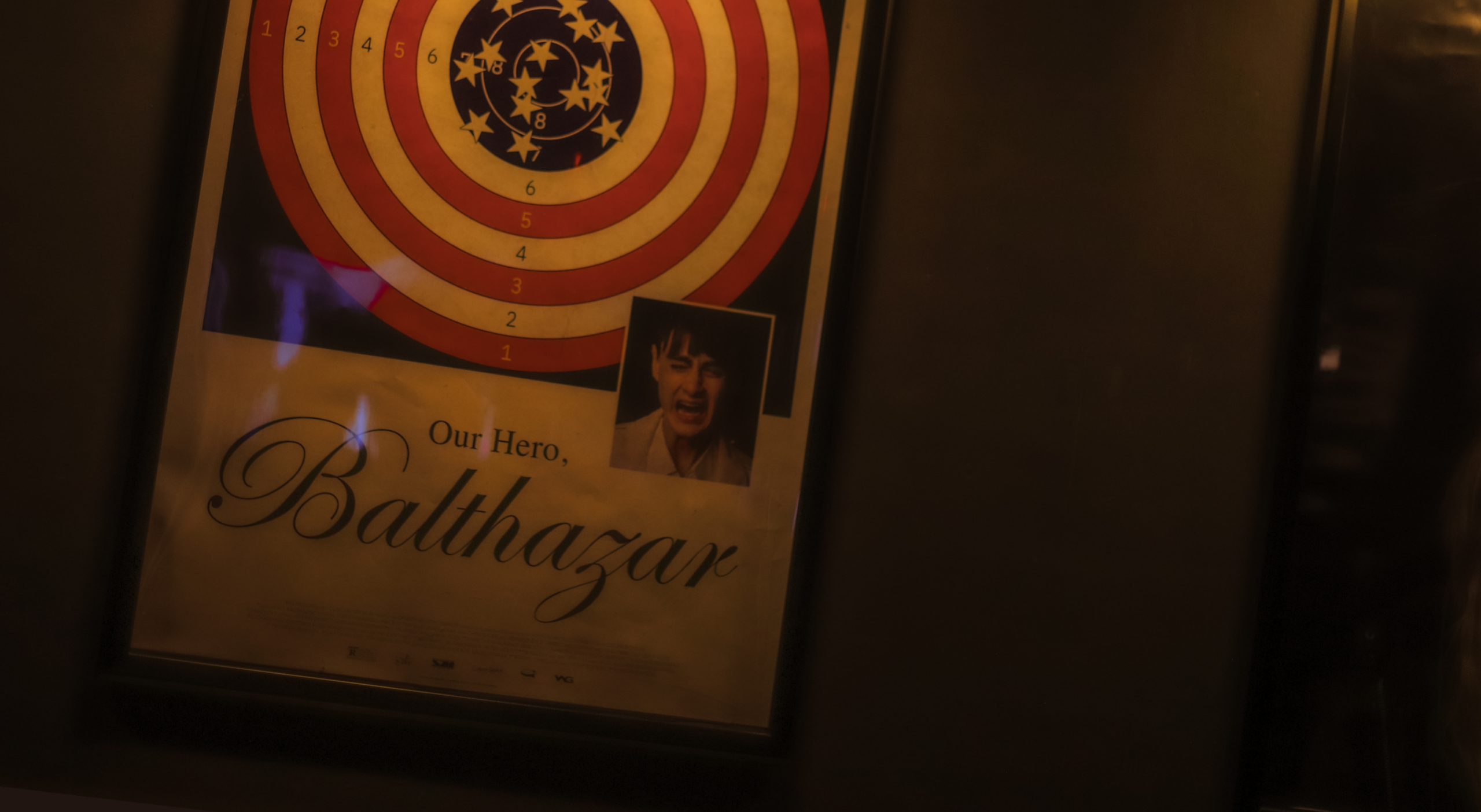
WHAT CAN WE LEARN FROM ANOTHER SHOOTER-CENTERED STORY?
Trigger Warning: subject matter contains mentions of real-life school shootings.
For fans of hits like Uncut Gems and Good Time, seeing the producer-turned-director Oscar Boyson at ByTowne Cinema was huge! For anyone crossing their fingers wondering if the character study on the all-white leads would lend itself to insight on white supremacy, toxic masculinity, or a careful look into inceldom, well…
Let’s hear what Boyson had to say about his unconventional take on the school-shooting genre.
Local content creator Emma Orhun led the first half of the Q-and-A, her first question being,
Q: “[…] The question that we’re probably all wondering is what character do you identify with the most?”
A: “[…] I live in New York City, but I’ve always… I’ve never felt like I’m from there, because I’m not, and I’ve always felt like an outsider, even if I’ve lived there for a while, so I definitely would be more [like] Solomon.”
“But then also, Eleanor, I think, is probably the one with the perspective that most of us can relate to on some of the more unsavory issues in the movie.”
No Spoilers (just yet)! Who are these people?
Balthazar, played by Jaeden Martell, is an ultra-wealthy New York teenager who tried to impress Eleanor, his “activist crush,” by flying to Texas to stop Solomon from committing a school shooting.
Solomon, played by Asa Butterfield, is a young Texan man who is struggling to make ends meet, is selling “testosterone supplements” for his estranged father’s pyramid scheme, and jokes about inflicting violence online.
Eleanor, played by Pippa Knowles, is Balthazar’s classmate and a scholarship student. She’s the only character that systematically criticizes the culture of school shootings in the U.S.A. and hosts an unsuccessful rally shortly thereafter. Eleanor’s brief appearances in the movie are used to kick off the main storyline between Balthazar and Solomon.
Understanding vs. relating
From these quick character introductions, Boyson’s initial answer should raise a few eyebrows. Due to the nature of the question, there is a tendency to pick between Balthazar and Solomon, since they are afforded more nuanced characterization. Boyson choosing not to engage with these nuances and chalking their violence to “unsavory issues” is superficial at best, or indicative of Boyson’s lack of care for the roots of his characters’ violent behaviour at worst.
Q: “Am I wrong to assume that there was a little gay vibe between [Balthazar and Solomon?]”
A: “I mean, your subjective experience is the most important thing. That’s what I go to movies for, [the] emotional experience. And if someone has something that is different from someone else, that’s beautiful, and that’s way more important than whatever I say as an answer to that question.”
Intention vs. interpretation
Subjectivity is a necessary component of any art form, as once one’s work has been published, one does not have control over its reception and interpretation.
However, Boyson’s call for subjectivity rings a little strange.
With lingering shots of Solomon teaching Balthazar how to hold a rifle while embracing him, and a pride flag stuffed in the corner of Solomon’s room (which he attributes to one of his many “phases” alongside Nazisim), the audience is left wondering why Boyson would choose to include queer imagery.
Not all stories need a clear explanation of their themes; one prominent scene is found in the film Elephant by Gus Van Sant, where two high school boys, perpetrators of a violent school shooting, are seen to be sharing an intimate kiss in the shower. Both Boyson and Sant engage in the discussion of the suppression of queerness and its externally violent repercussions, but where they differ is the intentionality of queer themes.
Rather than exploring the alienation of many queer youth, specifically boys, in a strict hetero- and cis-normative society that is quick to “straighten out” those who fall out of line, Boyson’s comment recontextualizes his reasoning for adding queer imagery from meaningful commentary to spectacle.
Q: “How would you imagine the movie would be different if Solomon and [Balthy] either had a healthy relationship with their fathers?”
A: “I can’t even imagine that, you know. I think once you write the guys, and Ricky, my creative partner, and I, we act out the scenes, and we work on them, and we ask questions about them, and we throw them away, and you know, build them back up, and really try to interrogate, and make them as good as they can be. And but I also try not to think of somebody at least until I know that the actor can do it, but then once the actor becomes the character, then they can’t think of anybody else being that character, and also can’t think of the characters having a different father, I guess, so they just, you get locked in, and you know what they are, and you know what they aren’t, but you don’t necessarily know what they would be in a different life…What did you think?”
Interviewer: “I don’t think the movie would exist if they had a healthy relationship […].”
Boyson: “Yeah, you’re right.”
Interviewer: “Without their fathers, there would be nothing that interesting to write about, though. […].”
Boyson: “Right? That’s like the script that it, like, an actor brings you. I want to play a guy, like you know, with a dad, and I like my dad and my dad’s a good guy too, and you’re like, this is gonna be the most boring movie of all time.”
Say hello to the nuclear family
The suggestion of the emotionally and/or physically absent father as the root of Balthazar and Solomon’s violent actions raises concerning implications about Boyson’s perspective on the nuclear family.
Take, for instance, Solomon’s relationship, or lack thereof, with his father; Solomon spends the entire film negotiating his respect and love for his father after years of estrangement. However, when his father is around, Solomon is ridiculed, physically abused, and manipulated into joining his father’s pyramid scheme.
Once we take Boyson’s commentary into account, it implies the toxic-masculinity behaviour Solomon’s father shows is not at fault, reinforcing the hierarchical moral high ground masculine figures are offered in nuclear family structures. We find this type of reinforcement in everyday conversations, with statements like, “fatherless behaviour.”
This way of thinking disregards the emotional labour, often carried by the feminine figure in heterosexual relationships, and attributes the harm Solomon causes to others as an individualistic family responsibility, rather than a larger systemic issue. Community members and institutions from teachers and schools; friends and community spaces; co-workers and workplaces- as well as the content someone consumes, have a hand in the formation of Solomon’s and Balthazar’s violent actions, and tragedies, such as the ones exhibited in this film, should be addressed with a more holistic approach in mind.

The ethics of inspiration
Q: “ There’s a lot of different things that help build a picture of him, the body pillow, mouse pad, and all these things, but there was one thing in particular that I noticed, which was the theme song of the cartoon he listened to…That was a reference to a very specific kind of shooting that happened right?”
A: “There is a shooter named Randy Stair who is especially tragic for me because he was a vlogger and you can actually watch 200 hours of his vlogs on…if you want to, and he was obsessed with Danny Phantom.
It’s sad when you watch those videos, because he’s just a kid. I really don’t think that’s a scary guy at all. He’s a kid who has nobody to talk to, and you want to just give him a hug and be like, Randy, dude, it’s going to be okay; it’s a tough part in your life, but go outside, let’s make some friends, let’s play.”
Let’s pause real quick.
Randy Stair was 24 years old at the time of his murder-suicide. To tell him and other individuals to go outside and play grossly categorizes violent behaviour as an outgrowth of mismanaged growing pains, when the root of the problem is much deeper.
This language infantilizes shooters who don’t just “wind up killing [their] coworkers.” Stair’s “social media posts included videos of [him] firing, brandishing weapons as well as praising the Columbine killers, and one video describ[ing] his plans for the grocery store massacre in intricate detail.”
Boyson’s film and commentary glance over the sinister and gradual character of radicalization by failing to look at the structural factors that enable it beyond the absence of a mythicized nuclear family.
Back to Boyson:
“Instead he just goes deeper and deeper into, you know, into the validation machine that is the internet, making you feel like these dark thoughts that you’re having are actually the right thoughts to have, and he winds up killing his coworker at the grocery store where he worked and shooting and killing himself.”
For context,
Solomon’s character is based on Stair in more ways than one through the workplace setting. Apart from the direct reference through “Jimmy Phantasm”, Solomon’s character had been harassing his female coworker throughout the film. There’s one scene where the fictional story is uncomfortably close to Stair’s situation.
An upset Solomon sneaks into the gas station while his former co-worker Jessica is on shift, and the threat of violence looms in the air as he’d been shooting his guns moments prior. The tension breaks with Solomon fake-crying in Jessica’s face and reaffirming how ‘harmless’ he is with the crocodile tears.
Both the film and Boyson’s dialogue around it push victims of violence out of the narrative completely.
Humanizing complex individuals is not a problem, but solely centering perpetrators of violence is. Doing so without explaining where they fit within harmful systems such as those of white supremacy and hetero normative masculinity detaches the characters from the social reality they are moulded by, enable, and in turn reproduce. Lonely as they may be, the two main characters do not exist in a vacuum even when they’re in an online echo chamber.
“If you watch those videos, it’s just different, because you see him before the shooting, and in our media we always just hear about these guys after, and they’re a monster, they’re psycho, they’re not like us, they’re an alien, and when you watch those videos, you’re like, no, this is a kid who nobody was looking out for, and we could have done better, and he just liked animation, and for whatever reason, because nobody cared about him, and he had nobody to talk to, he did this terrible thing, right? So something about that just felt like this reminder that he’s just a kid, you know?”
Despite Boyson’s comments on the vilification of shooters, Stair, like many other white male shooters, received rather favourable mainstream media coverage which consistently highlighted the loneliness he felt and his disgruntled mental state. White shooters are consistently privileged with individuality, through emphasis on their mental health and personal toils, whereas violent acts by people of colour are commonly seen as reflections of entire races.
*Spoilers ahead*
Ironically, after fatally shooting Solomon and his grandmother, we see Baltzathar, protected by his gender, race, and especially his economic class, demonstrate this bias as he receives a favourable interview in the comfort of his home.
When asked about this ending, Director Boyson focused on how it shows that the people around Baltzathar would never let him truly feel what he’s feeling, again looking at the harm of his crocodile tears from one dimension.
Is Baltzathar the only one harmed by his lack of consequences? Is the way Capital shields him from accountability for his crimes secondary to how his murders affect him personally?
Throughout the night, Boyson was never as enthusiastic as when he discussed how a city’s urban policy around film shootings can hurt indie film production and how draining working on blockbuster films is. “I worked on a commercial, that would be a pretty major production,” he told the audience.
Adding, “It makes me want to blow my brains out after like two days.”
An interesting hyperbole to close the discussion around a film on shootings, which features a close-up shot of someone’s face blown apart.