ROMANCE IS WHAT GIVES DRACULA HIS POWER… AND WHAT UNDOES HIM
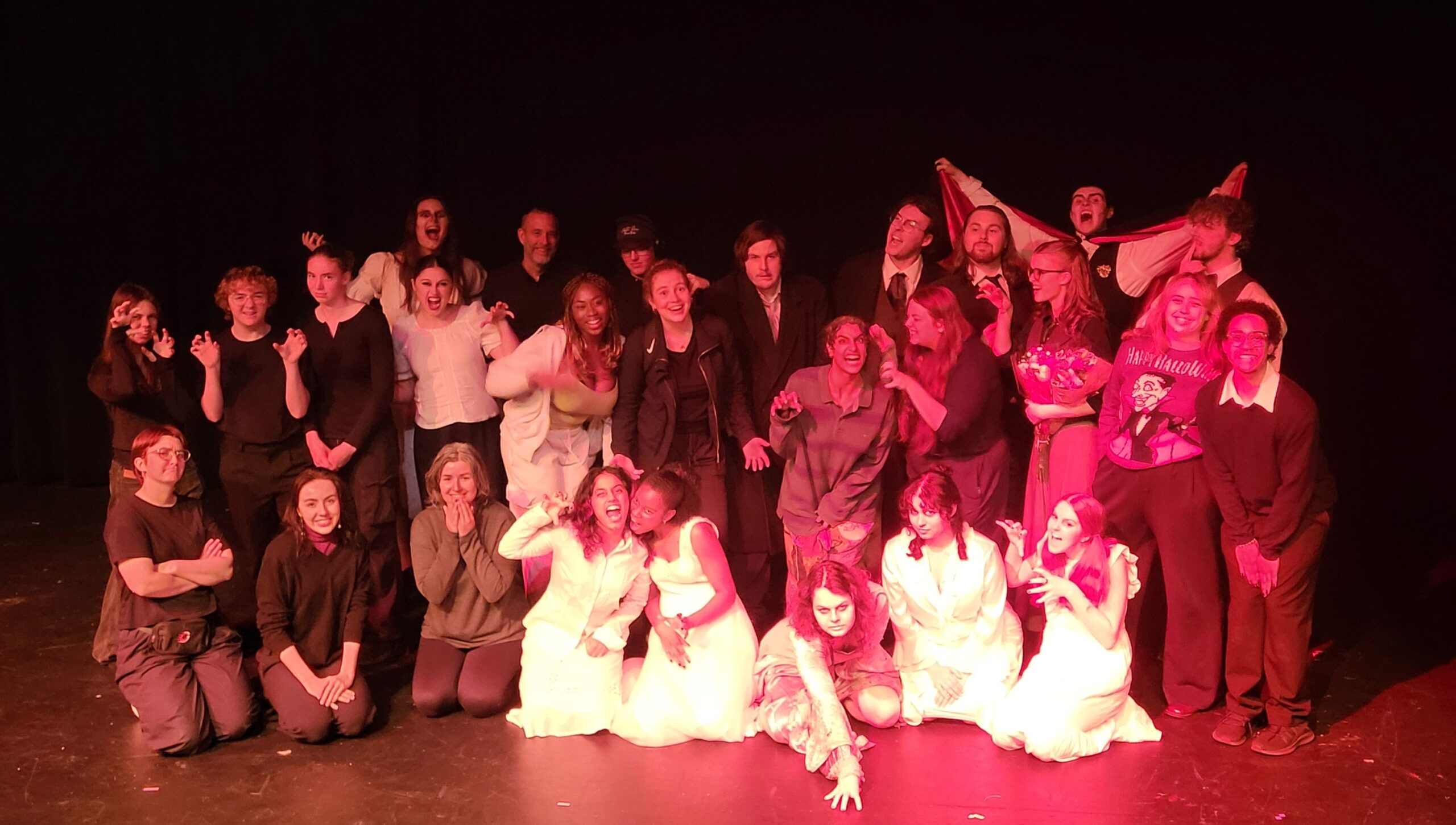
Nestled in the nervously beating heart of Ottawa’s Gladstone Theatre, 41 members of cast and crew are bathed in red stage lights. They dab on last touches of makeup, run through their lines, and practice their bloodcurdling screams for the University of Ottawa Theatre Club’s (UOTC) imminent production of Dracula.
The club was founded in 2023 and presents two shows in French and two shows in English (including a musical) each year.
Dracula, adapted by Stephen Hotchner, is the club’s first production of the 2026-2027 academic year. It ran from Nov. 11 to 14, 2026, with three of the five performances completely sold out.. All proceeds go straight back into the club and are allocated to their other productions!
Bram Stoker’s Count Dracula currently holds the Guinness World Record for the most portrayed literary character in film, with a total of 538 cinema releases and TV films – not counting theatre interpretations.
Why is the UOTC’s version of Dracula worth telling?
Anna Taylor, who plays Mina Harker and is Head of Costumes/Designer, explains that, “We must keep these stories alive, no matter how much time passes. There is always going to be a collective good standing up for what’s right. [Dracula] is about strength and depending on each other and standing up for what you believe, even if you’re the only one.”
Taylor also highlights the directors’ feminist approach to the blood-sucking Count’s tale: “We’re very intentional about how the women are talked about in the play, because a lot of it is unnecessary and you can understand the dynamics without following 1879 verbal language […] it was nice to kind of carry that feminism and show that women have always had the opportunity to be strong.”
The UOTC’s VP of Equity and Representation Renée Ryan notes, “I think Dracula is a really good depiction of what the theatre club wants to put out there, which is stories that reflect our values […]. I think that we’re very intentional in the stories and the directors that we choose to ensure that those values are very well-portrayed, and showcase what we believe in […]. I think that theatre is a very powerful medium to do that […] and I think all of the other plays we’re going to have this year are going to have the same impact.”
How was this vision born?
The UOTC’s Dracula is the fruit of two strong visions brought forth by Director, Jeff Scott, and Assistant Director, Evelyne Laforest. Both share a lifelong love and personal connection to Dracula. While Scott initially saw the ultimate “good guys beat the bad guys story”, Laforest envisioned a morally grey perspective, examining the humanity of each character.
Laforest adds, “The second I heard I was Assistant Director, I just started drawing everything visual […] I knew that this play had a chance to tell a wonderful story but also be a piece of art in and of itself.” The directors share that most visual elements came from Laforest’s imagination, with their sketchbook ideas informing costumes, makeup, and set design. The National Arts Centre also lent fundamental prop pieces to bring the play to life, including Dracula’s coffin.
“The [way] to make a play visually interesting is to put purpose behind colors […] Dracula is the only one who wears red while a lot of other characters only wear neutral colors like black, white, brown and greys and very muted tones. As the play goes on, you can see who’s being infected and who’s not. [A character] loses some of [their] white and gains some of the red,” Laforest reveals.
Scott completes the visual elements by adding structure to scenes, with blocking and atmospheric music. As the main director of 20 stage plays and years of high school teaching under his belt, he admits that he can be absolute in his vision. Nevertheless, he recognizes different types of expertise and viewed the production as a team effort.
Scott also expresses his initial reluctance to relinquish parts of the source material: “It was hard to let go of some of the things I loved so much in Bram Stoker’s work, but once I let that go and started to see it coming together, that’s when it started to really build as a picture for me. These actors have embodied their characters […], taking [them] off the page and putting them on the stage in a way that is so believable to me, and they have such ownership over these characters that I wouldn’t change that at all. It’s fun as a director when you’re watching a play and you forget the actor’s name because they’ve become the character.”
What creative hurdles were encountered?
Stage Manager and Director of Marketing Marcie Hicks highlights the incredibly compressed timeline the production team had to work with due to venue availability dates – only nine weeks for the whole play to come together, with only two rehearsals with the full ensemble. Moreover, the production was completely volunteer-based, with 95% of the production team being full-time university students with jobs.
Scott also emphasized that students were not rehearsing in a theatre, but in classrooms around the University of Ottawa. “I commend this club because I’ve seen other productions they’ve done too, and it’s amazing given that they’re rehearsing in classrooms and carrying props in”, Scott marvels.
A Stage for Outrageous Talent
The stage is composed of students from all walks of life – from political science to engineering – and not just from the University of Ottawa. Carleton student Reem Mabrouk was drawn to the UOTC thanks to campus mixers, and encourages all students interested in acting to go beyond what their school’s offer, and join the tight-knit community theatre scene. Emma Bieler, Producer and the UOTC’s President, shared a similar sentiment, stating, “Everyone is welcome, no matter your background, [or] how much knowledge you come in with.”
Matthew Godreau, who plays the titular character, was cast without any prior professional experience, after a friend sent him the casting call social media post. He knew immediately it would be a “slam-dunk opportunity”. he embodies the iconic vampire remarkably. Godreau’s formidable stage presence and animalistic rage leave him shaking with raw power even as he steps into the wings.
Lighting designer and first-year student, Andrew Campbell, underscores feeling appreciated, despite the often overlooked importance of lighting in high school productions he’s worked in. “So far, my extracurricular experience at [the] university has been very positive. These guys have been awesome people, and I’d love to work with them again.”
(Blood)thirsty for a part in the UOTC’s next production?
Ocean Ruel, Producer and Head of Stage Management, advises those interested in joining the UOTC to keep an eye on the club’s Instagram and membership sign-up form, @uottawatheatreclub, and their website, though the latter isn’t updated as frequently. They are currently looking for stagehands for their next three shows, to support the Assistant Stage Managers and assist with set transitions.
Final Thoughts
Sabine Duknic, who plays Lucy Wenstrom, remarks that live theatre is incredible for allowing for immediate feedback, fostering a symbiotic relationship between the actors and the audience.
My own grandfather started his own theatre troupe, the Swansea Players, upon his arrival in Canada from India 60 years ago. Live theatre is an immensely powerful art form, bringing people from diverse backgrounds together, to simultaneously entertain and remind us of the forces conditioning our human existence; it allows them to funnel their energy and inspiration into a living, breathing show that is never exactly the same every time it is performed.
Dracula is a phenomenal team effort that yielded an outstanding result! I encourage readers to explore supporting the UOTC by attending their next performance, or even taking part!