Designing a competitive board game became an unexpected lesson in cultural respect, higher mathematics, and family connection.
For local STEM professionals Irina Bukhteeva and Alexey Smirnov, a love of board games was a shared escape. After being stuck inside during long winters and craving connection with family abroad, their five-year-long hobby turned into something far more personal: a hand-crafted board game built to transcend borders and bring people closer together.
Island maps and the analytical mind at play
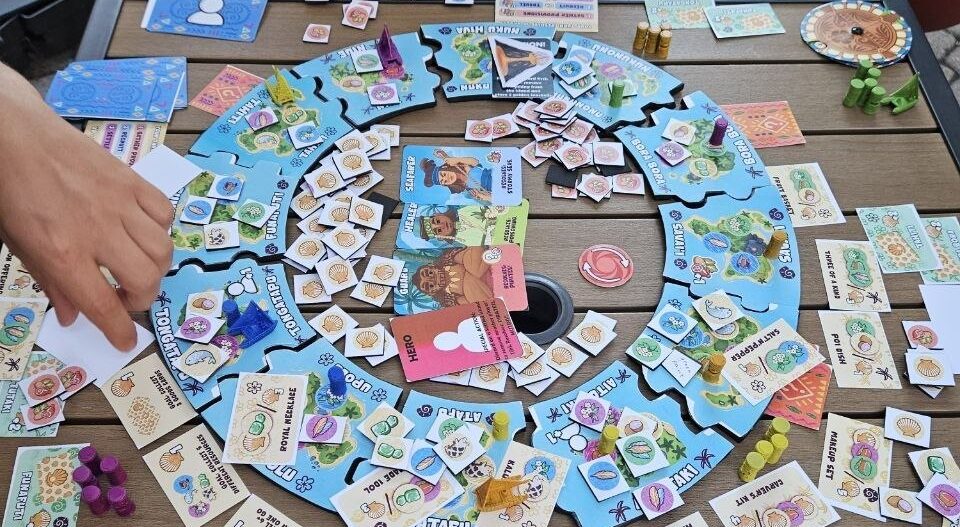
Fair Winds is a competitive board game drawing inspiration from trading in ancient Polynesia. The game features a circular board, depicting real Polynesian islands, that can be rearranged into 1,700+ different combinations. Players work to collect resources native to the land and combine them to get goods.
What truly sets this game apart is its high replay value. For many board games, there are strategies that you can learn that increase a player’s win rate per round. Fair Winds’ creators pride themselves on not having that in their game, with Alexey commenting that “I designed the mechanics, I’ve played the game between 50-100 times, and I’ve only won it like five or six times.”
This was an intentional design, with randomization built into almost every facet of the game due to Alexey’s PhD in Mathematics. They treated game development much like a research project: testing mechanics, gathering data through dozens of playtest sessions with the local students, and tweaking the variables until the balance was just right.
However, they had to tackle another problem to ensure the game remained fun. To solve the problem of the alpha player, the pair looked to an existing system in ancient Polynesia.
“[The alpha player] is not [just] the problem of a game. It happens in life all the time. You have a very successful person who catches a lot of fish, and everyone is just starving because they’re unlucky or whatever,” Irina explained. “We found out that [Tokelauans] solve this problem by creating a system called Inati, which essentially allows you to share the resources through redistribution.”
“We borrowed this mechanic from real life, implemented it into our game, and it solved the problem of the alpha player magnificently. We couldn’t believe it. It was so weird because we tried different, complex mathematical and statistical things to rebalance the game. Nothing worked. As soon as we implemented this one, very simple rule about redistribution of resources, it started working from the next game we played,” Irina finished.
Using Inati was one of the ways Fair Winds’ creators utilized real cultural practices as they placed heavy emphasis on drawing from cultures respectfully rather than treating it as a skin.
Navigating cultural representation respectfully
Popular board games have a tendency to treat real-world locations as mere aesthetics — using cultural themes for appeal without proper research or consultation, while relying on mechanics focused on resource hoarding, land claiming, and extraction. This approach often treats rich histories and living cultures as passive backdrops to be exploited for market optics rather than respected. Thus, asking Fair Winds’ creators ‘Why Polynesia?’ was important.
Alexey replied that “It’s really hard to avoid, especially in the games where you need to travel to places. The question usually comes up about who lives in this place where you are traveling. What was there? What resources are you picking? Are you actually taking them by force? I didn’t want the game to be about violence or about conquest, like many other games. I wanted this game to be about exploration. And [Polynesians], during this time, were the first men on this uncharted island, and that’s the reason why I chose them: to tell the story of travelers that uncovered new land, and yeah, to make it beautiful and enjoyable for everyone.”
The couple wanted the game’s world to be grounded in real history rather than used as decoration. As such, the plants, animals, and resources on the board are based on what they learned about the islands from historical and ethnographic sources. They also recognized that Polynesia is home to many distinct cultures, and that no board game could represent them fully. Thus, rather than portray any one culture, the game draws on Polynesian voyaging history as a whole.
Irina and Alexey understood learning about this history as an ongoing process and reached out to Pacific Islander communities and researchers during the creation of the game. This is also why they recently renamed the game from Tokelau to Fair Winds: the game is inspired by the whole region, not one place.
The distance bridge: gaming across oceans and borders
To its creators, this game means much more than a game about ancient voyagers.
“[Fair Winds] evolved after we first moved to Canada,” recalled Irina. “We were here all alone for a few months in the beginning. At some point, we came up with an actual board game, not just printed cards. I think it was like four years ago. [The game] looked completely different back then, but the idea was the same.”
The game became a way for the couple to remain connected with their family and friends outside Canada. It started from wanting to create a game to share and play with their parents to creating an activity that became a common talking point with their family and friends. In an era dominated by screens, sending a physical board game across oceans offered something a phone call couldn’t: a transnational experience. Sitting around the same board (even thousands of miles apart) allowed them to recreate the feeling of being in the same room.
“[The game was a way to] kind of unite the family at very long distances […] we couldn’t afford at the time to travel,” said Alexey. “When you live for a long time in two separate countries, your whole context changes, and it becomes more and more evident that you have less things to talk about […] that’s why we decided to do it.”
Now, the pair are crowdfunding to ensure that their board game can give others the same connection it gave them. They plan to raise $15,000 for 500 copies of the game to be distributed across Canada, the United States, and the United Kingdom — countries that were chosen due to transportation costs as well as their market share in board games.
The couple hopes to retain ownership of the game instead of passing it off to a board game company because they wish to retain the unique elements of the game that may be scrapped by a company once they no longer have control over it.
Fair Winds’ creators will be having playtest with their first professionally printed prototypes at Level One game pub on November 24th with more information shared on Level One’s social media accounts in the future. To learn more about Fair Winds, support their fundraising efforts, or pre-order a copy, you can check out their website, Instagram, or campaign on Kickstarter.
Editor’s Note: This article was changed on 15/10/2026 due to updated/inaccurate information. The board game name was changed from “Tokelau” to “Fair Winds”. The name references were changed from “Smirnov” and “Bukhteeva” to “Alexey” and “Irina”. The funding goal of $25,000 was updated to $15,000. The figure of 1,700 was updated to 1,700+. A few passages overstate the creators’ claims and were reworded for accuracy.