“OUR PRESENCE IS POWER. BE PROUD OF YOUR ACCOMPLISHMENTS LOUDLY.”
Each year, Youth Ottawa recognizes 21 exceptional individuals between the ages of 14 and 21 who demonstrate outstanding leadership in their community, field of study, or creative pursuits.
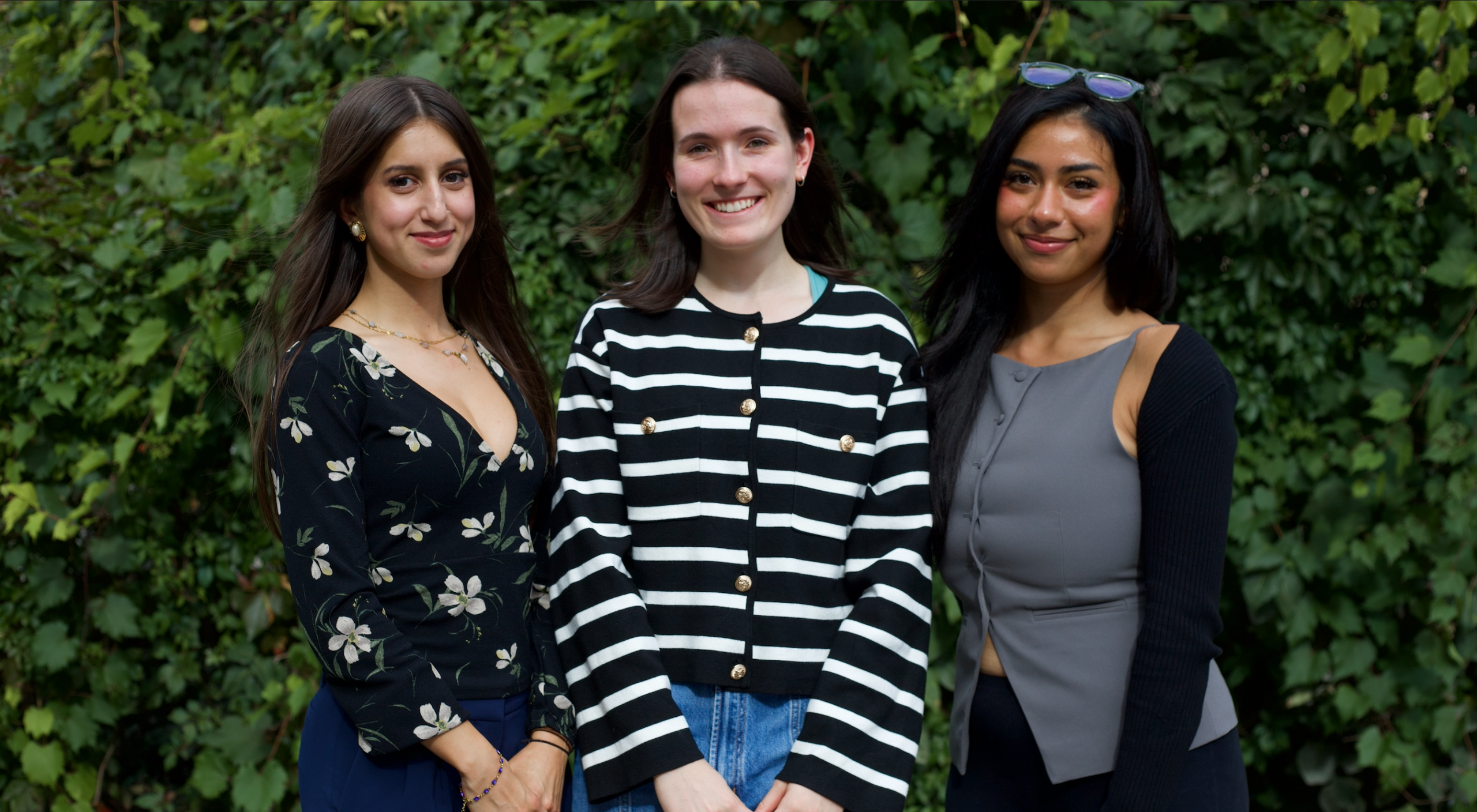
This year, Safia Albadry, Una Bilcar, and Laila Burns were among the 21 finalists, all three of whom are women pursuing STEM-related programs at the U of O. In a group interview with the Fulcrum, the three reflected on navigating their respective male-dominated fields, the challenges and triumphs that have shaped their journeys, and their determination to make space for other women to thrive alongside them.
Going above and beyond, and then some
Safia Albadry
“I was in a boat at Vieux-Port in Montreal watching the sunset when I got the email saying that I won the award,” recounted Albadry. “Honestly, people probably thought I was crazy because I was jumping up and down and [was] so happy!”
The moment marked a meaningful culmination of the countless hours Albadry had poured into community projects and organizations geared towards expanding access to healthcare. The third-year Health Sciences students interned with International Medical Aid, supporting physicians and nurses at a Kenyan referral hospital across various departments, including internal medicine, surgery, and emergency care. Albadry also volunteers with CHEO as a playroom monitor, collaborating with child-life specialists to engage hospitalized pediatric patients in activities that cultivate healthy coping and emotional regulation.
On campus, Albadry is the co-founder and president of HerDefenseUO, a student-led initiative focused on empowering women through self-defense education workshops. She also holds executive positions in various clubs, such as UOWomeninMed and UOPilates.
Una Bilcar
Bilcar is a student-athlete who excels on both sides of the hyphen. The second-year Biomedical Sciences student takes on her program’s demanding coursework while securing national titles on a karate tournament team.
Bilcar humbly credits the women around her who are also balancing athletics and academia with helping her feel supported in both worlds: “When I found out I was selected, the first person I called was this other instructor who is at the same karate place as me. She is also in [Biomedical Sciences] at Carleton so we understand each other’s struggles, and I knew she would genuinely be happy for me.”
With the few hours she has between classes and coaching at her dojo, Bilcar channels her passion for art into the Comfort in Cards, a project she founded in response to the loneliness she noticed while working at a local hospital. The initiative has engaged more than 150 schools and has delivered over 2,000 handwritten cards to hospital patients across Ottawa.
Laila Burns
“Well, the way I found out is not exactly as poetic as the other two,” admitted Burns, recalling that, “I think the first person I told was a client, because I had a meeting that had to be moved because [Youth Ottawa] needed me to come in person.”
The response comes as no surprise as Burns balances her part-time studies in Computer Engineering with her full-time job as the Chief Revenue Officer of Sielo Robotics. In 2024, Burns co-founded Sielo alongside other students in a lab at the University of Ottawa. The start-up “is developing a wheelchair-mounted robotic arm to help individuals with upper-limb physical disabilities perform daily tasks independently.” To date, Sielo Robotics has secured $1 million in funding from various partnerships, including the CHEO Research Institute and the Bruyère Health Innovation Team.
On top of this, Burns leverages her position on the Forbes Technology Council to publish expertise-driven pieces on evolving industry trends.
Sitting down with the Fulcrum
The Fulcrum: Women have only had widespread access to post-secondary education in Canada for roughly 150 years. With this in mind, what does pursuing an education and career in STEM mean to you?
LAILA: It’s a lot more than just being able to access STEM, but being comfortable with STEM once you’re there. At the beginning of my career, I started working in a machine shop on campus which was predominantly male. When I was working there people would never approach me for help; they would go find a man instead, even though I was a supervisor … I had one other woman co-worker, and we often talked about how hard it is to be taken seriously as a woman in engineering … I think it’s really important that women share their experiences so that we become aware that it’s not about you and your abilities, but the environment.
SAFIA: Going into Health Sciences, I’ve never felt like I didn’t belong. However, with my background, the male side of my family still has an expectation for you to be the traditional housewife. During my time here at UOttawa, I met a lot of women in my program, especially in UOWomeninMed, who had that same experience. We’ve been able to bond over that and prove our families wrong in a way … That sisterhood has given me the motivation to move forward.
UNA: In Biomed, we’re leaning more towards female-dominated classes. But I’ve worked in a hospital, and I’ve noticed it with my male coworkers. For example, if you’re asking a question, they answer it in a way that lets you know they don’t think you have common sense, while your male coworkers your age are assumed to know everything … In first year, these engineering guys who were in my microbiology class were like, “There are so many women outside of this class; it must be an easy one.” So my experience has been varied … My access to STEM hasn’t been just about proving people wrong, but about proving to myself that I can do this.
The Fulcrum: The three of you hold leadership roles, whether that be in your start-up, in your sport, or in a club you co-founded. What challenges have you faced being a young woman in these positions?
LAILA: In my career, I’ve had a lot of bad experiences with men taking my eagerness for business partnership as romantic advances … When I speak to other males in my field, I’m hoping to have a partnership on a business level, but I’ve had super old guys just throw everything out the window and ask me on a date … It’s almost like your presence is taken as an invitation. If you are not stone-faced as a woman in these spaces, your friendliness is taken as flirting, which is a huge disadvantage in this industry. Having a start-up requires having a ton of people in your corner, so networking is a large part of what I have to do. I have to build partnerships, and if I can’t be a salesperson because I’m automatically regarded as a romantic prospect, then I can’t do my job.
UNA: At karate, teaching is so difficult if you’re a woman. Let’s say if I’m teaching something, if I say something the kids won’t take it as seriously as when a guy my age comes to the front. Me and the other women instructors have spoken to each other, and we’ve all felt that way … I don’t think the kids are trying to do it on purpose, because I think a lot of them [were] taught at home that the male is the head of the house … which is still very unfortunate.
SAFIA: As a woman in those leadership roles, there’s a thin line between them perceiving you as a leader and them perceiving you as like… a “b-word,” essentially. You have to set boundaries as a leader and create those rules and make sure that everything is done a certain way. One of the biggest challenges when I’m working with a team, especially with HerDefenseUO, is asking myself, “Oh, what if I’m being too harsh or too bossy?” But I snap myself back into reality and remind myself that I started this club and there’s this mission I care about, so wanting a follow-through from others and requesting things to be done is normal. My goal is to make sure I am heard and that my vision is being taken seriously.
The Fulcrum: It sounds as though there is a sense of relief you all have felt seeing other women in the room alongside you. What are your thoughts on the stereotype that women are competitive with one another in these spaces?
LAILA: I think that competitiveness is present between both men and women. It’s just more noticeable to us when it’s a woman because we automatically assume they’re going to support us. If they come off as competitive, it’s so much more disappointing because you just don’t expect it from a fellow woman … I do admit it’s hard to find, but it’s important to have people in your circle who are supporting you. My best friend, Tiana, I admire her so much, and we’re both so ambitious, so we just always push each other towards our goals — I wish this for every woman.
SAFIA: When I see another woman succeed or have many projects, I have never looked at it and wanted them to fail. I try to have the mindset of “if you can’t beat them, join them.” A lot of women have connected me with resources and welcomed me into their projects … Honestly, in this field, you will have conflicts with people over jealousy issues. However, you will still find genuine and supportive women friendships as well. I’m just trying to say that people’s negative energy can make you start doubting yourself in these spaces, so you do have to be careful with who you trust.
UNA: I agree with that. I think that it’s a big pre-med thing. The second it was posted online that I was a finalist, people would come up to me and ask how I did it. And sure, I’ll help them out, but it just feels off because they didn’t have any interest in me before … But regarding competitiveness among women in the field, I think it honestly stems from the fact that for decades there weren’t a lot of spots for women in the medical field, so there was a sense of having to fight each other to secure them. Are things getting better? Slowly but surely, just not fast enough.
The Fulcrum: The three of you take on passion projects that have the mission of empowering others. But, with you all being in fields where women are so often underestimated, how do you empower yourselves?
UNA: Empowering myself was so difficult for me in my first semester; I experienced burnout. It was so bad, and my grades were not the best, but it had to happen for me because I had to learn from it. What I did was that I started seeking out spaces that felt like me. I kind of stopped going to karate in my first year because I felt like I had to have perfect grades. But then I went back to karate, which is my happy place, and picked up a new hobby; I] started running, which was super fun and helped me with school … Empowering myself has been about setting those boundaries and taking breaks, finding something I’m passionate about, and knowing where those safe spaces are.
SAFIA: I can count on one hand how many people congratulated me after I was selected for the award, so what I do to empower myself is practicing positive self-affirmations daily and just repeating to myself daily that I am deserving. Being pre-med, I used to have imposter syndrome looking at how those around me had done so much more and were being recognized for their work … But I told myself a year ago, “You know what, next year I’m going to have that.” And it happened. You have to have that positive mindset, because your brain is wired to believe a certain version of yourself.
LAILA: I have a good routine going. I have an apiary, so I go beekeeping every weekend and also go to the gym, so I have that on lock. But honestly, to feel empowered and keep ambition up, I keep thinking about what would be an awesome achievement for the company, and I go and try to get it. Whenever I am feeling down I try to find ways to build Sielo more, just because with the mission we have, getting the wins feels so good. The start-up is genuinely a hobby of mine because I actually do find it to be so fun and I just love it so much.
The Fulcrum: A bit of a sharp segue, but given how the three of you strive to be high achievers, do you battle with tying your self-worth to your accomplishments?
LAILA: I think my self-worth is very tied to my accomplishments, but I wouldn’t say I’m battling with it. I don’t think it’s necessarily a bad thing that I am super proud of my accomplishments. I am very happy with where I am in life, and I feel that if my younger self saw where I am, she would be so happy … A lot of the time, there is pressure to not be proud of your accomplishments and, especially as a woman, be humble. Even though the worst thing a woman can do is be humble. Humility will not open doors … You have to be proud of your accomplishments loudly, even if you’re going to get hated on.
The Fulcrum: Then let’s change the question: what are your experiences with dealing with the expectation for women to be humble?
SAFIA: Honestly, I’ve always been a shy person and was always shy to talk about my accomplishments. When we were at the media day for Youth Ottawa, they asked us to give a thirty-second explanation of what we do, and the first thought in my head was that I don’t want to sound too cocky. Now, I regret the way I was talking, because when I saw Una’s video, I regretted not having that confidence. Looking back and seeing all the hard work I’ve put in, I realize “Wait, no, I have the right to talk about this.”
UNA: When I got the award, I was like oh what’s next. It’s not like I expected it; it’s just like crossing it off the list and moving on to the next thing. I think for me that stems from being the oldest daughter with three younger brothers. I’ve experienced that expectation to be quiet about my accomplishments, because I don’t want others to feel bad … Especially since people our age have their whole lives ahead of them and we all have our own journeys. I used to try not to talk about it as much, but now I know you have to put it out there because people need to know.
LAILA: A mentor once told me she is always willing to help younger women break into her field. But she said, “How are any of them going to know that I can help them if they don’t know about what I’ve done?” People come up to me and ask about my accomplishments, and then I’m able to tell them how to do [the same] because I talk about these successes. I just think that sharing your accomplishments, especially with other women, allows us to help each other.
MARK YOUR CALENDARS
If you’re looking to join in on celebrating the honourees, the 21 Under 21 Youth Awards Gala is taking place on Nov. 10 at the Canadian History Museum from 5 p.m. to 6 p.m.