
A letter to activists everywhere, big and small
Dear activists of the past, present, and future,
Everyone seems to have a question for you: What drives you? How do you sustain your zeal? And what does your work actually look like?
Looking from the outside, your lives draw a mix of reactions. Some people are perplexed by your drive; others stand in awe of your resolve. Many simply don’t understand what you do all day. Yet, even when the world questions your relevance (or doubts whether any of what you do makes a difference), you persevere.
You are far more than a job title or a stereotype; you are an ecosystem. You span every sector, carry vastly different skillsets, and show up in ways that rarely look the same.
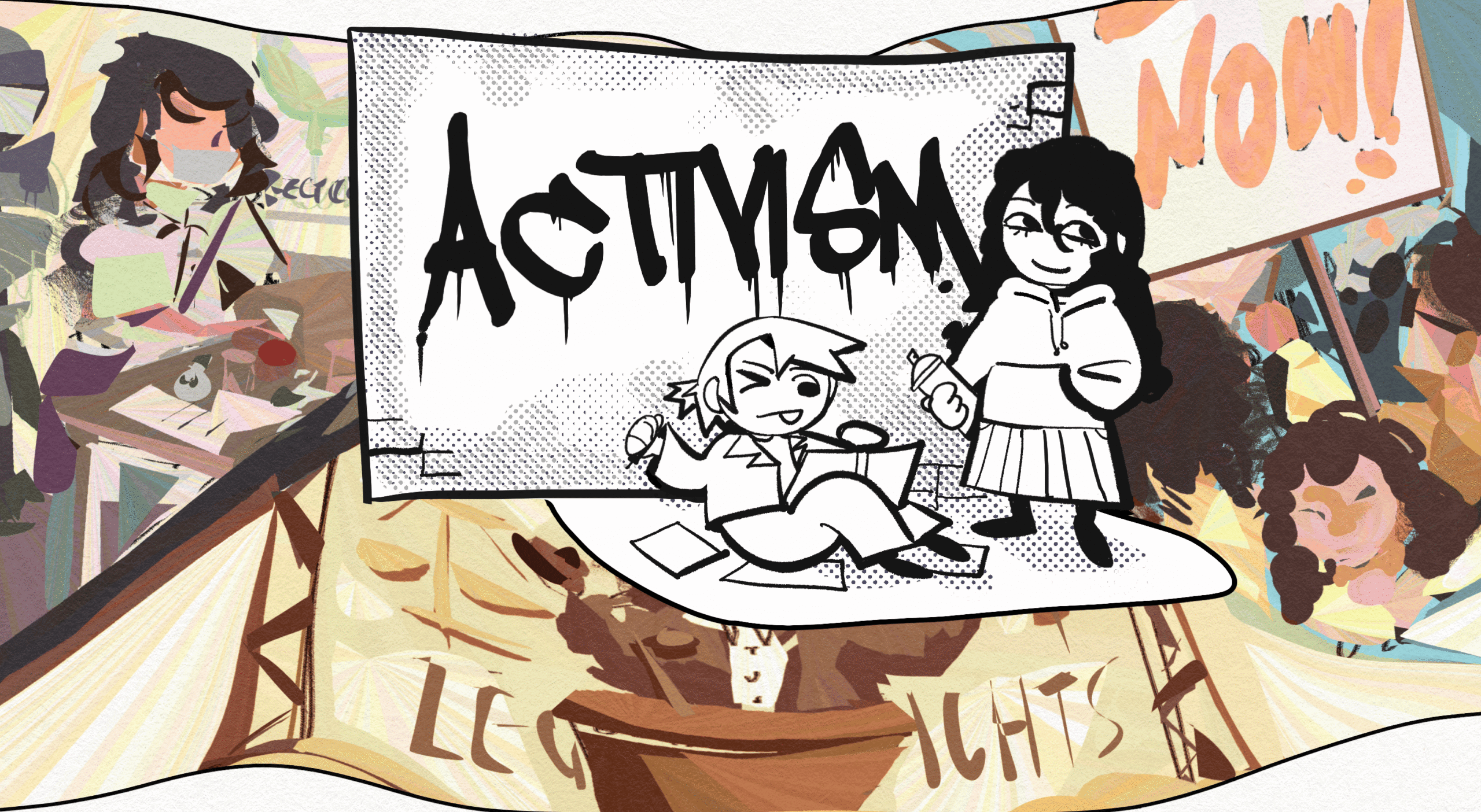
The most visible of you dominate the evening news. You hold the line at sit-ins, lead chants through downtown streets, and walk picket lines in the cold. Yet, just as vital are the quieter versions of you working outside the frame — using art to start and continue difficult conversations, shifting corporate behaviour through boycotts and buycotts, circulating petitions, or having honest, uncomfortable conversations with colleagues over lunch.
Although scholars have tried, the breadth and depth of your work cannot be neatly compartmentalized.
Sociologist David Aberle attempted to map your agendas. According to him, some of you lead alternative movements, asking people to shift their daily routines and consumption, like the youth organizers behind Fridays for Future. Others drive redemptive change from the inside out, rebuilding lives through radical personal transformation, as seen in Alcoholics Anonymous.
Many of you wage reformative battles to reshape specific laws and social norms across society, echoing the long arcs of women’s suffrage and marriage equality. And when a system is broken beyond repair, there are those of you who build revolutionary movements — dismantling and replacing the order itself, just as anti-apartheid and anti-colonial organizers did before you.
Contemporary political scientists W. Lance Bennett and Alexandra Segerberg moved beyond these classifications, focusing on the fluidity of your movements rather than the aspirations of your work. For generations, you relied on what they call collective action: formal organizations like unions, NGOs, and student associations, anchored by centralized leadership and top-down campaigns. Today, many of you operate through connective action — replacing rigid infrastructure with personalized expression across digital networks. Instead of waiting for institutional scripts, you take on flexible frameworks like #MeToo, #EndSARS, or #BlackLivesMatter and broadcast them through your own social ties, scaling movements at lightning speed without the need for formal directives.
In theory, these labels neatly explain your raison d’être, but in practice, you exist beyond these classifications and often have to make rapid changes to navigate your spaces.
For U of O graduate student and activist Elita Uch, advocacy swings between front-facing action like mobilizing and behind-the-scenes work like policy research and writing — a pendulum-like movement necessary to achieve goals and protect the self.
“I’m shifting more towards policy work to have a wider impact on people,” Uch told me. “I think it’s really important for us to have that dual approach, but the catalyst for me [shifting work] was realizing that someone with my identities would always be engaged in asymmetrical power relations. That made it really difficult to shift the pen.”
Like many of you, Uch has had to deal with uphill battles that forced her to choose between herself and her work. Like many of you, she chose both: shifting her sphere of influence by gliding past the rigid classifications of sociologists and political scientists.
Your activism does not live in classifications; it lives inside the people in our communities, and the unglamorous work is what sustains important causes after the hashtags are forgotten.
For U of O professor Nadia Abu-Zahra, these people are vital to every movement: from writing to members of parliament to raising funds for solidarity to creating peer education circles. Each facet of work targets a different goal vital to keeping a movement alive.
The people I admire the most are the people who do a lot of the organizing, who plan for contingencies, who have to do things because something has come up. They are the people who put an enormous amount of effort while making [the movement] look effortless.
These people, many of whom she has met through her work with Voices in Exile (supporting activists in exile), embrace the ideas of solidarity and upliftment. She noted, “[They] continue to support one another and not only continue their individual activism work, but they also are now active on shared issues.”
But these burdens can only be borne by those who can remember that moment when watching from the sidelines was no longer an option for them. U of O student environmental activist Norah Bello remembers that moment.
“It was the first time I heard [someone say] the government does not care about the climate and they would not be here in the next 20, 30, 50 years,” Bello recalled. “They would not be the ones suffering. We would. And I thought, if I want to live my future in a healthy and safe world, I would have to wake up and do something about it. They [the government] were not taking matters into their own hands, so I would.”
Some of you may not remember the exact moment when being a bystander was no longer an option, but many of you will remember the emotions that spurred you into action: anger, determination, indignation. Even more of you will remember the reason why you do what you do: addressing inequalities, responding to injustices, building community.
The path you have chosen often looks romantic: the megaphones, civil disobedience, and lobbying appear edgy or alluring to bystanders. However, most have no idea the grief and friction you navigate — even amongst your own ranks. They are even less aware of the stakes that always feel too high if and when you get it wrong.
“When you work across different groups, it’s tricky,” Bello said. “Different groups have different ways of doing activism and you can start to butt heads. It creates tensions and rifts and sometimes, movements fall apart.”
As advocates, you constantly have people watching and measuring your every step. Disunity or enforcing hierarchies of importance amongst yourselves can be the fastest way to make sure no one gets what they need — and all because someone didn’t understand the importance of intersectionality.
“[Every] issue extends broader and deeper, and it affects different people in different ways,” Bello reminded me. “If you are fighting for one thing, you should be able to fight for others; if not, you’re not really standing up and showing up in solidarity. Success is not about how many people show up; it’s about what people are taking away from the event.”
Perhaps that is why, when I asked those of you already in the thick of it what you would say to someone stepping into activism for the very first time, none of you told them to go buy a megaphone.
Instead, Uch offered this:
Being mindful and more considerate of the people you are working with, showing up for each other in ways that matter and are helpful, goes a long way. We need to uplift each other as a community.
And when I sought a word of encouragement for burnt-out and tired advocates, Abu-Zahra, emphasized that “You have a right to rest [if you are burnt out]. There are some people who have done more than their fair share and have the right to rest if they can while the rest of us step up more. But if you must keep going, I would see what I could do to recruit more people.” Abu-Zahra’s activism journey started with an invitation to work with Amnesty International, and a lot of her work has started from being invited and inviting people — to share stories, experiences, and stand in solidarity in whatever capacity they can.
You are all walking a road that never stops shifting beneath your feet. Along the way, stay curious enough to evolve, and refuse to grow too comfortable in a single frame of thinking. Leave space for the unexpected, and never disqualify your own voice from the room. Even when the world questions your methods or treats the word activist like an accusation, wear it proudly because the work you are doing matters.
You do not need a title to belong in this letter, and you do not need to be loud to leave a mark. Whether you are holding a banner in the rain, writing to a representative, or simply refusing to stay silent at the dinner table — thank you. History has never been moved by a single voice. It moves because of the chorus — past, present, and future.
In solidarity,