Renovation, sale, or redevelopment. Students bear year-after-year of indecision.
Dotted across Sandy Hill, one number stands out above the rest: 613-562-5411.
Usually found behind caution tape or an overgrown bush, the Protection Services’ emergency line adorns nearly every residential door in Sandy Hill that belongs to the U of O.
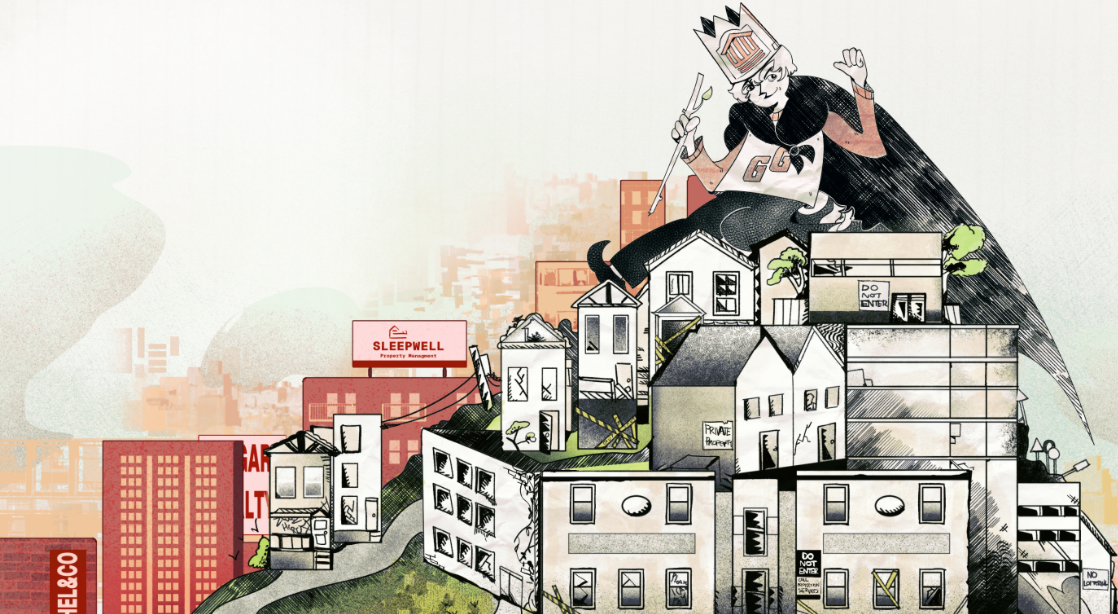
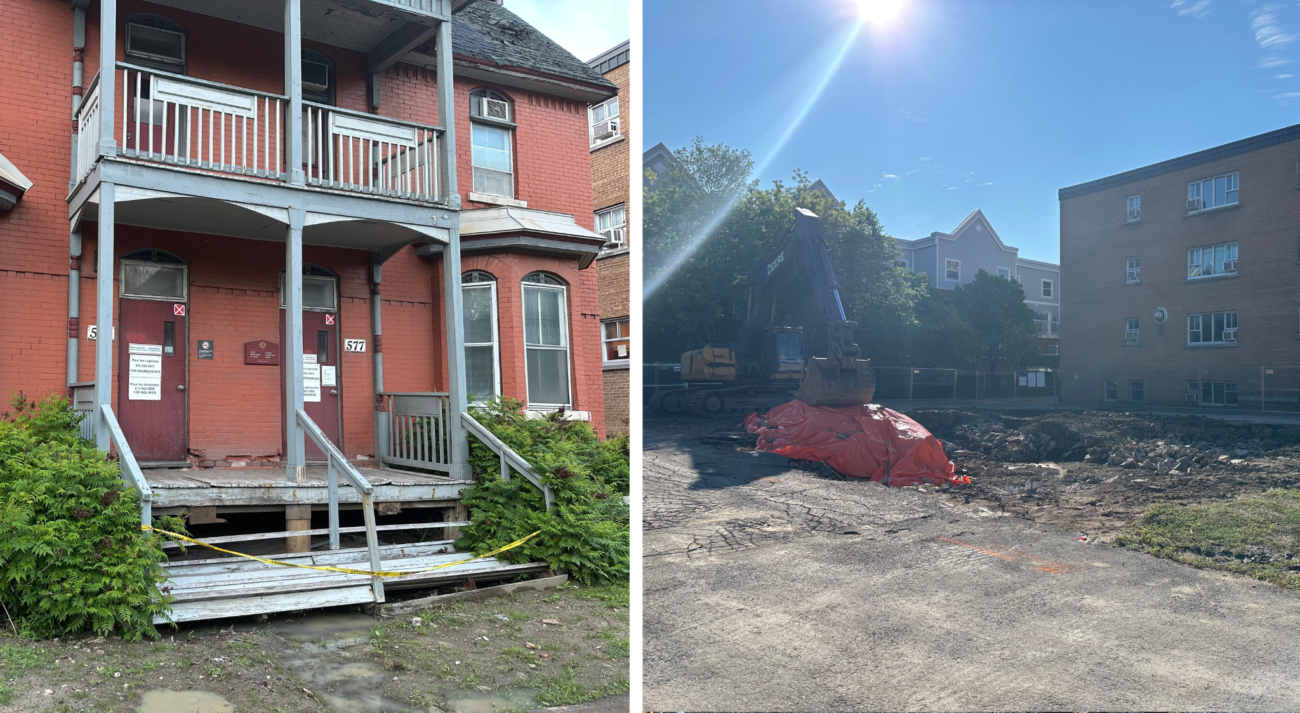
Along King Edward Ave, Henderson Ave, and Templeton St, the U of O owns around 42 residential properties that have hosted zero students, faculty, or visiting professors in upwards of half a decade. These vacant units have an uncanny place in the streetscape of Sandy Hill, as the impeccably trimmed lawns contrast with their interiors devoid of any signs of life.
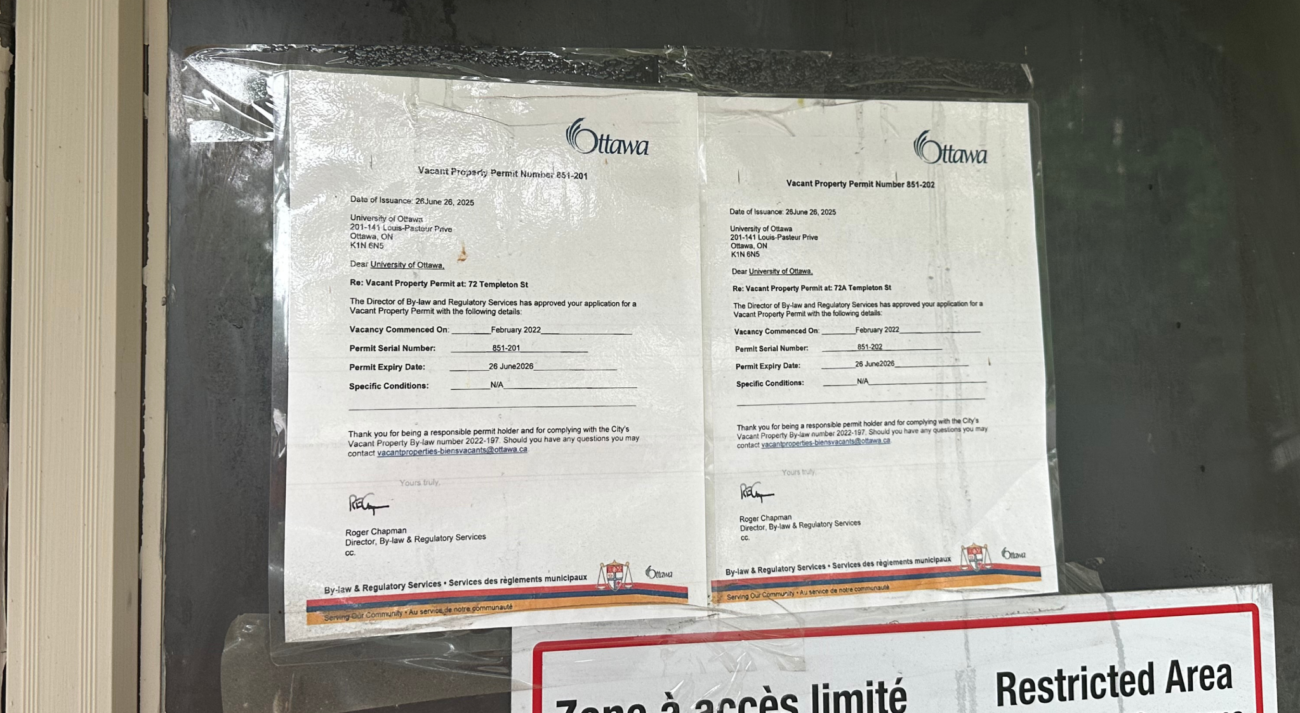
The block has been deserted for local neighbour Quanah Traviss’ entire five-year degree at the U of O: “I think it’s kind of heartbreaking. There’s a lot of students I know who have struggled with housing. Not necessarily the affordability of housing, but the existence of housing. There might not even be something they can get.”
When asked about the vacant properties along King Edward Avenue and Henderson Avenue, Elnaz Enayatpour, President of the University of Ottawa Student Union, answered, “I imagine the reason the University has delayed any consideration for these spaces is because of the cost and planning capacity. However, students are asking, when is the University not strapped for cash, capacity and space? As the University population grows, here’s an opportunity to launch small-scale projects, one residence at a time, partner with community members, and engage students in consultation and planning.”
The U of O stands to lose nothing from inaction. According to the Assessment Act, the provincial legislation on property tax, land owned, used, and occupied solely by a university would be exempt from taxation if it were occupied by the owner.
The University still trims the grass and patrols its properties hourly; any claim of occupation would stand up to the Municipal Property Assessment Corporation, the agency responsible for municipal property tax in Ontario. Aside from the hours of its employees, little is lost with this arrangement.
There needs to be extensive refurbishment of the necessities before a student or staff member steps foot into one of these units. At minimum, these properties have been in disuse since the pandemic and beyond.
A study conducted by Education Consulting Services in 2015 found every single University-owned unit on King Edward, Templeton and Henderson to be wholly unfit for their current use. The small size of the residential units limits the options for University staff to work in, not to mention the rickety condition of some of the properties.
THE UNIVERSITY IS AT A CROSSROADS
The university admin has three shiny buttons at their disposal. They can renovate and use these buildings as is, sell the property to interested commercial partners, or redevelop the land to create new housing units or facilities.
1. RENOVATE THE PROPERTIES
Renovation, no doubt, would be the cheapest option for the U of O.
The houses that stand empty on King Edward and Sandy Hill are architectural marvels and fantastic examples of 20th-century design. The long detached houses on Henderson Avenue sport sprawling backyards with gardens and sheds that host a vibrant ecosystem, and 190 Laurier Ave E, built in 1886, still holds up as both a gateway to the Sandy Hill neighbourhood and as an office space for U of O administration.
Looking at the renovation option, the paramount concern is that half of these buildings were built in the early 20th century, when owners decorated their buildings with lead paint, and builders recommended the use of asbestos as a fire-retardant.
585 King Edward, a former academic complex with the footprint of a modest apartment building, is noted by engineering firm Egis to contain asbestos in certain areas of the drywall, the entire ceiling texture coat, and vinyl flooring in some rooms. Egis conducted its first survey on March 19, 2020, and an additional reassessment in 2022 and 2023.
A week after the first survey in 2020, the University allowed the City of Ottawa to use the then-unused 585 King Edward as a transitional housing space for vulnerable families self-isolating after exposure to COVID-19. Despite the inherent safety risks in allowing vulnerable families into buildings believed to be containing carcinogens, the University is capable of opening disused buildings quickly and efficiently when it wants to.
As previously done in 2020, there would be few internal barriers stopping administration from reopening 585 King Edward and others like it as-is, keeping the historic constitution of the Sandy Hill area intact while ensuring that the land is appreciated by its many guests.
Renovation has its benefits and drawbacks, but this decision does not need to be made by the U of O. This responsibility can be shifted onto a private-sector developer, who buys the land from the University and decides its future use.
2. SELL THE PROPERTIES
Housing roughly100 residents across 62 houses and apartments, the Sandy Hill Housing Co-operative has been an institution in the neighbourhood since 1984. These houses are leased to the Co-op by the U of O, which is ending the nearly 45-year lease with the Co-op in 2028. As housing prices rapidly increase in urban areas like Sandy Hill, the stability of the Sandy Hill Housing Co-operative and other social housing enterprises is needed more than ever in today’s climate.
As the blocks of King Edward and Henderson comprise a mix of co-op-maintained houses and University-maintained houses, no wonder the University potentially seeks full authority over the whole of its property in Sandy Hill. Any approach to complete redevelopment of University property east of King Edward Avenue would be best suited for a wholesale approach, allowing block-by-block development instead of cutting slices out of Henderson to build a lecture hall weaving around single-family houses.
The continuation and expansion of this lease, if not an outright sale, is a mutually beneficial arrangement that serves to host individuals and families across all walks of life in Sandy Hill and provide monetary compensation for the use of University property. Since the U of O is not working with the Sandy Hill Housing Co-operative for a housing solution, the University may be seeking uses outside of social housing.
The liquidation of these properties is not limited to private-sector and non-profit development. The City of Ottawa could explore buying these properties for public services or pursue a partnership with the U of O to bring affordable housing solutions to Sandy Hill.
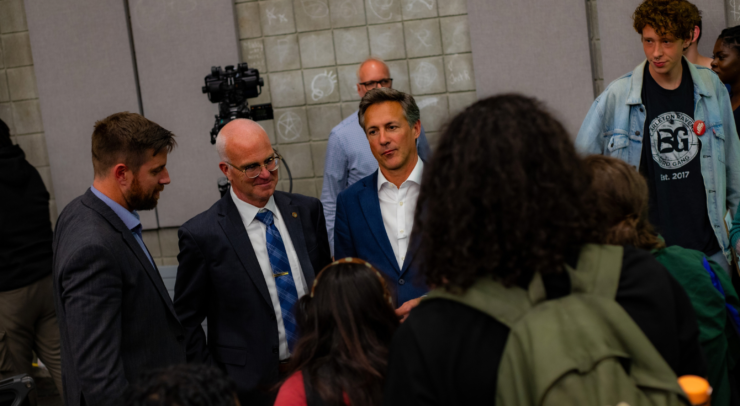
Asked about his remedy for the University’s vacant housing issue on King Edward, homebuilder and mayoral candidate Alex Lawson said, “Let’s see what’s holding them back from utilizing this property to its full potential and go from there. I think there might be a great opportunity here for the University and the City to work together for the benefit of the community.”
Lawson is not alone in this thinking. Economist and mayoral candidate Neil Saravanamuttoo mused about the possibility of a city-owned non-profit, such as Ottawa Community Housing, buying the vacant property to renovate or redevelop it into a livable community.
A partnership with the City may present opportunities for facilities providing municipal services that residents substitute with services provided by the U of O. A new recreation complex, similar to the new Southeast Ottawa Recreation Complex, sporting affordable gyms, swimming pools, and outdoor volleyball courts would make sense, with the size of the precinct potentially facilitating an attached library or municipal child care centre to support the growing population of Sandy Hill.
A turn-off for any buyer’s redevelopment efforts is the Sandy Hill Cultural Heritage Character Area. The City designated this area to preserve the unique 19th-century architectural style of Sandy Hill, and all new development applications are processed in cooperation with this framework.
Furthermore, the unused buildings on King Edward are designated by City staff as an aspect of Sandy Hill’s original character. The City specifically considers 190 Laurier for protected heritage designation, and recommends the retention of 542, 546, 558, and 575-577 King Edward in redevelopment plans. Of these, only 190 Laurier is currently inhabited by the U of O.
But selling severs the connection these properties have shared with the old College of Bytown since the institution’s inception. If the properties are unfit for student use, then why not build on top of the area’s weathered foundation to foster a new relationship between the U of O, its students and faculty, and the Sandy Hill community?
3. REDEVELOP THE PROPERTIES
Redeveloping the U of O property on King Edward and Henderson is the most attractive option for students. University-owned amenities, housing, and academic space bring purpose to the land.
According to Enayatpour, redevelopment is the solution.
“King Edward is one of the highest-traffic streets in Sandy Hill. These spaces are a part of uOttawa’s history, and as the University deals with a shortage of classroom and office space, converting the residences is a no-brainer.”
King Edward’s vacant units are all two-story homes, each with their own ten-car parking lot. While these homes sit empty, students miss out on the necessities.
“As you might know, Sandy Hill recently lost its last laundromat. I don’t know what students are doing – some are driving or Ubering to laundromats in Vanier, and going months without clean clothes. How cool would a university-owned (or better, student-owned) laundromat be? While the water and electricity costs would be high, I think the King Edward spaces would be perfect for a student and community laundromat.”
This infrastructure is incapable of supporting the rapidly growing student community. As enrollment numbers grow by the hundreds and show no signs of stopping, Sandy Hill is the premier housing destination for its convenience, the proximity to campus, and workplace learning opportunities downtown.
Which option will the University choose to keep Sandy Hill in the horizons of Ottawa’s future?
U OF O CHOOSES INACTION
In a statement, U of O Chief Communications Officer Ricky Landry told the Fulcrum, “The University continues to assess the long-term future of its real estate holdings, including the King Edward Precinct and surrounding areas … No final decisions have been made regarding specific properties or redevelopment initiatives in the King Edward Precinct and surrounding areas.”
This was not the plan. In 2015, the U of O released its Campus Master Plan, commissioned by Urban Strategies Inc. This 20-year plan lays out the vision for all university properties, with facility visions laid out for the next five to ten years. This Campus Master Plan, previously available unabridged in a forgotten corner of Urban Strategies’ SharePoint, closed to the public somewhere between the drafting of this article and when The Fulcrum started asking questions. This plan is now only available in fragments on the University website from Google’s cache.
The King Edward Precinct, comprising the six blocks on both sides of King Edward between Laurier and Templeton, receives special attention from Urban Strategies as not an edge of the University’s main campus, but a face of the U of O and gathering space for the greater Ottawa community.
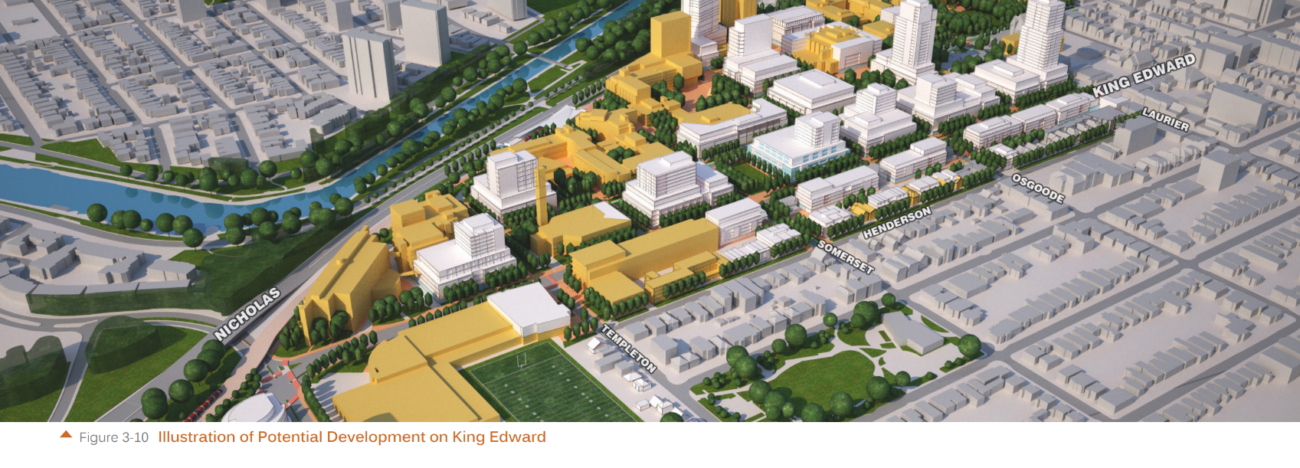
Expectations for King Edward were lofty, to say the least. Within 20 years, every residential property on King Edward was to be razed and replaced with mid-rise and high-rise towers hosting businesses, retail, and student residences. They planned for King Edward Avenue to be converted to a two-lane road with grade-separated bike lanes and street parking lined with vibrant foliage.
Leblanc, Brooks, Fauteux, and Louis Pasteur were to be demolished to make way for mixed-use academic buildings. Across from the fire station on Laurier, they envisaged a signature academic and cultural centre, turning King Edward into a gathering place for the greater uOttawa community.
The historic vacant residences and occupied co-op buildings on Henderson were recommended for retention both due to their liveable conditions as a result of the occupancy of co-op members and to maintain relationships with the community of Sandy Hill.
Evidently, the dozens of houses lining the U of O’s King Edward Precinct stand tall, but the Campus Master Plan has succeeded in other areas at its mid-point. MacDonald Hall has been demolished, Lees Campus has been redeveloped, the University core has been pedestrianized, and the redevelopment of the Brooks Residence is underway.
WHAT NEXT?
With the roadwork near the empty Brooks Residence underway, the pathway to demolition and redevelopment of one western block of King Edward has begun. Only time will tell if the future redevelopment of these vacant properties will be as belated as the process of the Brooks Residence, its hundreds of beds sitting unused since 2018.
With the university signalling its preference for inaction, what can students do?
“It’s up to neighbours to take action. It’s up to them to report infractions [referring to the Property Standards Bylaws] to the city,” advised Jeff Leiper, city councillor in Kitchissippi and mayoral candidate.
Neil Savaranamuttoo echoed Leiper’s sentiments: “The university is not incentivized to maximize profit. The students should give them an incentive.” Savaranamuttoo added that “If the university doesn’t want to do anything, you should become the university! Students should organize and really make this the university’s problem.”
As Saravanamuttoo says, the students only stand to gain by using their voice to pressure the U of O into taking action. Students stand to lose housing and community-building opportunities, as well as avenues to grow academically. In contrast, the university stands to lose nothing from inaction on the status of its vacant homes in the King Edward Precinct. Building a strong future in their students takes tenacity and a willingness to take risks. This future lies in the hands of the U of O as another generation passes through campus wondering what could have been.