
ORGANIZERS SAY FACULTY OF ENGINEERING HAS FAILED TO PROPERLY SUPPORT WOMEN
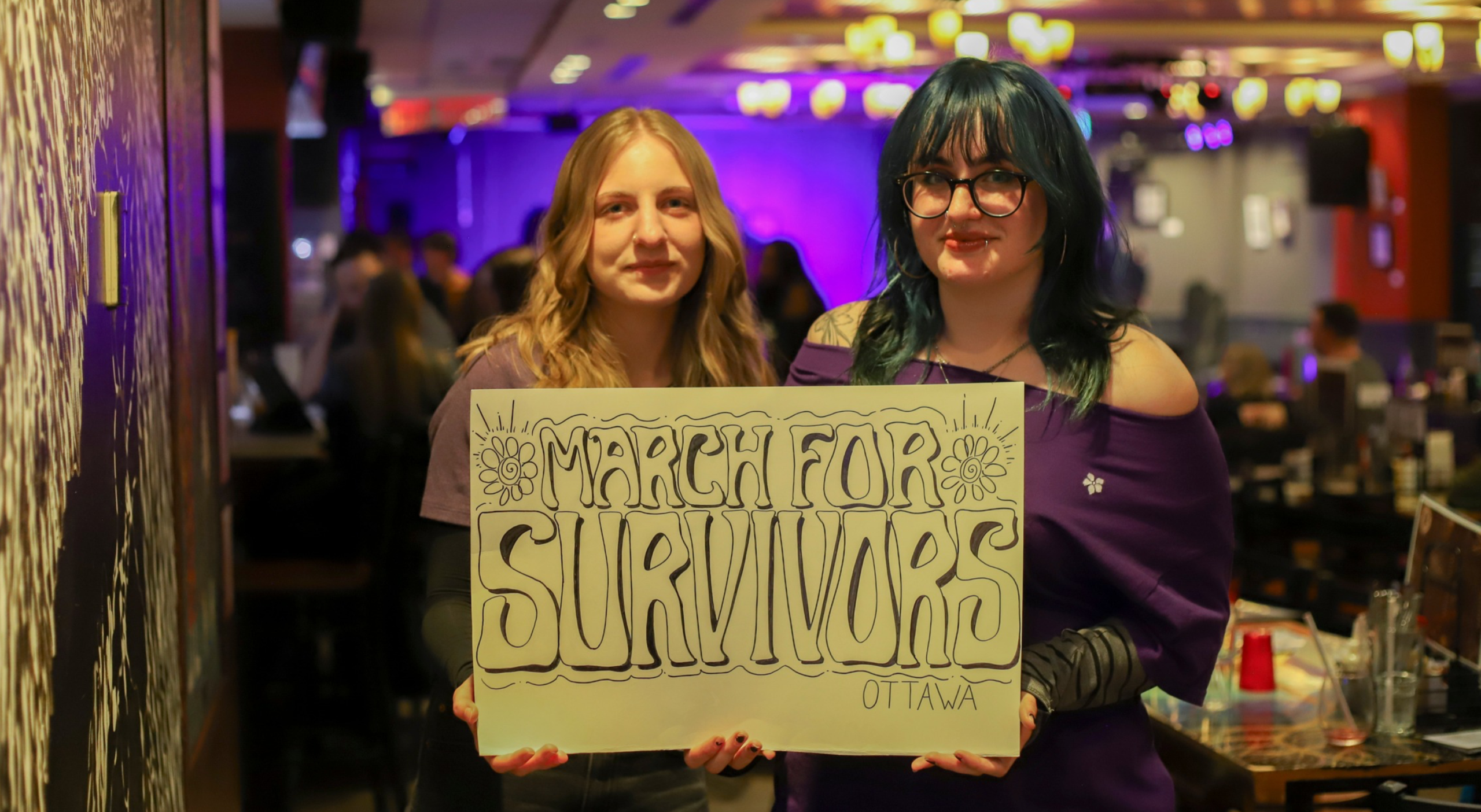
The sound of car horns and cheers followed roughly a dozen marchers through downtown Ottawa on Nov. 13, as participants looped from UCU Square to Nostalgica for the U of O’s first March for Survivors. The student-organized initiative brought together students and community members to raise funds and collect essential supplies in support of two local women’s shelters: Cornerstone Housing and Harmony House.
The march gathered attention from attendees and passers-by alike. Drivers honked in support, while people gathered on a nearby bridge to cheer the marchers on. By the time they’d arrived at Nostalgica, the march had given way to an evening of live music, conversation, and fundraising.
Local women-led bands Campbell, Blush, and Stendhal Syndrome performed throughout the evening, with sets ranging from softer acoustic songs to energetic punk-rock performances. Hammoud described the atmosphere as intentionally upbeat, as “it [wasn’t] about grieving what they’ve lost, and more about celebrating how they’ve persevered.”
Making Space for Women in Engineering
For third-year engineering students Amira Hammoud and Natasha Dumoulin, organizing the march grew out of their own experiences navigating an educational environment where women remain underrepresented, an issue they say is especially pertinent in their field. Dumoulin says:
When you’re the gender minority in a mostly male program like this, it feels like you’re special in a bad way.
They described feeling pressure to establish themselves in a discipline historically dominated by men. In 2024, female-identified undergraduates accounted for just 18.9 per cent of mechanical engineering students in Canada. They also noticed gender inequality surfacing in everyday classroom interactions.
“There is no gender neutral language used by 95 per cent of our professors. They will always say ‘he,’” Dumoulin described. Hammoud further explained: “You will still have your male teammates assuming that you cannot do something or you don’t know best in this scenario, despite consistently proving otherwise, and that’s very frustrating.”
They also raised concerns that women’s contributions to engineering are underrepresented in the classroom, arguing that the content students learn often overlooks the role they have played in the field’s development.
“It feels like we’re being taught by men about men for men. It’s a very male-centred experience, and that’s what leads you to feel so isolated,” said Hammoud.
The organizers said the university’s effort to celebrate women in engineering doesn’t always reflect their environment and lived experiences. Although initiatives such as the annual Women in Engineering networking event are meant to celebrate and promote women in STEM, Hammoud describes it coming off as “surface level and performative.”
They say this disconnect is reflected in the classroom, stating they are often forced into forming pacts with fellow women classmates to compensate. “If we’re in separate groups, it takes so much more work to establish ourselves,” described Hammound. “But when we’re together, we’re able to vouch for each other.”
That sense of solidarity became the very reason for the march. The organizers wanted survivors to feel recognized and supported rather than isolated in their experiences.
I just wanted to be able to make something that would tell those girls that they’re not alone, said Hammoud.
Their concerns also speak to a wider campus issue. Between May 2024 and April 2025, U of O support services received 478 requests related to sexual violence, including 235 categorized as sexual assault and 74 as sexual harassment.
Additionally, in 2025, the Ottawa Police Service recorded 7,960 intimate partner violence incidents, averaging 22 reports per day. Women accounted for 80 per cent of victims.
These figures only represent the reported requests for these services, rather than the full number of incidents. Alleged and founded incidents of gender-based misconduct involving OPS officers have fuelled distrust in the service, with nine executive directors of assault and rape support centres expressing concern about its impact on public confidence. For survivors who already face barriers when it comes to reporting, this additional layer of fear and distrust of the police makes turning to them an unsafe option.
Supporting Survivors beyond Campus
Donations from the march were directed towards Cornerstone Housing for Women and Harmony House, two Ottawa-based shelters that are at capacity.
Cornerstone provides emergency shelter and supportive housing for women and gender-diverse people experiencing homelessness. Despite expanding its emergency shelter capacity to 150 beds, with 15 additional overflow spaces, the shelter continues to be full every night.
Harmony House provides transitional housing and support for women and children leaving situations of violence. It has 16 self-contained units and consistently harbours a waiting list of over 100 families. Both of these services provide crucial protection for survivors and victims of gender-based and sexual violence, as finding adequate shelter is often the largest barrier they face.
By the end of the evening, the organizers had collected approximately $300 in monetary donations, in addition to essential supplies such as feminine hygiene products and toothbrushes donated by attendees.
As keynote speaker and former city councilor candidate Yvette Ashiri reminded attendees earlier that evening: “Real change happens when awareness becomes action, when sympathy becomes accountability, when silence becomes advocacy, when bystanders become leaders; each of us has a role to play. There is no small action.”