IN THE FINAL MINUTES OF THE ASSEMBLY, THE UNION’S SITTING PRESIDENT WAS CALLED OUT FOR UNPARLIAMENTARY LANGUAGE BY THE CHAIR AND STILL WENT ON TO SAY, “HE CAN’T WAIT TO NEVER DEBATE THIS MEMBER AGAIN.”
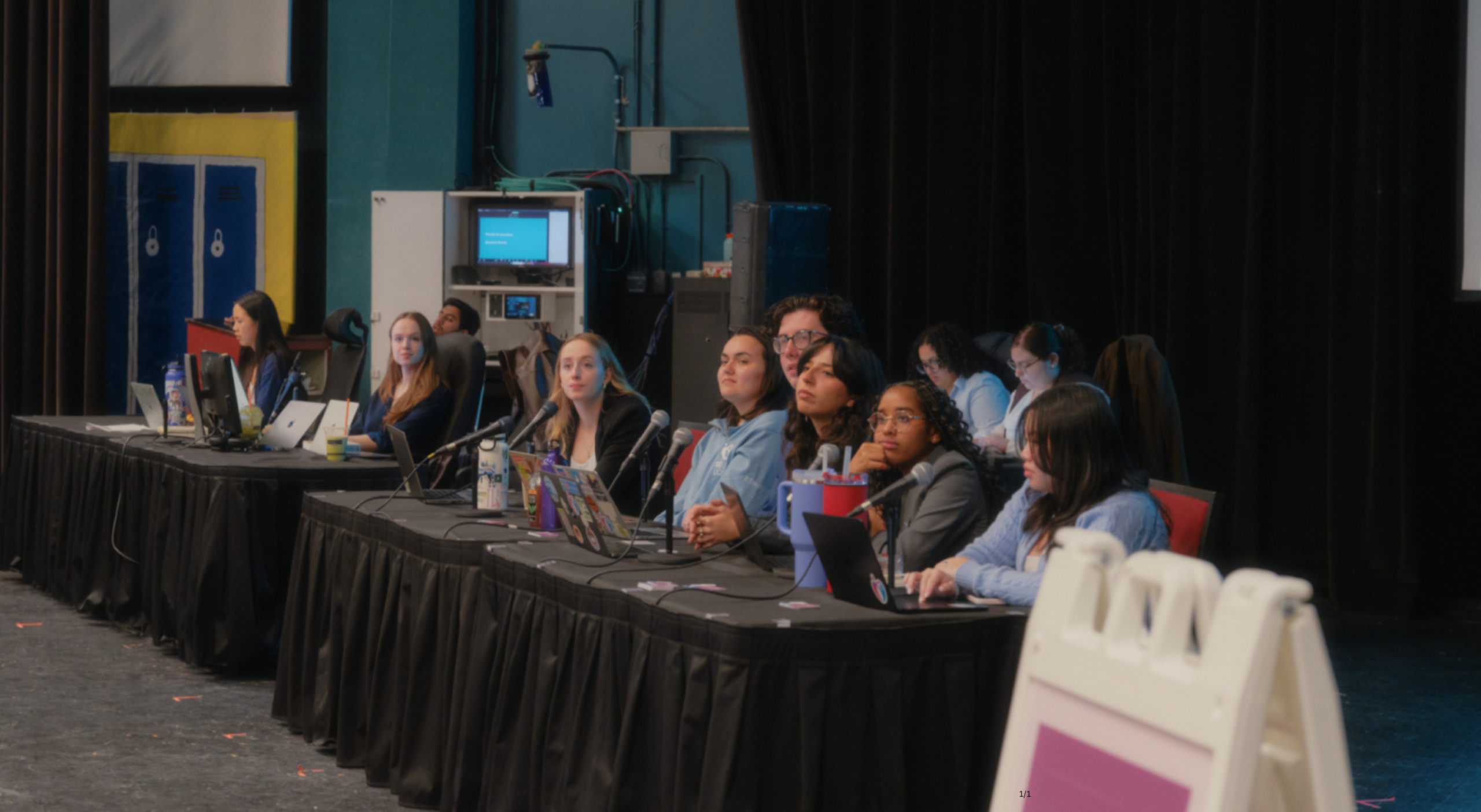
The University of Ottawa Student Union’s (UOSU’s) Winter General Assembly (WGA) started at 10:06 a.m. with lots of new faces in the crowd. Following the chaotic general election, where only one of five executive positions was filled due to bilingualism issues, students braced for what many thought would be a long day.
However, with one of the shortest run times in UOSU history, the roughly five-hour assembly packed little procedural substance to address the year’s shortcomings. Few motions were passed, none of which addressed the lack of engagement with union roles as seen through the many vacant and uncontested executive and board positions, or the issues with bilingualism testing.
The day closed off with a heated exchange during the varia period that showed anything goes when contracts are ending and represented the second personal chide made towards a student by a UOSU executive this month, following the recent presidential debate.
Opening Remarks
The chair, Maya Sinclair, promptly started off the day with a land acknowledgment and a motion to pass the WGA’s agenda, before heading into the first motion of the day regarding priority speaking rights for people with disabilities. The motion raised by Ethan R-D proposed that students with invisible or visible disabilities be provided with accessible seating near the microphone and be allowed to speak first during discussion periods.
An additional microphone, requested as part of accessibility accommodations, was provided prior to the vote.
Grace Clark spoke in favour of tabling this motion until an accessibility caucus is created to factor in the perspectives of multiple students with disabilities and create a more holistic policy. The motion to table passed with 118 for and 7 against, concluding debate.
Executive Updates
In a change of pace, we headed into the executive update period. UOSU’s President, Jack Coen, highlighted the U of O’s first blood drive co-run with the Indigenous Students Association, the expansion of fed-up stands to Morisset library, and the work he did to cover the operations portfolio while president-elect Elnaz Enayatpour was on leave.
Operations commissioner, Elnaz Enayatpour, has been working on a preliminary budget for the next fiscal year. She gladly noted that Pivik has run a profit and the $80 000 compass agreement has been terminated, putting $3 back in the pockets of every student. Although the 2$ printing levy passed, Enayatpour stated that the union will be ending free coloured printing to open up the printing budget, which was exhausted earlier in the year, and topped off with reserve funding.
Advocacy commissioner, Alex Stratas, has been in talks with the U of O to ensure the new Brooks residences are affordable and has hosted legal clinics to inform and equip students to advocate for their rights as renters. Stratas has been busy meeting with MPs, speaking to major Canadian news outlets, and mobilizing against Bill 33, Bill 60, and now the OSAP grant cuts. She notes that “this is a winnable fight,” but we need to show MPs that we are a threat. Adding that, the Ottawa-wide walkout on March 24th is the next big step in the fight against Ford’s cuts.
Francophone affairs commissioner, Ève Tremblay, is proud to have hosted the weekly francophone coffee hour “Espresso Yourself in French” to support students struggling with linguistic insecurity. Tremblay also hosted a francophone frost event and has been making faculty-specific demands to advocate for engineering and education students who don’t have the necessary French course options. She is on the committee for the university’s new Francophonie consultation and feels the U of O is headed in a positive direction in this regard.
Student life commissioner, Samar Mohamed Ahmed, stepped into her position in December 2025 after the by-election, and has since distributed over $100,000 in club funding and scholarships, collaborated with registered student governments on Frost month, planned the upcoming student life awards, and approved new clubs following the reversal of the club caps.
Communications commissioner, Kaitlin Ma, has dissolved the role of the communications commissioner as part of a restructuring of the communication portfolio. Throughout her term, she relaunched the free graduation photos program, featured 37 unique clubs and student associations through weekly club features, and supported staff on the day-to-day communications operations, such as the creation of Instagram content. This is no longer a student position, and the union is currently recruiting a Communications Specialist with “at least 3 years of equivalent experience in a progressive management position.”
Question Period
The question period that followed executive updates went on longer than in previous years. The disqualification of several candidates due to bilingualism testing was top of mind for many at the assembly.
A student named Lucien asked a question about changing bilingualism standards, given that “these are some of the most bilingual people we’ll meet in our lives,” and they failed. When asked for their opinions, Coen answered that “it won’t be us who are deciding, it will be the General Assembly.” Enayatpour added, “One thing that execs can and should take on is to look at other available sources for testing.”
Another student, Alec Tweddell, pointed out that “we can’t blame bilingual testing for vacancies on the board of directors, for example. So I think that’s a bigger problem than just bilingualism testing. I think that’s an engagement problem. So I want to hear your thoughts.” To that, Coen responded, “We need to be doing a better job going forward, at communicating what the Board of Directors actually does…It actually isn’t as intense as people think it’s going to be.”
Speaking of the board, answering a student’s question about the status of the Bounce contract, Coen said: “The board decided last month to look for other options for Student Life contracts.” Adding that, “this was a decision by the board and the board alone.”
In a change of tone, Trevor Nyguen asked: “What will the UOSU do to get uOttawa a drinking culture?” Enayatpour answered that “as a pro-drinking student,” she’s been thinking about collaborating with the Nano-brew club to brew a Panda beer and that “it’s coming.”
In a change of tone, a student came forward to explain how she’s not comfortable with her student fees going towards a pub levy, given her family’s experiences with alcohol. While the pub-levy is opt-outable, refunds can take up to a year. Earlier on, Enayatpour said she “just sent out the money from 2024 a few months ago.”
Another student asked executives about a timeline for the pub levy, and whether he should “expect to drink at the pub by the time [he’s] a post-grad researcher.” The chair explained that the pub’s referendum question did not include a timeline. Enayatpour added that UOSU has committed to collecting the levy, but she is open to revisiting whether or not it should continue or be repurposed on next year’s ballot.
The Q/A period concluded with a question about U of O’s Multi-Faith Chaplaincy Services and if UOSU is doing anything to improve its functionality. Advocacy commissioner Alex Stratas noted that UOSU can only make recommendations since they don’t operate the service, and that she has been actively working with the university to improve it.
Election Results
After the question period ended, the election results were up for discussion. The motion to ratify the election results was approved without debate and included all results except the operations commissioner and student life commissioner.
The operations commissioner and student life commissioner were externalized, to be debated and voted on individually. Both motions sparked debate among students, and both candidates spoke for themselves.
During the general election, Zach Lebel ran for operations commissioner in a contested race, receiving approximately 38 percent of the vote, while Carly Huber received 61.65 percent.
Before voting began, Huber had initially been disqualified by the Chief Electoral Officer for not meeting bilingualism requirements. She appealed, citing technical difficulties, and the Elections Appeals Board allowed her name to remain on the ballot temporarily to grant her additional time to prove her eligibility.
The Elections Appeals Board made it clear that if Huber did not meet the requirements, her disqualification would stand. When the election opened on March 2, both Huber and Lebel were listed on the ballot, although Huber’s eligibility had not yet been confirmed. She withdrew later that same day after failing to complete the additional testing.
After the election, Lebel challenged the results, arguing that having a withdrawn candidate on the ballot put him at a disadvantage and that, as the only eligible candidate, under section 9.6.1 of the Constitution, he should have faced a vote of confidence.
The Appeals Committee reviewed the case and found that the ballot did not fully comply with constitutional requirements. Following the Elections Committee’s recommendation, the operations commissioner position was brought to the General Assembly as a motion for a vote of confidence, which Lebel won with 146 votes in favour and 34 opposed.
Similarly, Hamza El Mendri, up for the role of student life commissioner, also had an externalized vote of confidence. During the general election, El Mendri won with approximately 64% of the total votes. However, Quanah Traviss motioned to externalize this result, citing concerns about El Mendri’s involvement with 102 week and scamming students.
Traviss spoke, citing concerns that “someone who ran a club that scams students during 101 week should not be in charge of 101 week for almost 5000 students.” He continued, “I would encourage you all to vote no on this motion so we can hire someone who’s more fit for the job.”
El Mendri spoke to Traviss’ comments, stating that “This issue was not brought to my attention,” and that “We hosted all of our events.”
El Mendri continued, emphasizing that “I do not believe using the word ‘scammed’ is appropriate here,” and “If you have any proof against it, if the students feel like they have been scammed, we’ll be more than happy to reimburse them the $30 that they paid.”
After debate concluded, the motion passed with a very close call at 52 for, 45 against.
Motion to renew expiring positions
Before taking a recess, the assembly moved to adopt the constitutional amendments presented by the board of directors, which must be renewed every three years according to UOSU’s constitution.
The motion included 17 positions for readoptation, which can be found on the WGA agenda, including but not limited to: decolonization and reconciliation, anti-discrimination, pro-choice, and accessibility. The motion passed with no externalization or debate.
Motion A: Student union autonomy
This motion was moved by Daniel Thorp and called on the union to adopt “a position on student union autonomy and democratic self-governance.” Thorp argued that UOSU “should guarantee legal continuity, institutional autonomy, and protection from arbitrary defunding, derecognition, dissolution, or unilateral override of democratically determined structures and fees.”
The motion comes as a precautionary measure in light of Bill 33, which could jeopardize the union’s funding by giving universities the power to decide which fees are essential and how they should be collected. The motion passed with 48 in favour and promoted no debate.
Motion B: Procedural recourse and the appeals committee
Also moved by Daniel Thorp was a motion to “[strengthen] internal access to justice and procedural recourse and the appeals committee.” The motion proposed modifications to internal dispute resolution mechanisms with the aim of “resolving governance disputes without recourse to external litigation.” Thorp suggested that the Ombudsperson recommendations be implemented, the appeals committee be separated from the board, and that the board draft a plan to implement this resolution for the next general assembly.
Quanah Traviss motioned to postpone debate on motion B indefinitely. Traviss’ motion passed with 63 in favour and 11 against. Motion B was killed without any debate regarding its content.
The final hour
Nearing 3 p.m., the WGA was on track to be one of the shortest in years. The final 30 minutes concluded with Varia, which multiple speakers, including board members, RSG leaders, volunteers, and UOSU web coordinator, Yusuf Rahman, thanked the chair, Maya Sinclair, for her years of service, and concluded with the union’s President Jack Coen stating that, “he can’t wait to never debate [Daniel Thorp] again.”
Moments prior, Thorp expressed that “UOSU is working well for the people in this room and for a small student minority.” Citing the lack of debate on motion B as an example that “the union is not working the way that it should be”, Thorp stated that “there’s a lot of work left to be done.”
Thorp said, “I see lots of clapping, but not talking about fixing issues.” In response, the faculty of social sciences board member, Lien Huynh, noted that they ran “because [they] didn’t like the culture [they] saw in UOSU… however, to keep focusing on UOSU’s past and to say that we are not improving, completely neglects the work people are putting in to change things.”
There appeared to be a sharp disconnect between UOSU staff and Thorp and the “silent majority” he claimed to represent about whether or not the union is doing enough to support, listen to, and advocate for students.
With files from Kavi Vidya Achar, Alexandrea Abungin, Sifa Tisambi, and Daniel Jones.
Editor’s Note: This article was changed on 4/3/2026 due to inaccurate information. The following name was misspelled “Lucion” and changed to the correct spelling “Lucien”. “UOSU staff” was made more specific to state “which multiple speakers, including board members, RSG leaders, volunteers, and UOSU web coordinator, Yusuf Rahman”. The statement “An additional microphone, requested as part of accessibility accommodations, was provided prior to the vote” was added to accurately reflect the accommodations provided upon request. Paragraph titled “Election Results” was substantially corrected to accurately reflect Zach Lebel’s candidacy, noting that he was never disqualified, successfully passed bilingualism requirements, and received 38% of the vote in a contested election; it also clarifies the outcome and language of his subsequent appeal and the role of the Appeals Committee.