
Student journalists don’t live in the moment — they document it
A popular catchphrase of self-help gurus or those in the manosphere is that “we all have the same 24 hours.” The journalism equivalent may be “we all have the opposite 24 hours.”
While most student journalist’s alarms aren’t set quite as early as morning show hosts, and our bedtimes are probably not too much later than an adderal-fueled university student cramming for an 8:30 a.m. midterm, the point still stands.
But let’s back up a second. What is student journalism in 2025? What is the Fulcrum in 2025? Depending on your familiarity with our outlet, the answer is going to be different to all of you. Let me try to explain mine.
What even is the Fulcrum?
This is a question I have had to answer hundreds of times for the past two years, to friends, classmates, family, and potential sources. But there was a time on this campus when that question didn’t have to be asked.
At one point not too long ago, our newspaper had a circulation of more than 20,000 papers a week. Our papers were everywhere, our office had lines out the door during pitch meetings, and most importantly, we captured the essence of student life on campus — the now-since forgotten monoculture.
So what happened? While not trying to dodge all responsibility from our side of the equation, student newspapers have been in the trenches for the last handful of years.
Rising paper costs, disappearing advertisers, student apathy, and alternative sources of information like Reddit forums and Instagram pages were already coming for us before Doug Ford’s decision to let students opt out of nonessential fees in 2019 put us on the ropes.
An exodus of students — and therefore, an exodus of campus sports and student life — due to COVID just a couple years later put us down for the count, and the federal government’s introduction of Bill C-18 in July of 2023 gave us a Mike Tyson sized knockout as it shut down our renewed version of a print paper, our Instagram.
Long before Instagram was a shred of an idea in Kevin Systrom and Mike Krieger’s minds, the Fulcrum was founded in 1942 by the English Debating Society, as an idea to start a newsletter. Since then, we’ve been an ever-evolving idea. People on our campus not knowing what the Fulcrum is or what it does is akin to a commuter not knowing what road they’re driving on to work.
It’s there, whether you know the name of it or not. If it’s full of potholes you’ll probably take notice and start complaining to your friends and family. But if the government is spending money and the road is good — it’s adding lanes, fixing potholes, and getting you to work quicker — you’re probably going to share it with your friends too.
I hope you too will consider the Fulcrum as being in the era of spending countless millions of dollars on metaphorical infrastructure projects, even if we don’t put up a big blue sign advertising that fact like Premier Ford would.
A journalism program you don’t enroll in
The University of Ottawa’s journalism school was suspended in 2013 and took a few years to return. When it did, it came back as a joint program with Algonquin and was reclassified to a digital journalism degree. Only a few dozen students are in the program.
In its place, The Fulcrum has been operating as the university’s journalism school for more than 80 years. We have no lecture halls, but we have an office. No professors, but we have editors. No grades, but we have deadlines.
Our assignments are stories, our exams are breaking news, and our alumni network stretches into newsrooms across the country.
Fulcrum alumni: Where are they now? – The Fulcrum
It’s been said that media is a reflection of society — which is neither here nor there for the purposes of this article, which I will try to keep under 3000 words for your reading pleasure and ever-shortening attention span. But it is an interesting point of view.
The Fulcrum should reflect the society that exists on and around the campus of the University of Ottawa. We were started by students, run by students, funded by students, and mostly read by students.
If you don’t like the vision of the Fulcrum, get involved with changing it. If you do like it, get involved with keeping it that way. If you’re just looking for a place to get your foot in the door in this ever-changing media landscape, take a chance. Submit an application when job postings go up in the next month or so and sign up to volunteer this summer. I’m sure thankful I did.
We all have the opposite 24 hours
Journalism beats — sports and new, particularly — require round-the-clock attention. When Vladimir Guerrero Jr. re-upped with the Toronto Blue Jays for the second largest contract in Major League Baseball history — 500 million dollars across 14 years — the first trustworthy reports came out after midnight on Sunday, April 6.
For Keegan Matheson, MLB.com’s Jays reporter, that report came almost 12 hours after the first pitch in the team’s Sunday afternoon series finale against the New York Mets, and certainly more than 12 hours after pre-game reporting began on the game.
The Jays travelling media contingent already didn’t have time to lick their wounds following the three-game sweep, needing to get to their Boston hotel and file their game recaps that night before they began a series against the Red Sox the following day.
It’s unusual for a student journalist reporting on Canadian university sports to ever be faced with a similar environment, but we have our own versions. Due to travel times and ease of game day logistics, U SPORTS basketball programs have doubleheaders every Friday and Saturday night.
For the Gee-Gees (and most teams in the OUA), that means the women play at 6 p.m. Friday, the men at 8 p.m., and then again, the following day, usually more of a matinee (say, 3 p.m. and 5 p.m.) than an evening game.
Clip highlight. Post highlight. Clip highlight. Post highlight. Clip highlight. Post highlight. Take a couple notes. Come up with some questions that will get Rose-Anne Joly (women’s head coach) or James Derouin (men’s head coach) talking. Interview the coach and sometimes a player or two. Write the story. Quickly throw the headline and pictures into Canva and create a graphic for Instagram, publish the story, and then put the link in our Linktree and post on Instagram and Twitter.
That’s game one. Now do that three more times in just under 24 hours. Maybe mix in a Bud Light or eight, and that’s pretty much your weekend. Is there anything else I would have rather been doing on some dreary, freezing, Ottawa night? Of course not.
Flash forward to March 8. For the first time in the history of the program, the men and women are playing for a provincial championship on the same night — in the same city, nonetheless. After two years on the beat for both teams and a cancelled ski trip for myself the weekend prior, after they made the semifinals, I was pumped.
It wasn’t a one-man show — one of my writers picked up the story for the women’s game at the Raven’s Nest, so I was able to take off immediately after clipping some highlights and watching the women win their first provincial championship in 12 years — ending the Ravens 42-game unbeaten streak in the process. The last time the Ravens lost was to the same Gee-Gees, on Dec. 6, 2023 — a story I was lucky enough to write.
And take off isn’t really a metaphor. I got the proverbial hell out of Dodge, ran to my car and maybe disobeyed a street sign or two on my way back to Montpetit Hall, gambling on an unpaid parking spot in the lot of the Fulcrum’s office on King Edward Street, just steps away from the dark and cavernous depths of the outdated-yet-comfortable basketball arena. I was sitting in my usual seat at the end of the scorers table before the anthem had even begun.
Of course, the men would win too, capping off a ridiculously full-circle night that I was lucky enough to be even a small part of. Just two weekends later, an even crazier weekend somehow followed.
We all have the opposite 24 hours
The Gee-Gees men’s hockey team weren’t really supposed to be underdogs, at least not to the extent that they ended up being in March. They had stocked up in a big way before the season began, and although they had known for a couple years that the program’s bid to host (and therefore play in) the 2025 University Cup at TD Place was successful, head coach Patrick Grandmaître had seemingly assembled a program “built to get through the front door.”
But a tough season filled with injuries, defenders playing forward, lines and defence pairings in blenders, and an uncharacteristic slump from 2023-24 OUA East Goalie of the Year Franky Lapenna would follow.
The team was still good, finishing with just one less win than the season prior, but the team’s playoffs culminated in a two-game sweep at the hands of the Queen’s Gaels in the OUA East conference finals.
On the tournament’s opening day, I had no idea what to expect. I believed in the Gee-Gees and knew that they were better than their record after watching them closely all season. But as much as I was a homer for the Gees, I was also preparing for my weekend to go poorly, because in their way were the UNB Reds.
The Reds, of course, were coming off back-to-back national titles. Last year, backed by the same Samuel Richard soon to be standing 200 feet away from Lapenna at TD Place, the team made their way to their ninth U Cup championship in the last 24 years unscathed, not allowing a single goal in three games.
But I never really had time to dwell on the matter of the Gee-Gees fortunes. The tournament’s opening game saw the fourth-seed TMU Bold stalemate the fifth-seed Mount Royal Cougars for five overtime periods, marking the longest men’s U SPORTS game in history. Lasting, by my count, six hours and 47 minutes of real-life time, the game pushed back the Reds-Gees matchup by more than two hours.
But the rest of that game is history. Despite being heavily outshot, Lapenna was weathering the storm and keeping the Gees in the game one paddle save at a time, culminating in a late tying goal from Peter Stratis and an overtime winner by Marco Seguin.
The Gees would earn a day’s break before a Saturday night semifinal, but on the media side, there was no time for a rest. For those of us standing in the second postgame scrum of the day in the depths of TD Place well after 1 a.m., it was hardly a secret that we had all been at TD Place for well over 12 hours. With the weekend’s third quarterfinal going the following day at 1 p.m., we would all meet back there soon enough.
After taking down the Bold in the semifinals on Saturday night, the Gees set up a meeting with the Concordia Stingers on Sunday at 5 p.m. More than 4,000 fans packed the building, creating an absolutely raucuous environment and spawning more “Franky” chants than I could count on both hands.
Before the game started, I couldn’t handle my nerves. My legs were shaking, I was getting up every few minutes to pace the concourse, and worst-case scenarios were running through my head.
Beside me, like at most games this year (though usually games with a couple hundred fans in the crowd rather than a couple thousand) was the Gee’s video coordinator, Prem Gupta. Despite it being his first year on the team’s coaching staff, he was as collected as could be. “Just live in the moment,” he told me calmly.
But that seemed impossible to me. If this was my hockey game, I would have been soaking it up, excited to step on the ice. But to cover it was an entirely different proposition. I couldn’t live in the moment — I had to document it.
By my count, I ended up spending more than 48 hours at TD Place over the four-day tournament by the time that Gees captain Anthony Poulin hoisted the David Johnston University Cup on Sunday evening and the champagne-soaked players spilled out of the dressing room for interviews a seemingly-lifetime later. And I wouldn’t trade the lessons or the experience that came with that for the world.
We live in a tilt-a-whirl world. We all live busy lives as students. Hopefully our words have helped you slow down a bit and relive the moments that have shaped this school year.
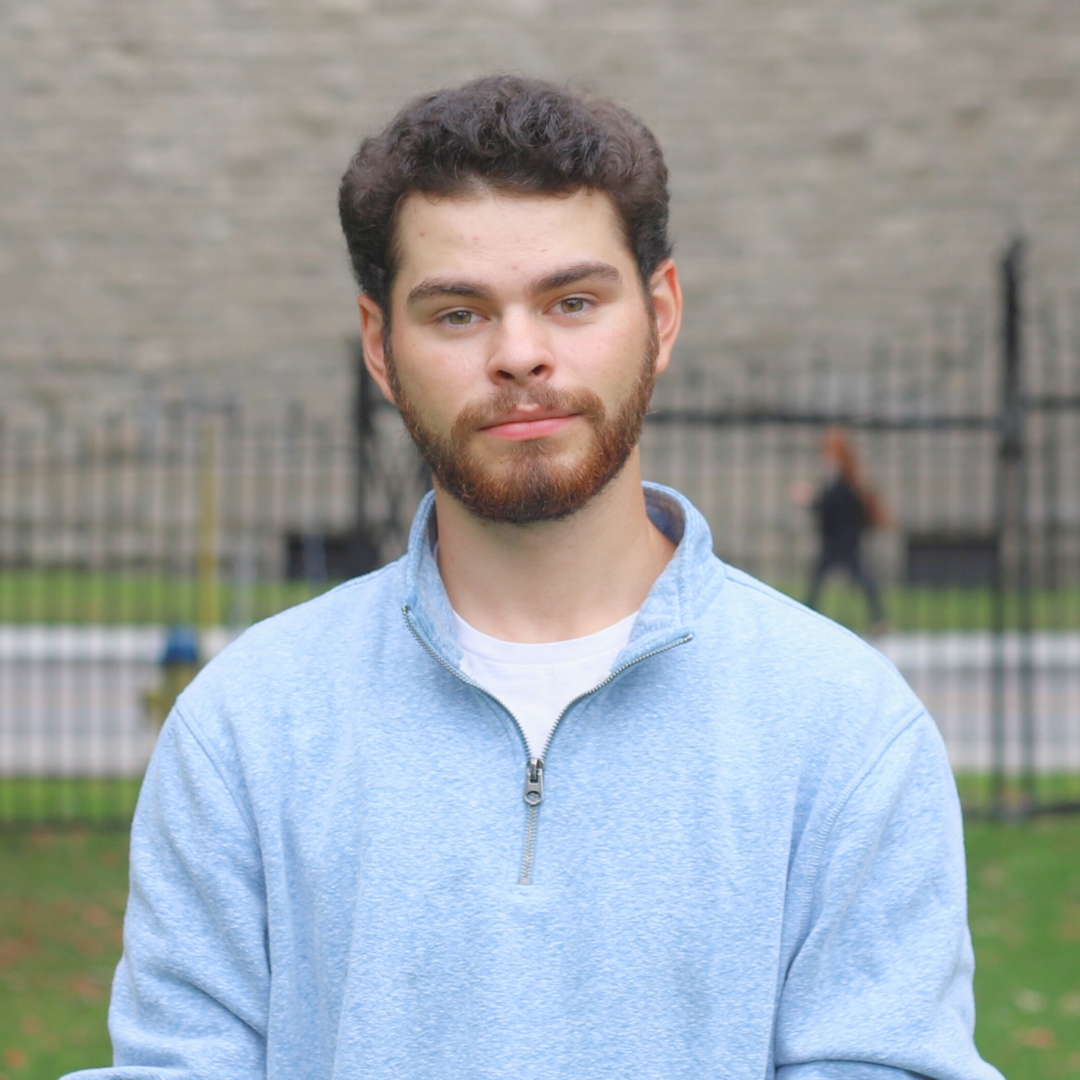
Andrew Wilimek served as Co Editor-in-Chief of the Fulcrum alongside Kavi Vidya Achar for the 85th edition of the University of Ottawa’s independent newspaper after serving as the paper’s sports editor the previous school year.