
Canadian students are getting better grades. That doesn’t mean they’re learning more.
Among the findings presented during the national launch of the Pandemic Learning Loss in Canada report at the U of O was an uncomfortable contradiction: Canadian students are earning higher grades, but standardized assessments suggest their academic skills are not keeping pace.
Published by the Royal Society of Canada, the report synthesizes 15 studies examining student achievement before, during, and after the COVID-19 pandemic. It identified declines in at least some standardized assessment outcomes across all 11 provinces and territories examined, even as teacher-assigned grades sometimes suggested improvement.
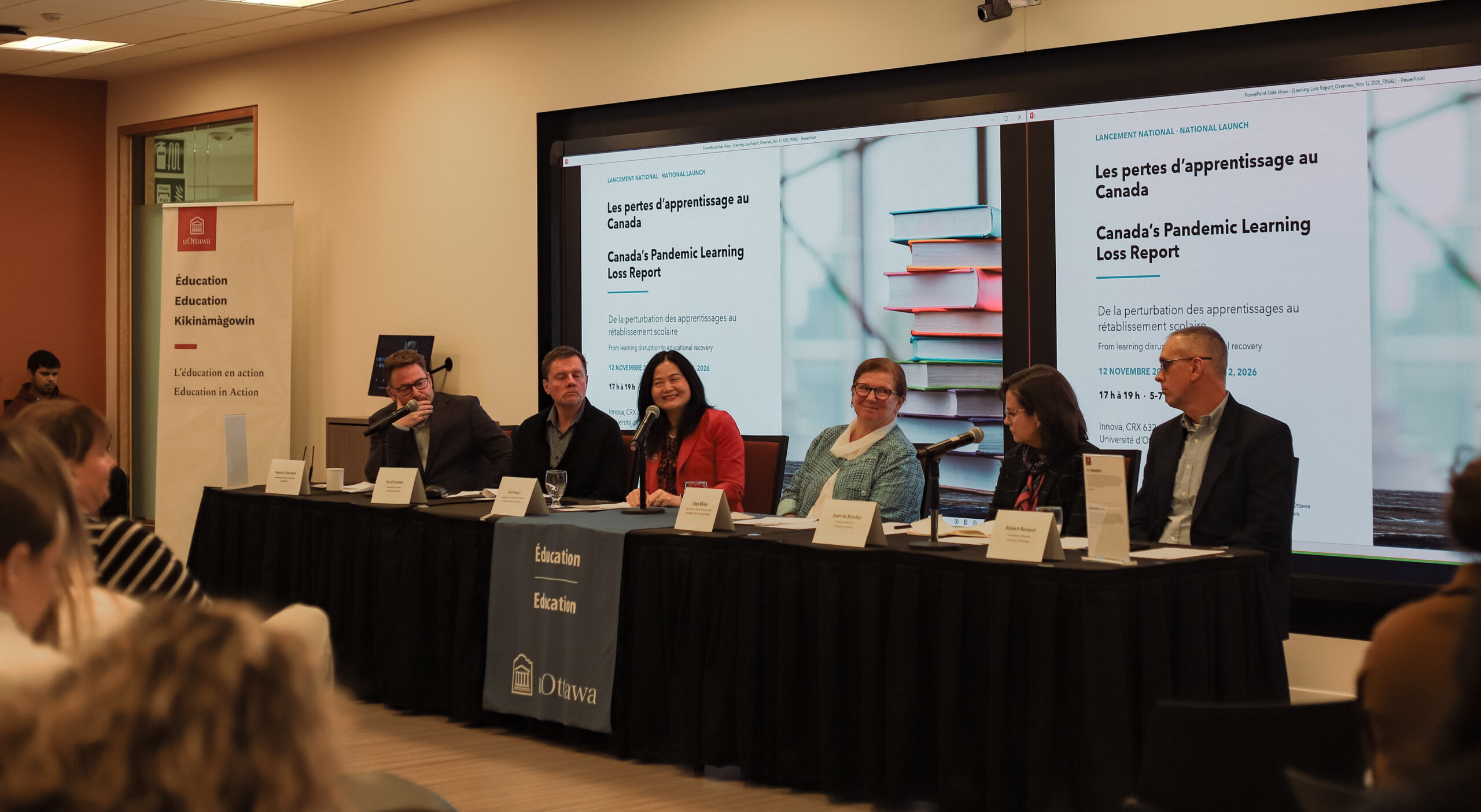
The findings were discussed during a bilingual panel held on the evening of Nov. 12 at the Learning Crossroads building. Hosted by professor and project lead Tracy Vaillancourt and moderated by Pino Buffone of the Council of Ministers of Education, Canada, the event brought together six researchers to examine the implications for educational recovery.
Progress without proficiency
Scott Davies, a professor at the University of Toronto, highlighted the divergence between classroom grades and standardized assessments. “We saw the teacher-assigned grades go up, up, up since, since the pandemic,” Davies observed. Provincial assessments, meanwhile, recorded declines followed by varying degrees of recovery, while international assessments pointed to more persistent challenges. “So I think we’re really measuring three different things,” he explained.
Jeanne Sinclair, a professor at the Memorial University of Newfoundland, drew attention to what these measures actually capture. Classroom grades can reflect participation, performance, and grading practices, while standardized assessments evaluate specific academic competencies under more consistent conditions. “How we measure student performance matters,” Sinclair emphasized. “When parents see those report cards, they take that as a gold standard,” she cautioned. “When universities are receiving those transcripts from the high schools, they’re taking those at face value.” As a result, strong classroom grades may lead parents and academic institutions to overestimate students’ academic preparedness, overlooking gaps in their understanding that become apparent through standardized assessments.
The discrepancy does not necessarily indicate deliberate grade inflation by the teachers. Rather, it exposes a limitation in how academic achievement is communicated. A transcript may document a student’s progression through school without fully conveying their preparedness for what comes next.
The changing landscape of student learning
Although the report primarily examines pandemic learning loss, it also highlights the declining academic scores that predate COVID-19.
Guofang Li, a professor at the University of British Columbia, identified longstanding learning gaps, teacher shortages, and changing student habits as potential contributors. “It’s not a unique pandemic phenomenon,” she noted. Li expands on how digital entertainment influences students’ lack of engagement with reading and classrooms. “Instead of reading, close reading and deep engagement with text, they’re now watching shorts,” she remarked.
Changing attention spans are only one part of the equation, albeit an important one. If students struggle to engage with academic content, the way that material is presented also warrants scrutiny.
Robert Renaud, a professor at the University of Manitoba, placed student engagement at the centre of educational recovery. “Whatever we can do as educators to improve engagement, that’s the bottom line,” he maintained.
The distinction becomes especially consequential as Artificial Intelligence makes it easier to complete academic tasks without necessarily developing the skills behind them. Sinclair raised concerns about cognitive offloading, the delegation of mental tasks to external tools. “Because if we don’t do the thinking, we don’t do the learning,” she explained.
Her observation complicates the relationship between academic output and understanding. An assignment may be successfully completed without requiring the intellectual effort it was designed to assess.
Renaud offered an example of how teaching could address disengagement. He described a student teacher in Manitoba who introduced Shakespeare to a Grade 10 classroom through contemporary music, encouraging students to identify literary elements in familiar songs before applying them to Shakespeare’s work.
Rather than lowering academic expectations, the approach made the material accessible by establishing a connection between students’ interests and the skills they were expected to develop.
Recovery efforts
The distinction between completing coursework and acquiring knowledge becomes particularly significant when students enter university, where foundational skills are assumed rather than retaught.
Tess Miller, a professor at the University of Prince Edward Island, described having to revisit mathematical concepts, including fractions and decimals, in first-year university courses for students. Her experience illustrates a consequence of academic progression without corresponding mastery: gaps that remain unresolved at one educational level become an obstacle at the next.
Addressing those gaps requires more than identifying them. The researchers discussed targeted tutoring, summer learning programs, improved teacher training, and more reliable assessments as possible interventions.
Patrick Charland, a professor at the Université du Québec à Montréal and holder of the UNESCO Chair in Curriculum Development, participated in the discussion of how educational research could inform recovery efforts and classroom practices.
Renaud stressed that the report’s significance would ultimately depend on whether the findings produced tangible improvements. “I hope this report doesn’t just go into a filing cabinet and never again see the light of day,” he remarked. He called for governments and school divisions to translate the findings into practical changes, particularly by directing support towards students most affected by learning loss and ensuring that recovery efforts lead to measurable improvements.
However, the discussion also raised concerns about the responsibility being placed on teachers to address learning gaps created by circumstances beyond their control. One audience member questioned the expectations placed on already overworked teachers to find solutions. Echoing these concerns, Li emphasized the need to “provide better working conditions for teachers so that more people want to become teachers,” highlighting the importance of addressing teacher shortages alongside student learning loss.
The report does offer evidence of widespread learning loss, but its implications extend beyond recovery of academic loss. It challenges the assumption that advancing to the next grade or entering higher education necessarily means students are academically prepared to do so.
The findings leave educators confronting two different measures of recovery: the progress recorded on report cards and the skills students can actually demonstrate.