
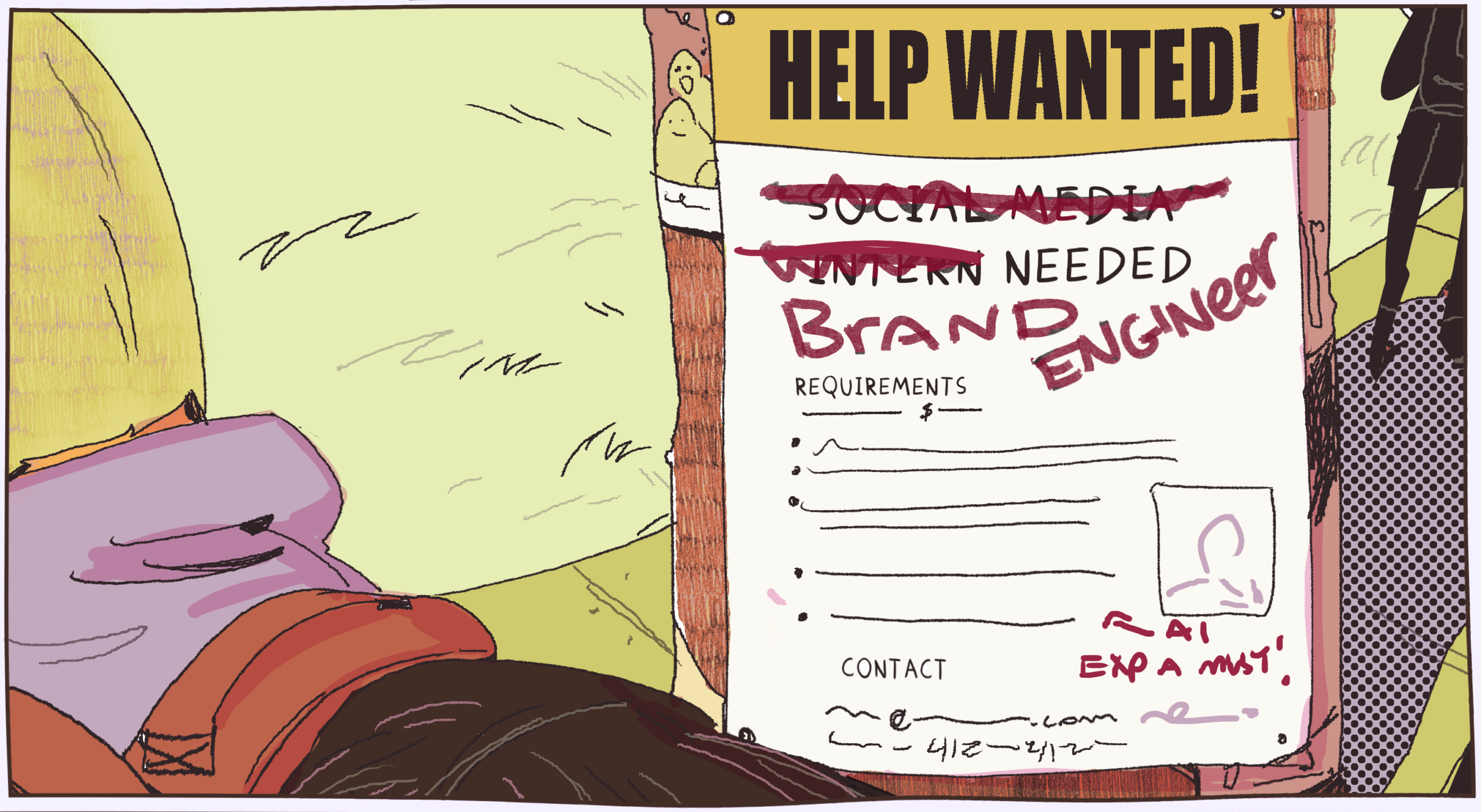
When did content creation become marketing engineering?
If you’ve braved LinkedIn recently, you’ve probably seen the subtle rebrand of social media-oriented roles to “Digital Marketing Specialist,” “Brand Engineer,” “Technical Marketing Engineer,” or even “Social Media Engineer.” Identical requirements and job descriptions for both positions suggest that “engineer” is chosen over “content creator” to change applicants’ perception of the role. I mean, this is marketing we’re talking about.
Remember when clerical programmers became software engineers?
Engineering is traditionally recognized as a male-dominated field associated with wealth and prestige. Even though women’s labour helped the field evolve, these contributions have often been sidelined, readily dismissed as “less technical,” and therefore compensated accordingly.
Fast forward to 2026, content creation is often regarded as an emerging, low-entry, female-dominated field. So, if we’re to take the women programmers of the 1940s (a.k.a. the original software engineers) as any indicator, the gendered dimension of this work will be inseparable from, and crucial for, determining its respectability.
Somewhere between the technical and the creative
At the U of O, marketing doesn’t fall into one specific academic field. Take Telfer and the Faculty of Arts. A Telfer student might learn about consumers through analytics, metrics, and revenue, while an Arts or Communications student might look at the same people through media, culture, and behaviour. They could graduate and end up working on the exact same campaign, bringing different but equally important skills to the table. Yet we tend to treat one side as more technical than the other. That divide becomes even more compelling when gender enters the picture.
According to the sociology professor and University Research Chair in Gender, Diversity and the Professions, Ivy Lynn Bourgeault, the pattern goes beyond terminology.
“There’s a healthy literature on the gendered nature of skill,” Bourgeault said, referring to the way society decides which forms of work are recognized as skilled or less skilled. “Feminization equals less status and money. Masculinization equals more status and money,” she said.
Bourgeault argues that changing the title may only go so far. “You have to also unpack the professions,” She remarked. “A profession may be gendered, but then there may be tasks within a profession that are gendered.” In marketing, this rebranding is relevant when creative and analytical responsibilities are treated differently, even when they contribute to the same outcome. The qualitative contribution of an Arts graduate and the quantitative contribution of a Telfer graduate might be equally important to a campaign’s success, but that doesn’t necessarily mean their expertise receives the same recognition.
Still, the language we use to describe that work matters. “Knowledge is power,” Bourgeault said. Simply recognizing these patterns gives us a reason to question why we value certain kinds of work more than others. As she put it, “language is power” too. Changing the way we talk about a job can change the way people see it. In that sense, language can reinforce these ideas, but it can also help challenge them.
The scope of the job of marketing certainly has evolved. Developments in automation, digital platforms, and analytics introduced technical responsibilities that didn’t exist before. However, this does not necessarily explain why traditionally technical language is increasingly being used to describe interdisciplinary work.
There is something ironic about calling someone a “Social Media Engineer” to make the role sound more serious. The title might help challenge the idea that social media work is easy, but it also suggests that the same responsibilities weren’t considered sufficiently impressive under a different name.
Engineering already carries the professional status that creative and communications-based work has historically struggled to receive. By adopting its terminology, marketing risks reinforcing the very hierarchy it might be trying to challenge.
Does marketing really need to sound like engineering before we recognize the expertise behind it?
Job titles shape more than how we describe a role. They can affect how much we expect it to pay, how seriously we take it, and even who we picture doing the job.
Marketing’s increasingly technical vocabulary tells us about more than an evolving industry. It also exposes the assumptions we make about what qualifies as skilled work, and why expertise associated with traditionally prestigious professions often receives recognition that creative work struggles to earn.