Epitome of curiosity, despite the age
What does it mean to be an undergraduate researcher? This year’s Connecting Young Minds (CYM) conference proved that being an undergraduate researcher requires one thing: curiosity and a desire to contribute.
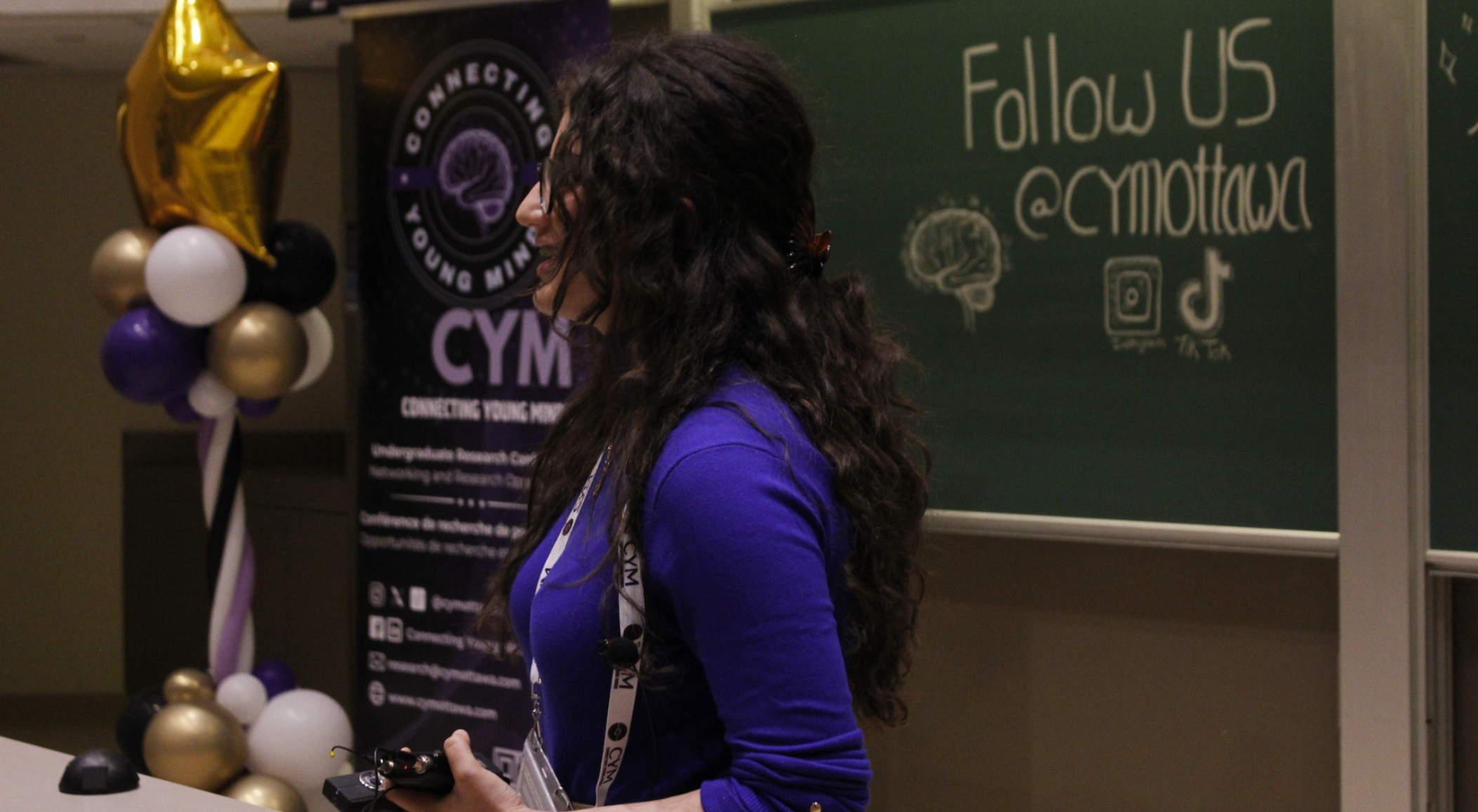
CYM, held on Sept. 26, 2026, at Roger Guindon Hall, provided a glimpse into the minds of the next generation of scientists. With the conference bringing together students from a wide range of faculties and disciplines including engineering, physics, chemistry, biology, and health sciences, the excitement was palpable from the start. The gleam of posters, the lanyards worn with pride, and the participants dressed to the nines spotlighted the stars of the show: the students!
The day-long event included talks by experts in cancer research, organic and inorganic materials, and optics. Dr. Jaclyn Brusso – the first plenary speaker of the day – emphasized that paths don’t need to be linear, and advised students to find mentors and stay curious.
From co-op projects to lab rotations to independent research fueled by personal experiences and motivations, the pathways to research were varied and inspiring. Still, getting your foot in the door was the elephant in the room. The ambiguity of research and the reality of what it entails is a shrouded mystery students often have to navigate on their own. Many iterations of the common advice of cold-emailing were heard at the event, but CYM attendees had unique spins on the age-old tactic.
Ellie Hao is a fourth-year Translational and Molecular Medicine student who began doing research through her third-year lab rotations. Hao showcased her poster on the role of alpha-synuclein in the nucleus in Parkinson’s Disease as part of Dr. Maxime Rousseaux’s lab and credited CYM with sparking her research journey as a first-year attendee. In advising students on cold-emailing, she emphasized that the interest needs to come across:
“How do you show that you really truly care and will put in the work once you’re in their lab, without them knowing who you are, without a prof[essor] knowing anything about you? You have to be able to convey that through your email,” explained Hao.
She also advises that conferences such as CYM is a good opportunity for prospective student researchers to talk to current students doing research while reflecting on if they are excited about the research that others are presenting.
Talia Jarkas is a second-year Biochemistry student with a microprogram in Science Communication who took part in CYM as an independent researcher. Jarkas presented her standout pink poster – which was later voted as the ‘Audience’s Favourite Poster’ award — on the effects of Metformin on Polyendocrine Metabolic Ovarian Syndrome (PMOS) patients. Personal experience got Jarkas interested in this particular topic. For Jarkas, the main barrier that arose when researching was that many studies covered the effects of Metformin on cancer and diabetes patients, but not on PMOS patients.
She said that the main takeaway from conferences such as CYM is learning. She herself did not think undergraduate students could partake in poster sessions. Prior to applying for CYM, Talia joined a student-led-healthcare journal as a Director of Connection, which led her to writing her first paper, which she later submitted to CYM.
While graduate students often get the spotlight when it comes to research, Jarkas expressed that undergraduate students have a lot to offer. She said that even if students don’t think they’re qualified, they should go for it and continue to scour for opportunities through mediums such as social media. In the future, she hopes to take this research into clinical settings to help alleviate the physical symptoms for PMOS patients.
“All of us are capable of pursuing research and doing science,” said Jumana Al-Karkhi, a second-year student in Biomedical Science with a minor in Biophysics. “As long as you’re curious and you love to learn, you shouldn’t have imposter syndrome here.”
As one of the top five research posters at this year’s CYM, Al-Karkhi and her partner Sarah Munsser presented their neuromechanical research on the glymphatic system in the hopes of slowing down disease progression such as Alzheimer’s. The project proposes a gravitational brain pump to enhance glymphatic clearance while sleeping. Al-Karkhi’s love for biophysics and their shared love of the nervous system and medical technologies was the origin for the project. Karkhi mentioned that in preparing their project, finding literature was difficult because this had never been done before. The duo reached out to Dr. Armen Saghatelyan in the Faculty of Medicine for feedback on their work ahead of CYM.
Al-Karkhi expressed that given that this is a very meaningful topic, she hopes to pursue this further with Munsser and potentially pursue graduate studies in this field.
Jonathan Robinson, a third-year Physics student who got started in research through a co-op opportunity, highlighted the importance of going to poster sessions, asking questions and being open to feedback. Robinson’s project on light-matter coupling and its impact on controlling organic materials as part of Dr. Jean-Michel Ménard’s lab was a learning opportunity. After emailing professors, Robinson was invited to group meetings and subsequently had opportunities to present his research through poster sessions.
Similarly, Maggie Divok, a fifth-year health sciences student and the Director of Marketing at this year’s CYM, said that being able to present your research is a key part of being a researcher. She explained that as the future of science, students need to be able to do all aspects of research. Divok emphasized that while these types of events can help you get your foot in the door, it is partially up to the students to open that door.
“It might not be you now, but it can be you in the future,” said Divok.
Staying true to CYM’s motto of supporting student research, each year CYM includes select abstracts from the conference to be featured in the Undergraduate Research in Natural and Clinical Science and Technology Journal (UNSCT). Abstracts from CYM 2025 can be found on the UNSCT website.