“The Lansdowne rebuild is being crafted to make whole a private sector entity to the detriment of the public interest”
Five years after Ontario Sports and Entertainment Group (OSEG) realized the Lansdowne 1.0 partnership would never turn a profit, a 15-10 vote at city council on Nov. 7th, 2025, has made Lansdowne 2.0 a reality. The millions in taxpayer dollars and city debt being funneled into the project are raising alarms for students about the city’s priorities.
What happened to Lansdowne 1.0?
Lansdowne 1.0 was a public-private partnership (P3) created in October 2012 to revitalize Lansdowne Park. This original contract placed the majority of the financial risk on a private entity, OSEG, rather than the city. With negative cash flows during the COVID-19 Pandemic varying between $2.5 million and $12.7 million, this financial risk manifested as the possibility of OSEG defaulting.
Sean Moore, the Director of the Lansdowne Park Redevelopment project, shared in his report to the Finance and Corporate Services Committee: “The City cannot assume that OSEG could or would continue to contribute to the partnership without a reasonable expectation of being able to achieve financial sustainability. In the meantime, the City has benefited greatly from Lansdowne 1.0.”
Lansdowne 2.0 shifts significant financial risk to the city. While the project is officially valued at $418.8 million with an estimated net investment of $130.7 million from the city, a report by Ottawa’s auditor general (OAG) finds these figures may understate costs by upwards of $100 million. Under this new contract, the city is responsible for covering any unforeseen costs. Additionally, the OAG notes, “if expenses are higher than projected in the short term, it will have a compounding effect over the life of the Partnership Agreement.”
When asked why the contentious proposal has been moving forward at city council, Kitchissippi Ward city councillor Jeff Lieper told the Fulcrum, “There’s a lot of uncertainty involved in the potential dissolution of the Lansdowne partnership, and I think the inertia that has been established through the decade of Lansdowne 1.0 is such that it’s difficult not to move forward for a lot of my colleagues.”
A city divided
Supporters of the development, such as the Ottawa Board of Trade, have described Lansdowne 2.0 as a “catalyst for job creation, small business growth, visitor attraction, and urban vitality.” Prominent critics such as Horizon Ottawa and Capital Ward councillor Shawn Menard argue the project depends on uncertain revenues and misallocates public funds for private means, all while producing no tangible benefit for the majority of Ottawans.
Diversion of dollars
When asked how Lansdowne 2.0 would affect students, councillor Leiper told the Fulcrum, “It’s about the diversion of dollars, that indirect diminishment of the city’s ability to help students in the areas where the municipal government has responsibilities to help.”
$17.4 million in unencumbered tax dollars will be allocated to annual payments of the Lansdowne 2.0 debt over the next four decades. Leiper says this money “would go a long way in filling the hole in OC Transpo’s operating deficit.” Adding that, “We’ve always told folks we don’t know how we’re going to pay for affordable housing and transit without raising taxes, now, without raising taxes, we’re taking a portion of taxes that people do pay and putting it towards Lansdowne 2.0.”
The Student perspective
The president of U of O’s undergraduate student union (UOSU), Jack Coen, says that as students, “our tax dollars come second.” Coen notes students are being dismissed at the municipal level despite going through the proper democratic channels, because “council knows that Sandy Hill students are largely transitory.” He identifies a vicious cycle where an “out of touch city government that has no feelers for how it will ever win back, or show up for, young people in the city”, is signalling to students that after graduation, they should, in fact, look elsewhere.
UOSU advocacy commissioner, Alex Stratas, highlights that “we have a lot of power as students, and if they invested in us right, we could bring a lot of power to the city.” Stratas explains Lansdowne 2.0 is “a conversation between corporations and private industry, versus what the public wants and the public needs.”
A donation tracker run by Horizon Ottawa reveals 13 in 15 City councillors in favour of Lansdowne 2.0 accepted private developer contributions in the last municipal election. In contrast, 1 in 10 of City of Ottawa councillors who voted against Lansdowne 2.0 accepted private developer contributions.
Stratas shared that “everyone’s really confused as to why this is happening. And if you’re confused, look at where the money takes you.”
There will be no affordable housing
The sale of air rights to Mirabella Development Corporation for the construction of two residential towers with 770 units at Lansdowne is projected to generate $14.4 million for the affordable housing reserve. Councillor Leiper notes that “a location like Lansdowne Park would be an ideal geography in which students could live, but the mayor is more inclined to maximize the value of property sales and put that housing elsewhere.”
Coen says “to see the 770 units dangled as a silver lining to students, is very disingenuous when that money could have been spent on affordable housing options in the inner city, transit, etc.” Adding, “With half a billion dollars, you could build a lot more housing than 800 units.”
Drawing on a recent UOSU survey, Coen highlights the correlation between a lack of affordable housing and food insecurity. At a time when 42% of U of O students are somewhat food insecure, Coen says, “42% of UOSU Food Bank users are spending over 70% of their income on housing.” Given the severity of crises afflicting marginalized groups across the city, students are disheartened by the city’s priorities.
Rising ticket costs: “Who are we building Lansdowne for?”
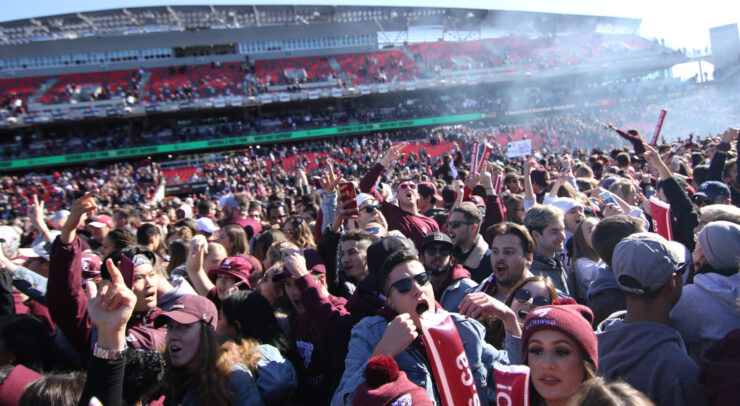
With 3000 fewer seats in the new stadium and a ticket surcharge on the way, the Lansdowne redevelopment is likely to impact students in one other way: the Panda game and the Colonel By Classic. Noting how ticket prices have skyrocketed in recent years, Coen says that “seeing the city take a step in the other direction, really sends the message that students are taking the back seat in the mind of the city council.” Similarly, councillor Leiper commented that “the ticket surcharge, combined with the lower number of seats, has a lot of us wondering who we are building Lansdowne for.”