‘ERICA RUTHERFORD: HER IVES AND HER WORKS’ DEMONSTRATES THE IMPORTANCE OF ARTISTIC SELF-EXPRESSION IN THE LIVES OF LGBTQIA+ INDIVIDUALS
The National Gallery of Canada hosted the ‘Erica Rutherford: Her Lives And Her Works’ exhibition from Jun. 13 to Oct. 13, 2025, recounting the life of the British Canadian multidisciplinary artist. The exhibit housed “over 100 works” in her catalogue, ranging from sculptures, children’s book illustrations, to ‘African Jim,’ the first all-Black cast in a South African film she produced.
Her extensive career had captured the attention of many museum-goers, including myself, with her distinctive, “hard-edged,” and simplistic imagery. However, what caught my eye was the depiction of her relationship with her queerness, notably, her gender identity.
Rutherford’s early works are coated with themes of “bodily and sexual repression,” as she maneuvred within her gender dysphoria, using “dream-based figures as images of inner-torture,” in her paintings and describing her acting performances like “an elaborate system I created to disguise the fact that I had no part to play in my life because I felt so divided from within.”
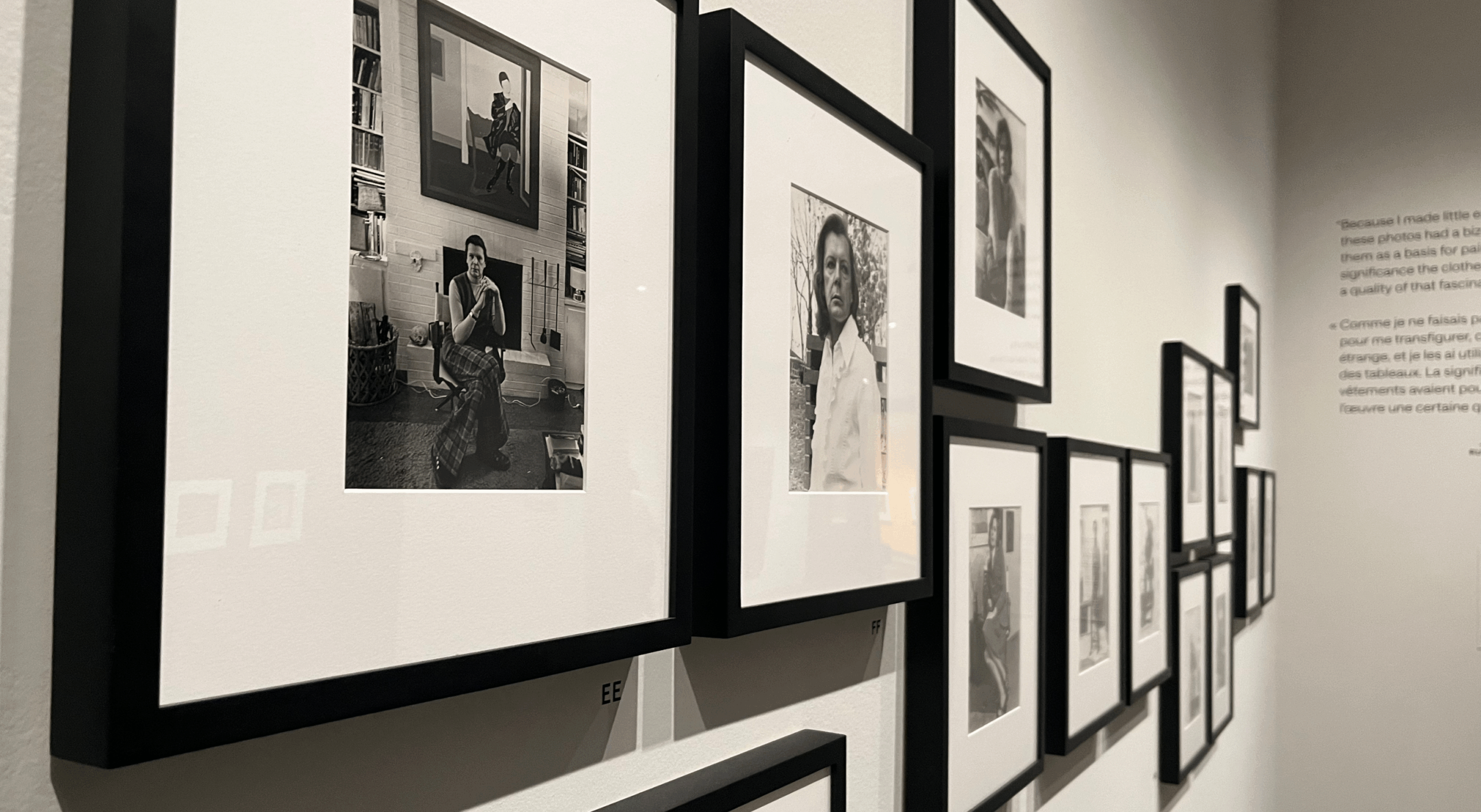
Throughout the 1970s, Rutherford’s art pieces shifted in tone as she started experimenting with her gender identity. Using photography, she took self-portraits of herself wearing women’s clothing, later using them as the base of many “featureless figures” in her paintings. Through her pieces, she was able to process her gender dysphoria by embodying her queerness in alternative ways.
Zachary D. Van Den Berg, the author of “Addressing traumatic experiences of cis-heterosexism with LGBTQIA+ clients in art therapy,” explores the influence of artistic expression for LGBTQIA+ individuals, stating that this outlet directly challenges cis-heteronormative beliefs, replacing them with “affirming pathways” towards self-acceptance. Artistic expression helps LGBTQIA+ individuals “expand their visual vocabulary beyond cis-normative constraints,” to explore their identity without social repercussions.
A direct quote from Rutherford found in the exhibit described the awkwardness she felt when she tried to wear women’s clothing. But through her art, she was able to “use this form of expression in a more positive way […].” In other words, she was able to express herself in a manner that affirmed her lived experience, rather than demonizing it.
Dakota Salva, the coordinator for U of O Pride Centre, reinforces this statement, describing art as a communication tool for expressing oneself when words are hard to find. As she is a queer artist herself, she understands the importance of art co-existence within queer lives, as it expresses the ability of “portraying [diverse] perspectives [within] our community[…].”
Salva also uses her art pieces to propose “an open-ended question” to whoever engages with it, challenging societal preconceptions of what it means to be queer, including religious belief systems. Her questioning of these norms affirms her authentic existence and encourages individuals to reconsider oppressive norms.
Exhibitions like Erica Rutherford’s are crucial in promoting and showcasing queer embodiment, not only for acceptance but also for celebration, especially within our current political climate.
Despite Canada’s efforts in protecting the rights of LGBTQIA+ persons, provinces such as Alberta and Quebec have attempted to establish regulations, banning the use of pronouns such as “iel (they)” and other gender inclusive terminology within the education system, the healthcare system, and “all government ministries, organizations, and municipalities,” as well as excluding transgender girls in “amature female sports.”
I applaud the National Gallery of Canada for hosting this exhibit, and I am hopeful that others featuring intersecting marginalized voices may jump-start an important conversation around our need for restrictive social norms.