
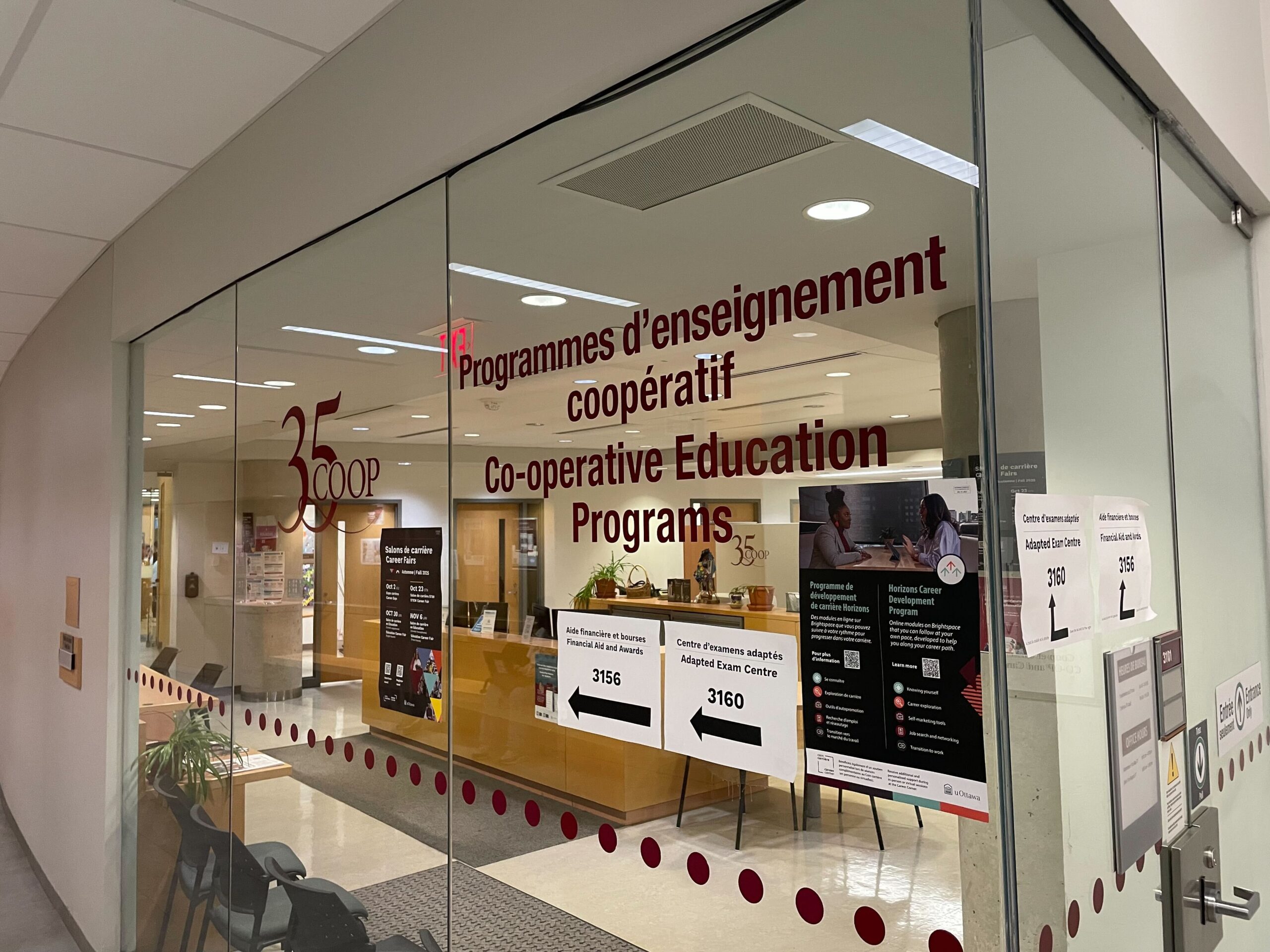
University acknowledges trouble in the co-op program during economic downturn
Across Canada, headlines have been dominated by youth unemployment and the summer job drought. Stories follow students applying to hundreds of jobs and finding nothing. It has also entered the political world with politicians like Doug Ford are telling students to ‘look harder’. For co-op students at the University of Ottawa, looking harder often didn’t matter.
The U of O’s co-op program, which, until 3 weeks ago, prominently boasted its 90 per cent placement rate, has become a sore spot for students; for most co-op students, this was a summer of unemployment.
In a statement to the Fulcrum, University of Ottawa spokesperson, Jesse Robichaud, acknowledged that the co-op program was experiencing difficulty. Approximately 3 200 students are enrolled in the co-op program each term, but that “…the summer 2025 term reflected a considerably more challenging job market” citing that only 1,511 students successfully secured placements.
If accurate, this represents an estimated placement rate of less than 50 per cent this summer. That is an abject failure for the program this summer in finding student jobs, and a sharp drop from the 90% previously claimed placement rate.
Context
In May, the unemployment rate for students reached 20.1 per cent. Excluding the pandemic, this is the highest it had been since 2009, more than double the national unemployment rate. Across the board, employers were hiring less, driven by economic instability like the tariffs, a decrease in spending overall, and political turmoil with an election happening resulting in hiring freezes in the federal service during much of the co-op hiring season. In July and August, the Canadian economy shed over 100,000 jobs, primarily in entry level positions, often the jobs that co-op offers.
On top of this, the amount of time young people spent looking for a job nearly doubled. The Canadian Centre for Policy Alternatives observed that the average time 20 to 24 year olds spend in between jobs went from 10 weeks in 2019, to 17 weeks in 2025.
In Ottawa, one of the leading causes of co-op students’ difficulties finding jobs is the current hiring freezes in the public sector. This was a result of Federal Finance Minister François-Philippe Champagne’s 15 per cent saving request for all ministers. As a result, youth employment in the federal public service recently hit a new low of only 13 444 dropping from 16 798 in 2024.
Sahir Khan, executive vice president of the Institute of Fiscal Studies and Democracy, and former Assistant Parliamentary Budget Officer noted that the hiring freeze was a result of the Liberal election platform and changing social expectations.
Student Experience
Jeremie Gorman, a fourth-year student in public administration, had never had trouble finding a job before during co-op. Normally, Gorman would apply to 15-20 jobs and be invited to around seven or eight interviews. But this summer, in his last co-op term, he applied to over 30 jobs through the co-op portal, and had a handful of interviews.
At one point Gorman asked to meet with the administrators of the co-op program to understand if he was doing something wrong, or if he was just a bad candidate.
Gorman claims that the co-op staff at the U of O told him that there was as much as a 50 per cent reduction in jobs offered through the co-op program in some majors, while across the board, a 40 per cent reduction was felt on average. “They even mentioned that it was up to 40% of their government jobs … that were no longer available compared to previous co-op terms.”
In the end, he was lucky enough to find a job through his own network, but not without considerable stress and effort.
Other University of Ottawa students weren’t as lucky.
Benjamin Colsante is a second-year software engineering student, a program which includes a mandatory co-op placement. This has historically been a major boon to the program and students alike, providing students with real world hands-on experience in the industry they wanted to work in.
“I had a professor tell me that [before this year] he’s really never met anyone who hasn’t gotten an internship, who’s had a CGPA of 8.0.”
Despite having a good CGPA, being engaged on campus, having various computer science projects behind him, and applying to over 300 jobs in both the private and public sector, Colsante was unable to find any job with the co-op program. He said the experience was similar for his friends: “I would guess about half the people [in my program] did not get an internship this summer. So yeah, it’s hard to tell, but most people I know didn’t get anything. But I do have friends who have met a few people that did get something.”
For other students, this summer wasn’t a unique experience. Leen Demyati, a fourth-year international student studying international development and globalization, has always found it difficult to find a co-op job. “[The co-op program] provides you with stats like if you apply for 10 jobs I believe you get one interview per 10 jobs, but those stats did not reflect international students.”
“I know there’s a recession, but even when I first started, which is around like 2022, [those statistics were] not a reflection of the international student experience.” Ultimately Demyati dropped out of the co-op program after failing to find a job in the program.
Matthew Yorke Gambhir, a fifth-year political science student, was able to find a co-op job after applying to over 100 jobs. Despite having over a year of work experience, he said it felt like none of the experience, his resume, or interview skills mattered and that he was back at square one.
Something Yorke Gambhir and numerous other students told the Fulcrum about was having interviews cancelled because the employer decided not to fill the position, and how demoralizing it was.
“If you put too much work into your application you might see that go up in smoke in the current state of things.” Yorke Gambhir said.
Yorke Gambhir, who had wanted to become a public servant after graduating, said it felt like young people were always “first on the chopping block” when there was economic difficulty.
Max Brazier, a fifth-year political science student, was also told that jobs he applied to were not going to be filled. Brazier said that two years ago he had over eight interviews; this time he had one.
“I went to one of the co-op drop-in things to help you get a job but it was mostly talking about interview tips and stuff.” Brazier said “…I didn’t get any interviews, so they weren’t much help.”
After applying to over 100 jobs, he was unable to find a co-op. He told us that basically everyone he knew either didn’t find a job, went back to their old jobs, or dropped out of the program entirely. “The economy is bad; the co-op program is bad.”
In the statement the University provided the Fulcrum, they seemed aware of these struggles, saying “…employers are offering fewer positions per posting and are increasingly selective in their recruitment.”
Formerly, students would apply through a University of Ottawa operated portal, but increasingly students were having to jump through hoops, and apply through distinct and privately operated hiring portals. “Many [employers] are also centralizing their hiring processes through their own platforms, which requires students to diversify their job search strategies beyond traditional postings on university portals.” Robichaud said.
“We recognize that this slowdown in the job market has created added stress and uncertainty for students, and we continue to seek out solutions and partnerships to support them in achieving meaningful work experience,”
Students broadly said that the co-op office and staff were nice, supportive, and doing as much as they could.
“The co-op office is, like, they’re very helpful, they’re nice, but they’re doing as much as they can.” Colsante said, “I guess to summarize, really, the job market isn’t great.”
What’s Next
Khan was concerned that these hiring freezes would lead to an older and less versatile public service. “This is actually the real challenge for the Federal Public Service, how do you rebalance in a way that allows young people to enter and renew the Federal Public Service instead of just relying on seniority.”
He said the University needed to be doing a better job of making the case to the federal public service that the co-op program was invaluable.
“[Co-op students] can take some of the tools they’ve picked up already, learn something from within the government department they’re working at, and … ensure that they’re … linking the things they study in class to what they’ve actually learned in the workforce…”
“That feedback loop is really critical. And it’s kind of a unique feature of co-op programs. It’s the type of thing that you would expect maybe the head of the U15 and others to maybe start to bring to the attention of the clerk of the Privy Council (Michael Sabia).”
To their credit, Robichaud acknowledged advocacy to the federal government saying:
“The Co-op team maintains active engagement with employer partners, including the federal government, to advocate for student hiring as a strategic investment in future talent. Even in difficult times of fiscal restraint, the program emphasizes to employers the importance of succession planning and the value students bring to the table. The program continues to be focused on empowering students to take ownership of their Co-op journey through networking, strategic applications, and leveraging all available tools to succeed in a more selective market.”
As the economy slows down, students facing graduation are beginning to wonder if their experience with the co-op program is unique. “Is this what the future is going to be like? Is that just, what it’s going to be like after graduation?” Brazier said.
Colsante, who still has a couple years left to graduate, had some advice for fellow students: “I guess just, we just have to keep trying, really. We just have to keep applying, even if it takes 300, 400 job applications.”