
Volume 49 – Issue 9 – Nov. 3, 1988
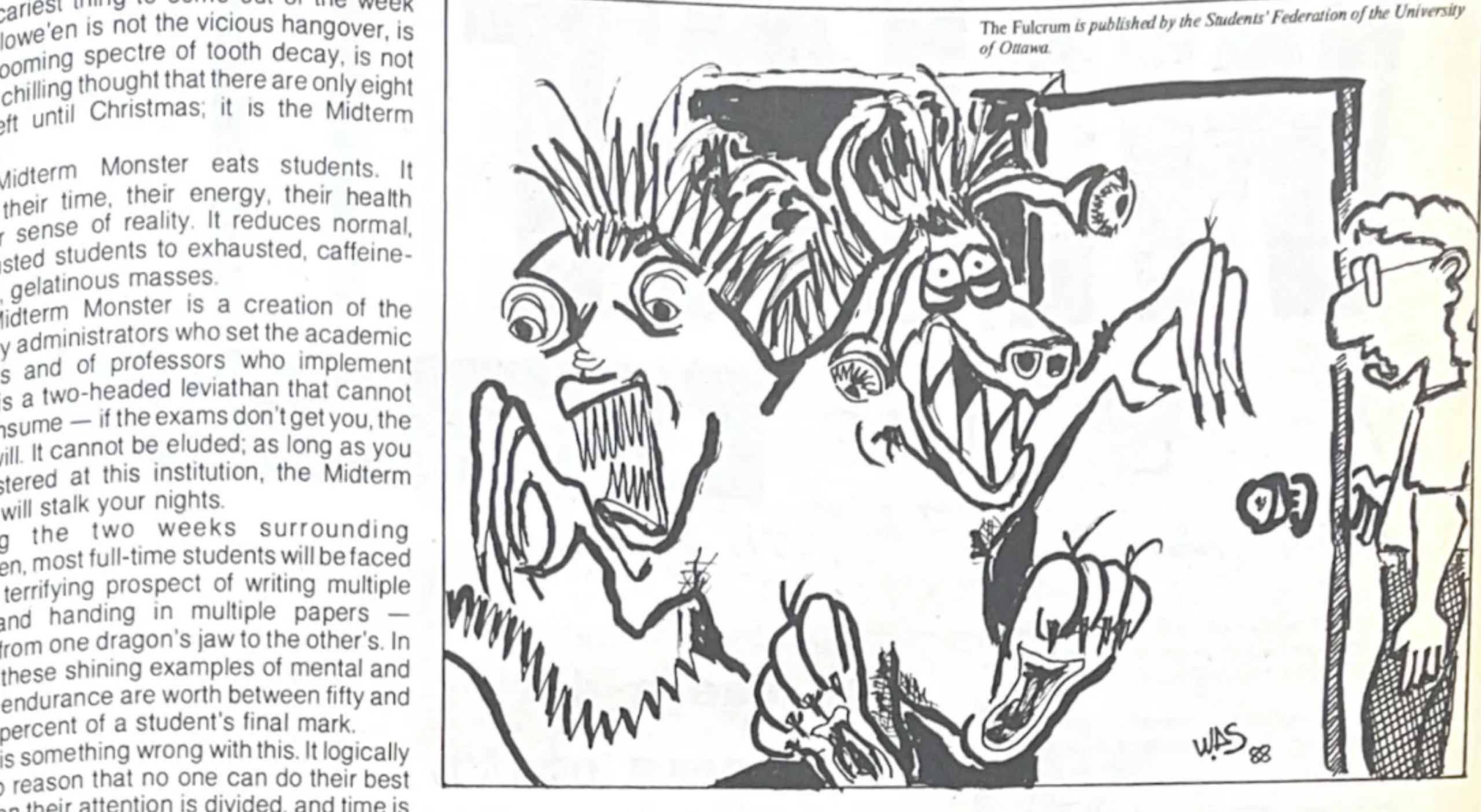
The scariest thing to come out of the week after Hallowe’en is not the vicious hangover, is not the looming spectre of tooth decay, is not even the chilling thought that there are only eight weeks left until Christmas; it is the Midterm Monster. –
The Midterm Monster eats students. It detours their time, their energy, their health and their sense of reality. It reduces normal, well-adjusted students to exhausted, caffeine-addicted, gelatinous masses.
The Midterm Monster is a creation of the University administrators who set the academic standards and of professors who implement them. It is a two-headed leviathan that cannot fail to consume – if the exams don’t get you, the papers will. It cannot be eluded; as long as you are registered at this institution, the Midterm Monster will stalk your nights.
During the two weeks surrounding Hallowe’en, most full time [sic] students will be faced with the terrifying prospect of writing multiple exams and handing in multiple papers – jumping from one dragon’s jaw to the other’s. In the end, these shining examples of mental and physical endurance are worth between fifty and seventy percent of a student’s final mark.
There is something wrong with this. It logically stands to reason that no one can do their best work when their attention is divided, and time is tight. Research papers which should demonstrate the student’s ability to do insightful research on a subject and end up giving insight only into how many other papers the same student has had to write. Too often, papers get thrown together at the last possible second – with coffee and prayers. Studying for exams has delayed their beginnings, and the necessity of typing makes the time even tighter for students without a computer who usually need at least one write draft. You can’t move a paragraph on a 1973 Smith Corona manual typewriter!
The system seems designed more for the convenience of the professors than for the students. It does not promote learning, which is ostensibly the reason we’re all here. We accept it because it has always been that way, but that doesn’t make it right.
It is not solely the fault of the professors, who are not encouraged to explore alternate forms of evaluation, and to whom they have probably never occurred. It is not solely the fault of the administrators, who are merely trying to ensure that a student’s evaluation is based on more than just a final exam. It is partly the fault of the students, who, rather than trying to find feasible alternatives, continue to complain, year after year.
No system is perfect, but there has to be something better than this. Any ideas?