Volume 61 – Issue 10 – Nov. 2, 2000
The media may be portraying it as a two-way fight, but the race for mayor of the new megacity is being contested by nine candidates of various backgrounds and ages.
The Fulcrum contacted all the candidates to get their position on youth issues in Ottawa, so U of O students can make a more educated choice on Nov. 13, the date of the municipal election.
Marc-André Bélair, an 18-year-old first year political science student at the U of O and mayoral candidate, doesn’t expect to beat the two front-runners, Regional Chair Bob Chiarelli and Gloucester Mayor Claudette Cain, but believes he can offer something different as mayor – vision.
Bélair’s vision for Ottawa youth includes a website linking young people to community groups and events.
“Young people are getting involved in politics and their communities,” said Bélair. “I think one of the misnomers is that young people cannot get involved because they’re not grown up.”
Cain, mayor of Gloucester since 1991, released a three-point plan for youth in September that she says will give young people a stake in Ottawa. Most notably, Cain would establish a mayor’s youth advisory committee and a youth jobs hotline connecting students with employment opportunities in the city.
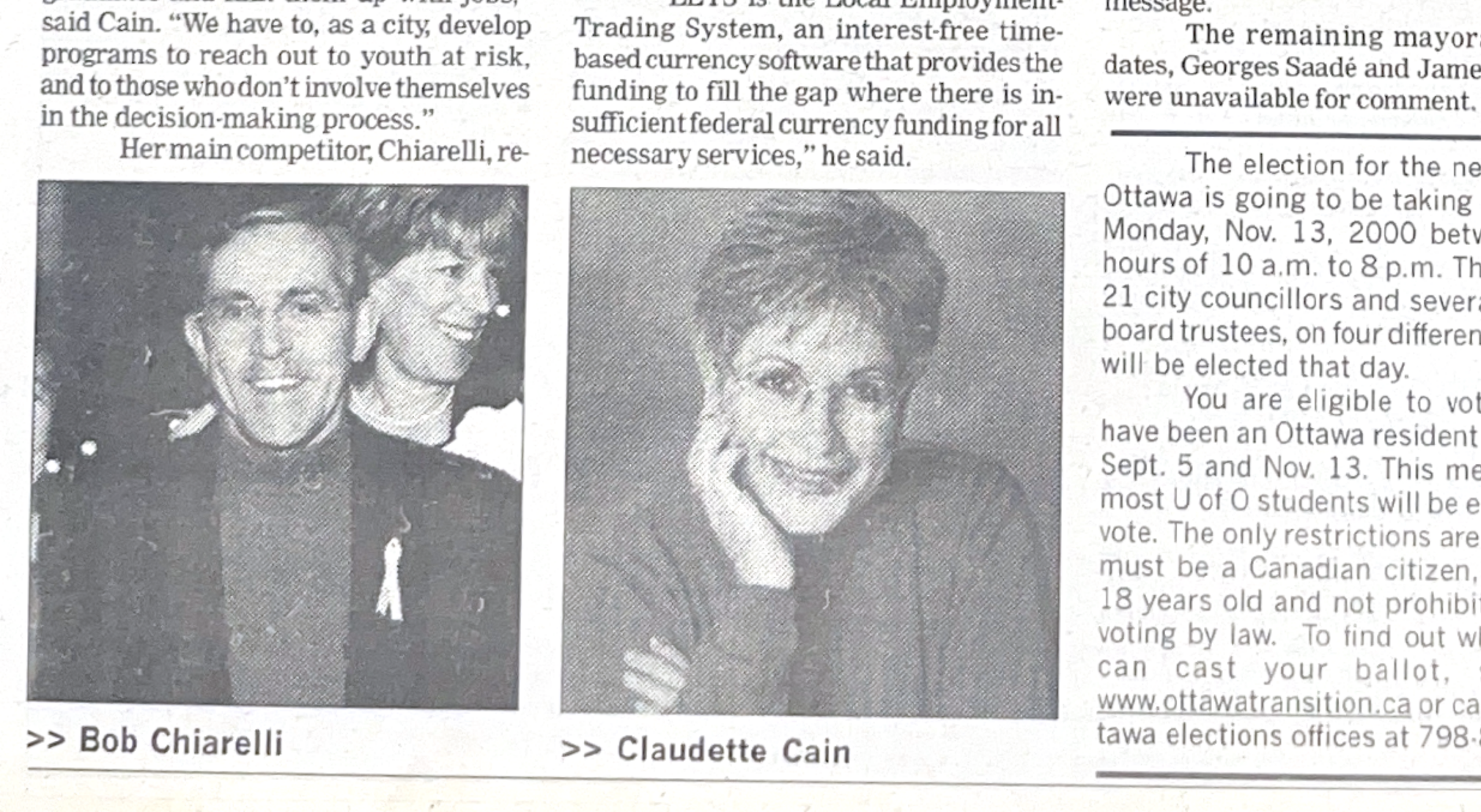
“[We have to] market Ottawa to graduates and link them up with jobs,” said Cain. “We have to, as a city, develop programs to reach out to youth at risk, and to those who don’t involve themselves in the decision-making process.”
Her main competitor, Chiarelli, regional chair since 1997, also has a policy on youth. The central plank of his platform is the creation of a $50, 000 fund to be distributed by youth to youth programs on a project-by-project basis.
“My philosophy is to not spoon feed youth, it is to let them take a leadership role,” said Chiarelli. “Youth should be active, animated and involved, and we’re prepared to resource them to do that.”
Contrary to Chiarelli and Cain, Paula Nemchin, a Gloucester resident and mother of five, is a political newcomer campaigning on three main themes.
“I’m in here to put some integrity back into the city, because we did have it at one time, [to oppose] declaring Ottawa officially bilingual, that’s a no no for me, [and to] save the students so that they can have a voice,” Said Nemchin.
Although she had no specific plans on youth issues, Nemchin insists she will bee a strong advocate.
“I will back up youth 100 per cent anywhere,” she said.
Dr. Morteza Naini, a civil engineer, believes his platform has two proposals that would benefit students in Ottawa.
“It’s a very nice platform for all you students. It’s a beautiful plan,” said Naini. “I want to have tax cuts for anyone training as students or anything else.”
He also plans to establish a program that will provide summer jobs for students in their field of study.
Unlike Nemchin, John C. Turmel is no stranger to the electoral process. He has run in 51 elections across the country and has yet to come out victorious. In all previous campaigns, Turmel has run on a platform promoting the LET system, which he helped design.
“LETS is the Local Employment Trading System, an interest-free time-based currency software that provides the funding to fill the gap where there is in-sufficient federal currency funding for all necessary services,” he said.
According to Turmel, LETS is an alternative to the traditional monetary system, which Tyrmel says can be blamed for most of the problems young people face today.
“Interest is terrible. It’s robbery! It’s stealing from the poor and giving it to the rich,” he explained.
The U of O’s Bélair is not the only student letting his name stand for the mayoral position. Kem Mills, a second-year Carleton political science student, is running to bring progressive social issues to the forefront. His major concerns are the sharp increase in homelessness and “other social issues.”
“In terms of youth issues I don’t have any comment on that,” said Mills.
“However, I would like to bring really, really cheap transportation to students enrolled in full-time programs, you know, like, free.”
He is trying to run a campaign that is different from that of his opponents. He claims that instead of using traditional means of communication like signs debates and canvassing, he is going to convince people one-on-one.
“What I’ve [sic] spent so far? A big fat goose egg, I didn’t really raise any money for my campaign,” explained Mills. “I’m not very good at public speaking and I’m not very good at debating. I’m taking more of a philosophical approach to my campaign. No, I haven’t been attending the debates and I’m not going to.”
Most of the candidates lack the financial resources of Cain and Chiarelli and are faced with budget constraints that do not let them communicate as effectively.
Bélair thinks that a candidate’s work should not be determined by their bank account.
“One part of the message I’ve been bringing forth as a fringe candidate – I hate that term – is that the message I’m bringing forth is stronger than my opponents’ advertising budgets,” he said. “I can’t afford the signs and brochures, but even if I could, it would be against my message.”
The remaining mayoral candidates, Georges Saadé and James A. Hall, were unavailable for comment.