
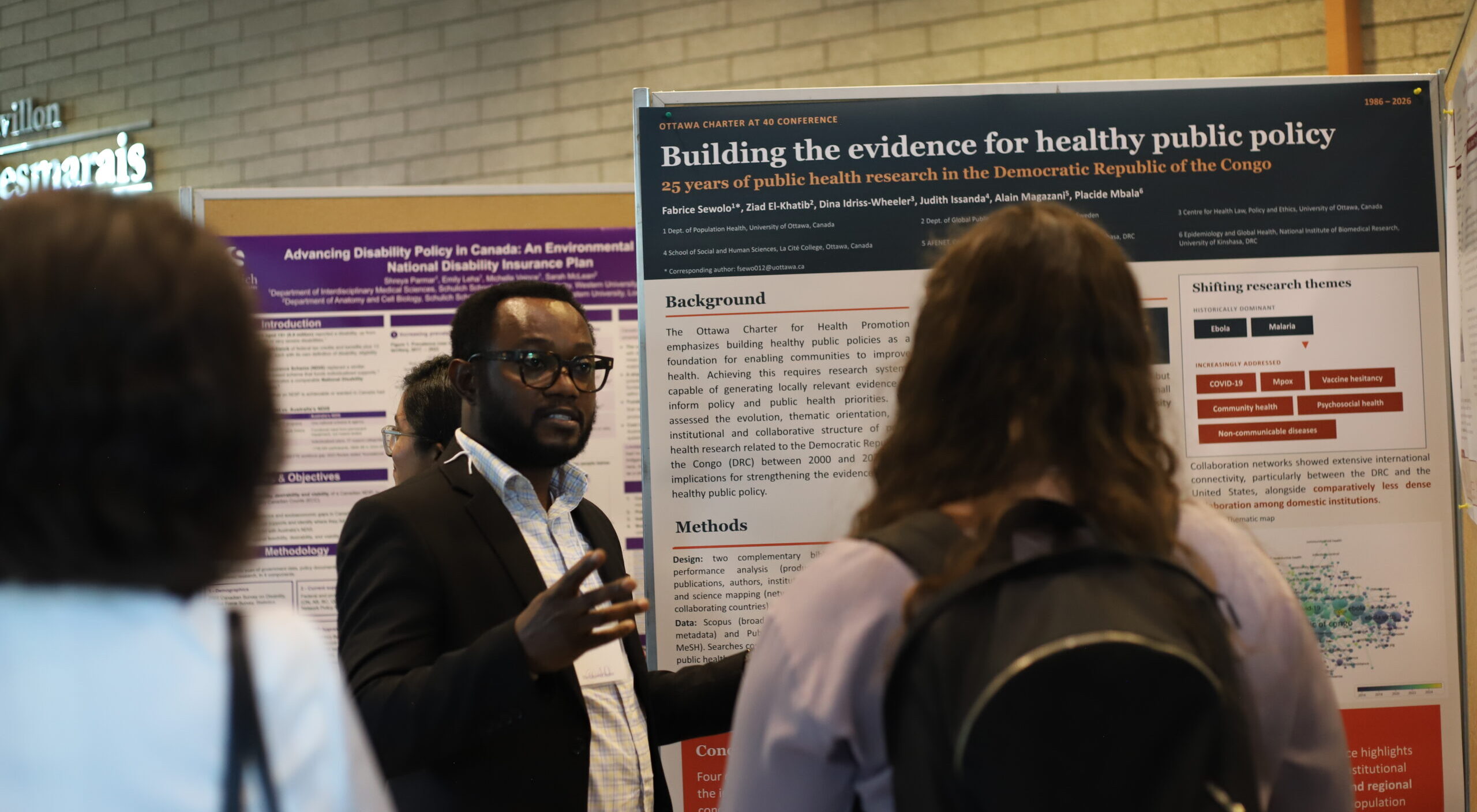
The Health Promotion, Equity and Rights conference brought together experts and paved the way for the next generation of health changemakers.
The Ottawa Charter, often referred to as a landmark document for health promotion, outlined five key pillars: build healthy public policy, create supportive environments, strengthen community action, develop personal skills, and re-orient health services. The Charter, which was first introduced at the first International Conference on Health Promotion in Ottawa in 1986, included action areas such as empowering communities by providing continuous access to information, assessing the impact of environmental factors on health, and opening the channels of communication between the health sectors and the political, social and economic sectors which ultimately affect health.
The two-day event hosted by Centre for Health Law, Policy and Ethics (CHLPE), brought together public health experts, including Canada’s new Chief Public Health Officer, Dr. Joss Reimer, and Dr. Evelyne de Leeuw, Canada Excellence Research Chair for One Urban Health at the Université de Montréal. Experts from institutions from across the world explored emerging health challenges such as information as a determinant of health and the use of AI in healthcare. Among them were the University of Geneva (Switzerland), University of Groningen (Netherlands), Institute of Tropical Medicine (Belgium), and Georgetown University (United States) explored emerging health challenges such as information as a determinant of health and the use of AI in healthcare.
Despite featuring research and speakers from across the globe, there was still particular attention to the role of local communities in improving health outcomes.
“All public health is local. And most of what shapes health like housing, income, education, sits outside of the health sector altogether, and that is why collaboration and community matters so much,” said Reimer.
A nod to the emphasis on local public health was the student poster session that took place during the event. Students explored topics such as how faith based organizations can strengthen HPV vaccine uptake, geographic disparities in access to lung cancer treatment, and the economic cost of substance use in Ottawa.
Jenn Green, a PhD student in Health Policy and Management at McMaster University’s Degroote School of Business was one of those poster presenters. With 15 years of experience in health planning and implementation, Green explained what drew her to pursue her PhD.
“One of our biggest barriers was always the policy that we had to work within. So, then I really just wanted to learn about how policy is made, how it’s influenced, how it moves into implementation, and where people in communities might be able to influence that,” said Green.
Green carried out a policy analysis of government messaging adopted by Wellbeing Economy Governments or WEGos which aims to deliver an equitable and sustainable distribution of wealth and wellbeing for people and the planet, compared to traditional economic frameworks that focus on continuous GDP growth. Green emphasized her interest in looking at policy outside of health to be able to achieve health and wellbeing as a society. She also emphasised her interest in looking more broadly at factors such as economics, transportation and environment, which reiterates the pillars of the Charter in looking at health promotion and health policies from an holistic viewpoint.
Judith Murungi, took a different path to being involved in health. Starting out with aspirations in law, she became interested in medical law and while completing her Master of Laws (LL.M.) at Georgetown University in the United States. She then decided to pursue her PhD in law at the University of Ottawa. She conducted a legal analysis using the pillars of the Charter as an analytical framework for examining Non-Communicable Diseases (NCDs). Her project emphasized the need for a strategic shift of national legal responses from reactive crisis management to proactive prevention oriented approaches, thereby reinforcing the pillar of the Charter in building healthy public policies.
Commenting on the interdisciplinary nature of her education, she said, “My background also helps me to be able to know that health is a very diverse issue that cannot just be looked at, you know, like, through the eyes of the law alone. It’s important to have a multisectoral kind of perspective, as we shape laws and policies for health.”
Alongside sharing their research, students also outlined the challenges associated with being in the health space. They shared their thoughts on funding for research, witnessing evidence based approaches learnt in class not be implemented, and seeing upper-year students struggling with securing jobs.
Anamika Mishra, who is in the Public Health and Preventative Medicine (PHPM) Residency program, echoed that while doing her rotation, she gained a better appreciation for the nature of work within health promotion. Mishra, who did her rotation as part of Ottawa Public Health, sought to understand the enablers and barriers to how comprehensive health promotion is carried out. Findings included barriers such as difficulty with outcome measurement as upstream interventions take years, which doesn’t correlate with short strategic planning cycles at local public health units.
The CHLPE Operations personnel Giles Holland said the purpose of the conference and the purpose of the Centre broadly is to get traditional disciplines to interact with one another. To meet the Centre’s aim of breaking the traditional disciplines out of their silos, Holland highlighted opportunities for graduate and undergraduate students such as lunchtime seminars and Café Scientifique with invited speakers, as well the Graduate Colloquium in Health Law, Policy and Ethics and the Online Institute in Health Law, designed as an intensive course for non-lawyers.
Mkeila Sowa, a MPH student who examined the economic implications of substance use with the Canadian Centre of Substance Use and Addiction in Ottawa said that often health students feel like policy and law are only accessible to students in those respective disciplines.
“It’s cool to see health sort of open up to policy and law because I know there’s a lot of students in health who have an interest in policy, but it’s sort of this ‘only business students can do it’ or ‘only law students can do it’. So, I think it’s cool to see that intersection developing or starting to develop,” said Sowa.
Dr. Roojin Habibi, Assistant Professor in the Faculty of Law drew parallels on the state of political division when the Charter was introduced in the 1980s against the backdrop of the Cold War, and now. She imparted that Canada’s role in global health at a tumultuous moment in time can provide students in the room with a cause for ambition on what they can do:
“The Ottawa Charter was developed in a moment of considerable political division and institutional pressure. In the 1980s, the Cold War was raging, and debt crises and structural adjustment programs constrained public health spending in many countries of the world … These financial and political challenges also coincided with the growing demands with the HIV/AIDS crisis that was unfolding in the world at that time. We should be careful and cautious about drawing direct equivalencies between then and now, but … this state of affairs in the 1980s, nevertheless reminds us that the Ottawa Charter did not emerge out of a vacuum or out of an unusually favorable moment in time.”
Reimer, when asked about her message for students, said, “Who knows what your career is going to bring forward and when those doors open, don’t be afraid to walk through and see what happens.”
And they did just that. Students walked through the conference hall doors with aspirations to contribute to the health field, with the Charter providing them with a framework for advocating for equitable and healthy public policies.