U of O Physics and Electrical Engineering student is building a life in live music to bring two worlds together.
For a lot of students, a double degree in Physics and Electrical Engineering would be enough to keep them busy. For Sébastien Kanaan, it exists alongside managing Juice Dudez, a juice bar and dessert shop and producing concerts in multiple cities through Laymoun, an independent cultural organization born out of his longing for home.
Kanaan came to Canada five years ago as an international student after growing up in Lebanon. Physics gives him the theoretical outlet he enjoys, while electrical engineering allows him to apply those ideas through experiments and laboratory work.
In 2025, Kanaan found himself grieving the passing of Lebanese composer Ziad Rahbani, an artist with a tremendous impact on Middle Eastern music. “I was feeling very sad and lonely because nobody around me knew who he really was,” he recalled.
To cope, Kanaan decided to organize a small tribute in August of 2025. There was no major production team or external funding. He managed a restaurant at the time, so he used the space as a venue and searched Instagram for local artists who knew Rahbani’s music.
“The budget was $20,” he said. The turnout exceeded his expectations, but what stayed were those feelings of wanting to share music with people who understood the music he had been missing. “Just seeing the community there, seeing people that really relate to the music that I love brought me closer to home,” he recalled. “I wanted to feel that feeling again.”
The next event became much larger. Kanaan rented an auditorium, brought in a band from Toronto, and incorporated Dabke (traditional folk line and circle dance from the Levant region) alongside Middle Eastern music. Eventually, those shows developed into Laymoun.
Kanaan credits engineering with helping him turn that passion into something sustainable.
“I think studying engineering helped me turn music into a business,” he explained. “You learn how to systemize things, how to make connections, how to manage projects.” For Kanaan, that structure helped turn an idea into something tangible. “As an artistic person, your mind is always all over the place,” he admitted. That approach has become increasingly important as Laymoun takes on larger productions, bringing together musicians, venues, and technical crews.
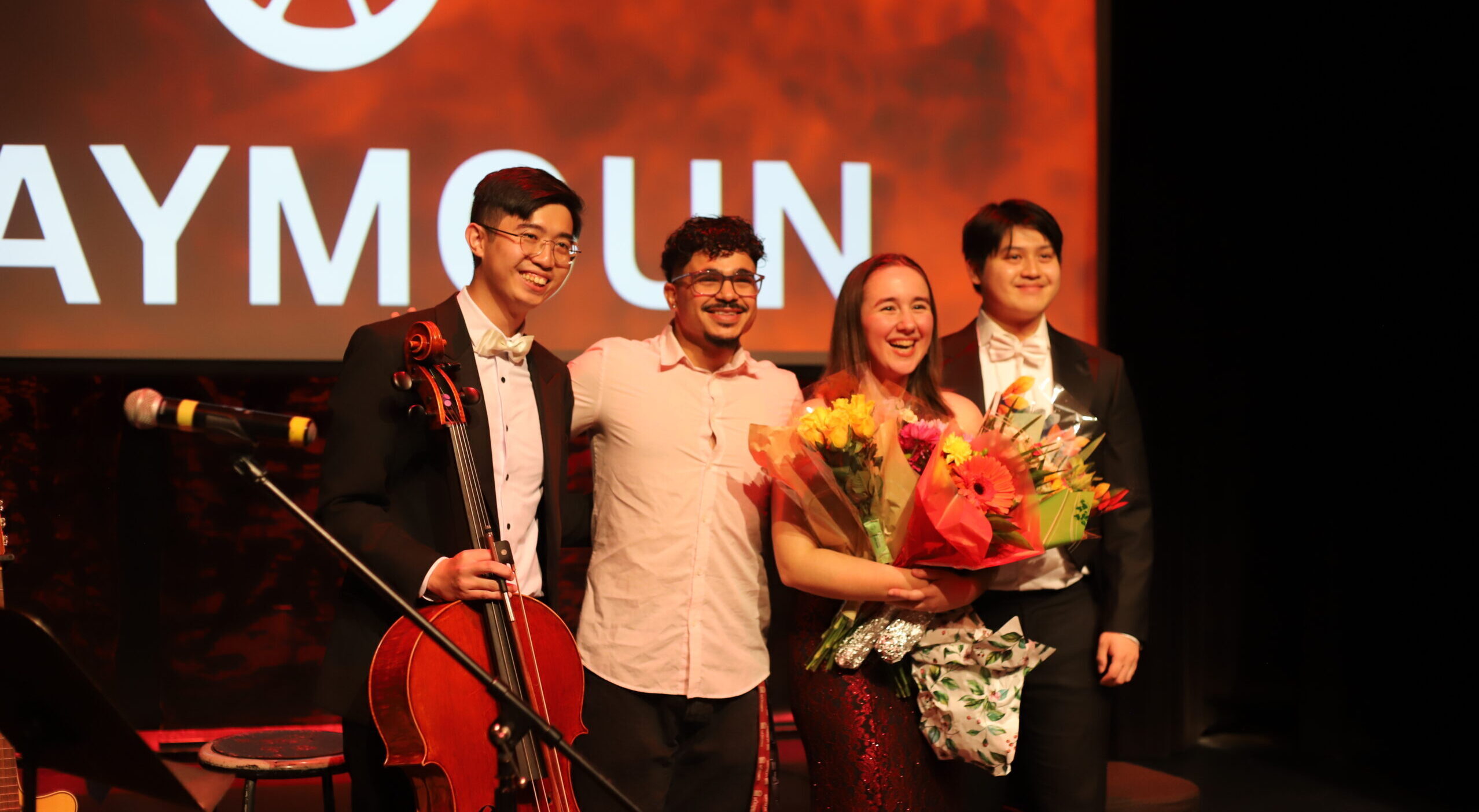
Laymoun brought approximately 180 people together for Légendes de l’Olympia on Oct. 17, a concert celebrating French music through the works of Edith Piaf, Dalida, and Céline Dion.
“It kind of represents all three generations of French music, like how it evolved and how the feeling and emotions are there in all three of them,” he commented.
The predominantly older audience was a crowd composed of couples, friends and family reflecting the intergenerational appeal of the setlist. Throughout the evening, attendees sang along, cheered, and applauded as familiar melodies came to life. One attendee, who had expected a mostly university-aged crowd, welcomed the turnout. “It was really nice to see, you know, an older crowd, just because of the nature of the songs,” they said.
The performance featured Lucia Micu, whom Kanaan noticed during a U of O opera production. Although her role was small, her voice caught his attention. “Her role was a tree,” he joked. “But her voice was very outstanding.”
Micu performed alongside Pacifica Duo, composed of cellist Keith Lau and pianist Chapman Wong, who had already worked with Laymoun on an earlier Dalida tribute.
The concert’s program, divided into Paris et les rencontres and Ce que l’amour coûte, traced different expressions of love, longing, and memory through familiar songs, including Piaf’s La Foule and Dion’s Pour que tu m’aimes encore.
For Kanaan, the goal was not simply to recreate the performances, but to reconnect listeners with the emotions they associated with the music. “Or maybe something felt when they were young and that emotion kind of died down. I want to bring that back to life.”
Behind Laymoun’s productions is a considerable financial commitment. Kanaan works with freelancers and assembles teams for individual projects. He reveals he has invested significant personal savings into the four shows he is currently producing,
“You’re just always stressed until the show actually happens,” he joked. “You’re like okay did I lose 30k or did I make 1k?”
Despite being a U of O student and holding some Laymoun events on campus, Kanaan disclosed he has found limited institutional support for the project.
“I did not see that support at all,” he voiced. His ability to navigate the university’s event spaces, he explained, largely comes from previously working on events with the university’s technical crew and already knowing people involved with those spaces. When he has approached the university more broadly for support, Kanaan recalled the answer has generally been that there is little they can do.
“Maybe I haven’t reached out to the right people,” he acknowledged. “But I definitely did try reaching out a couple times, and it was always a no.”
At the same time, being independent has helped shape Laymoum into something distinctly personal. Kanaan considered the possibility of making it a student club, but decided against it because the community he wants to build extends beyond university.
Kanaan plans to keep Laymoun going after graduation while pursuing electrical engineering professionally.
His experience has also changed how he thinks about the pressure STEM students often feel to dedicate themselves entirely to school.
“I think what people struggle with the most, especially in STEM, is just sitting in front of your laptop and feeling, okay, I can’t do anything, but ‘I have to study’.” Whether that is music, writing, exercise, or simply getting outside, Kanaan believes having something beyond academics can ultimately make students more productive.
“Just being tied to that one student life, that routine, it will kill your productivity,” he warns.
Laymoun began because Kanaan wanted to bring a piece of his home to his community. A year later, it has become a platform to build connections with music and your community members.
Students should pursue “anything that brings them peace,” he advised.
For Kanaan, that happens to be music.