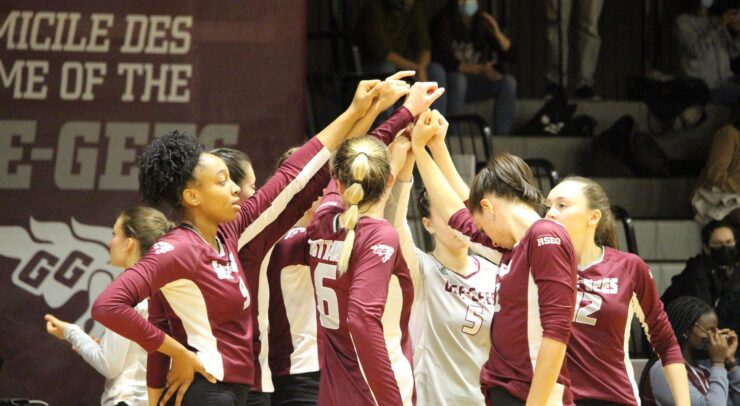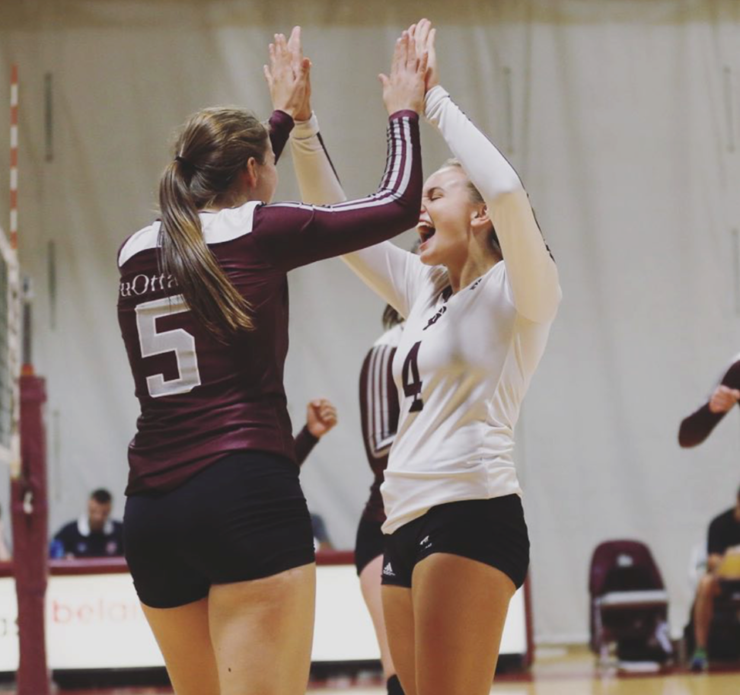
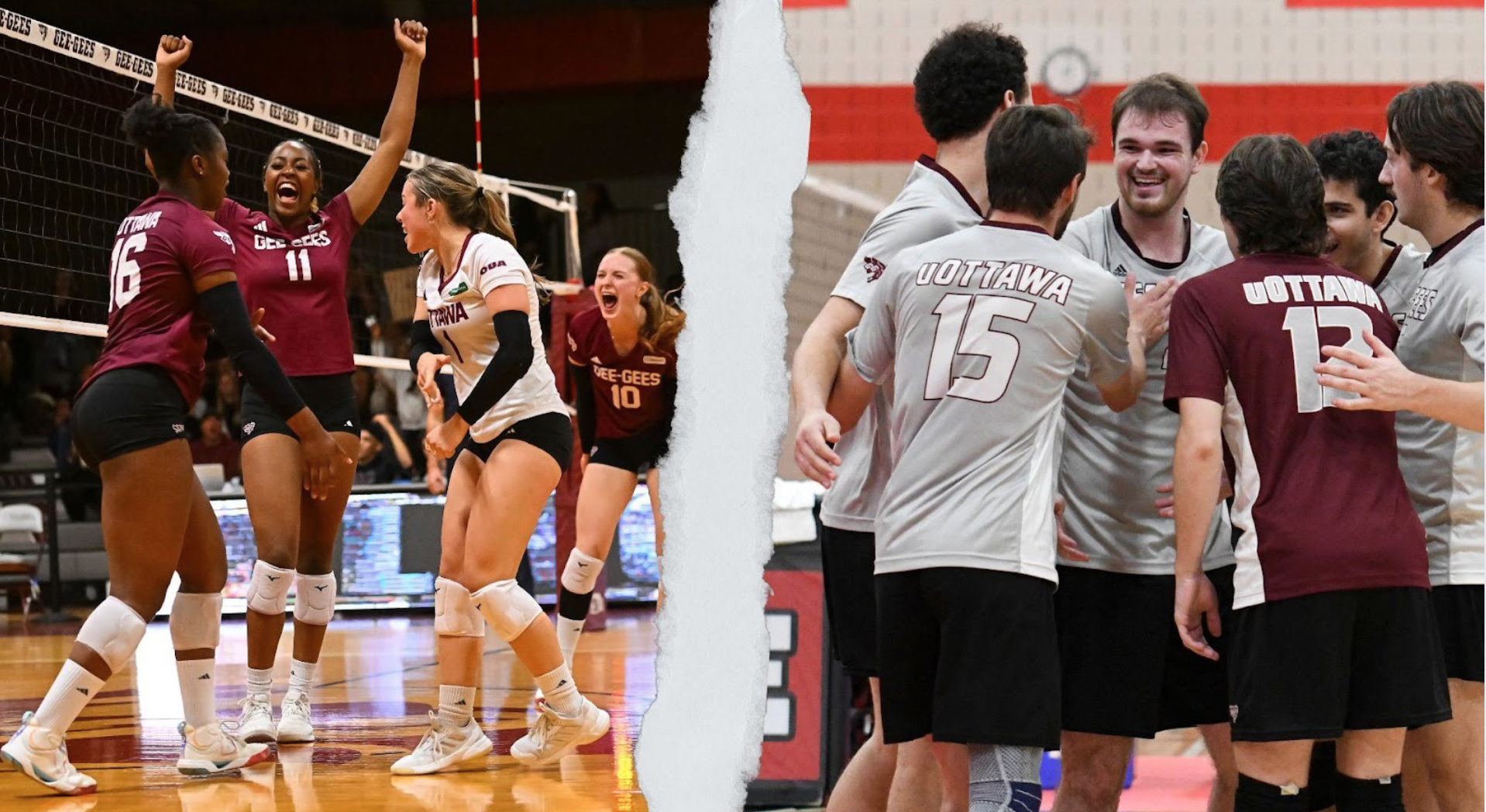
MUTUAL SUPPORT BETWEEN GEE-GEES VOLLEYBALL TEAMS COULD BE A STEP TOWARDS BRIDGING THE GAP BETWEEN U OF O’S VARSITY AND CLUB TEAMS
As anyone who’s attended a Gee-Gees Women’s Volleyball home game in the past two years could tell you, there’s a particularly rowdy group of 20-something-year-old gentlemen who sit across from the visitors’ bench, making as much noise as the rest of the crowd combined, and getting in the heads of opponents.
The culprits? The Gee-Gees Men’s Volleyball club.
A staple on the sidelines, they’ve been raucous in expressing their support for their female counterparts – support that hasn’t gone unnoticed.
“It’s been a fun dynamic,” said Liliane Boucher-Pfliger, a second year right side for the women’s team. “Having them as a constant energy really hypes up everyone else that comes to our games”.
“It’s super exciting to look over and [see that] there’s not a single person in that group that’s not giving absolutely everything to it,” added second year middle blocker Keely Lloyd. “It’s a huge help, especially when the vibes are feeling down or things aren’t going our way.”
A member of the men’s squad, second year setter Yiorgo Rowe humbly acknowledged the payoff of his team’s efforts. “If we can be a small part of [helping their success] by chirping the other team or cheering them on in general, then that puts a smile on my face,” he said.
During the Women’s season-opening homestand, the Gee-Gees took on the University of Toronto Varsity Blues and RMC Paladins, finishing with a 3-1 record (which has since improved to 7-3).
When Varsity Blues’ left side was struggling on opening night, the Men’s volleyball players made sure she knew all about it. Lloyd confirmed the home advantage they brought. “It’s really cool [to] hear them yelling when the other team’s serving, it almost makes you chuckle a bit. It’s great to have that behind us.”
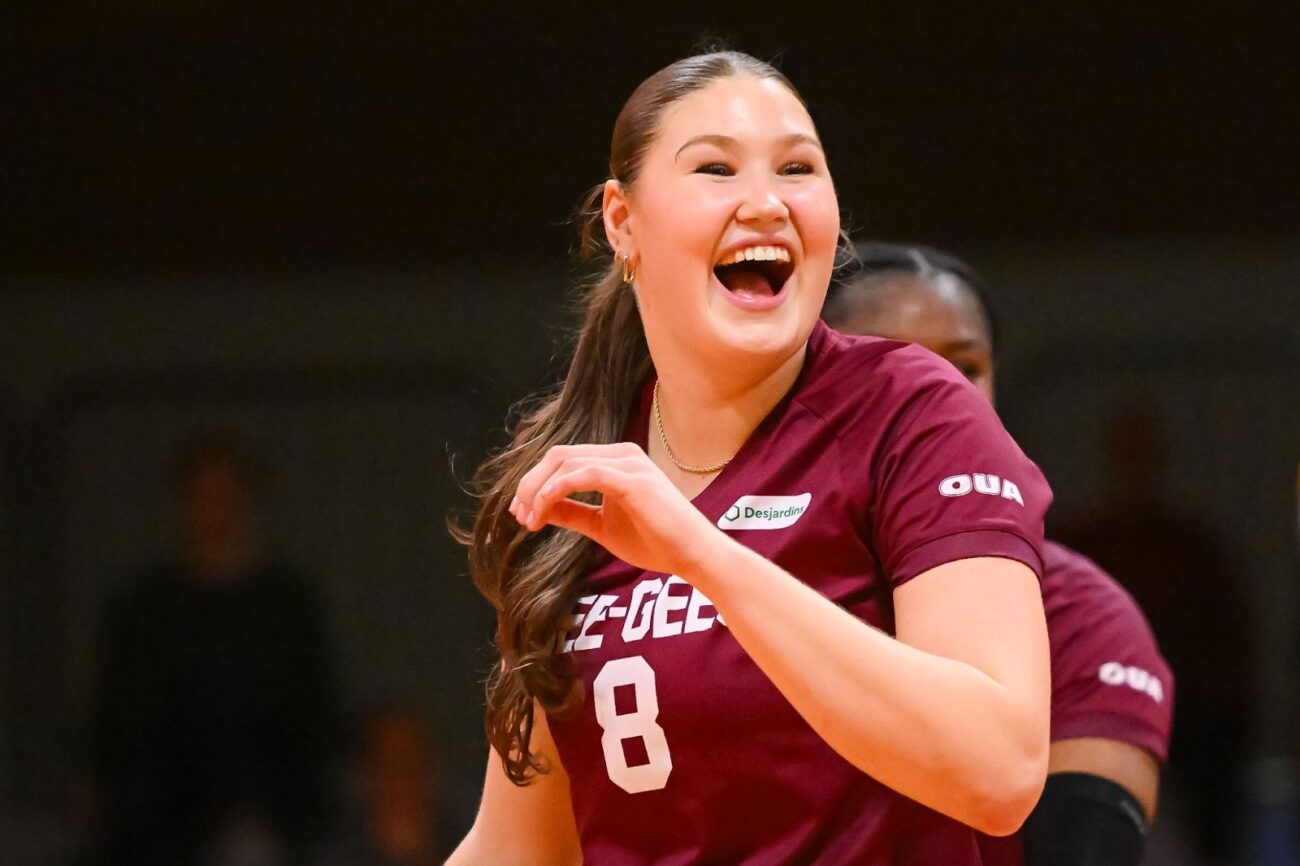
The next progression – to hear Boucher-Pfliger tell it – is for the two teams to work together on their celebrations. She said that the teams haven’t coordinated anything yet, but mentioned that perhaps they should, after having some of their celebrations inadvertently stolen by the Men’s team.
“Against Toronto, we had prepared two or three celebrations. Some of us on the bench had organized it, we were practicing them the week before. […] We were waiting for a good moment, and then literally a few points before we were going to do the bench press, they did it,” she laughed. “So maybe we should coordinate more to avoid copying”.
It’s clear that the Men have made a concerted effort of support, but the reverse has been true as well. Though the Men’s team – as a Varsity Grey team who doesn’t compete in the OUA – doesn’t host any traditional home games, the Women’s team has been a fixture in the crowd at the Men’s alumni games and intra-squad scrimmages, helping to strengthen the bond.
“It’s definitely meaningful,” said third-year middle blocker Crosby Butler, of the Gee-Gees’ Men’s team. “There aren’t a lot of opportunities for them to reciprocate that support, […] so even if it’s something as small as an intra-squad scrimmage, them taking the time out of their day to come and be loud like we are, [and] show that same energy that we give them when they’re playing, it’s super nice and I think it speaks a lot to [our] relationship.”
Re-greening efforts
What makes the volleyball teams’ friendship and support so important is the apparent – but largely unspoken – rift between Varsity Teams and Varsity Club Teams. Differences in funding, opportunities, and access to facilities (e.g. practice time, athletic therapy) between the tiers of the school’s sport model appear to be the strongest contributors.
However, Butler made it a point to share that despite these differences, he hasn’t noticed much of an impact on the way that he, as a Varsity Club Grey athlete – lowest of the three levels – has been treated. “It’s not as if they (Varsity Team athletes) look down on us. They don’t treat us like second-class citizens,” he said. “It’s just the hand that the school has dealt the program.”
So, what’s the source of tension? Club athletes feeling neglected by the school compared to their varsity counterparts? A lack of interaction between the groups that would help them understand how similar they are? Or is it something else entirely?
Whatever the case may be, recent efforts by the universities’ Recreation and Varsity Sports (RVS) department to bring the two groups together have seen success. The combination of the previously separate year-end Varsity and Club Banquets into a singular Gee-Gees Banquet, and the year-opening orientation barbecue – hosted by the uOttawa Student-Athlete Council (SAC) and Black Student-Athlete Advocacy Council (BSAAC) – have rekindled relationships and put a foot forward in the pursuit of leveling the playing field.
“I think it’s been helpful,” said Boucher-Pfliger, speaking about the various RVS and SAC events she’s attended. “It gives the opportunity to interact with people you don’t usually, and [..] creates more familiar faces.”
“It’s a great opportunity to meet everyone, and they all understand what you’re going through by balancing academics and sports,” added Lloyd.
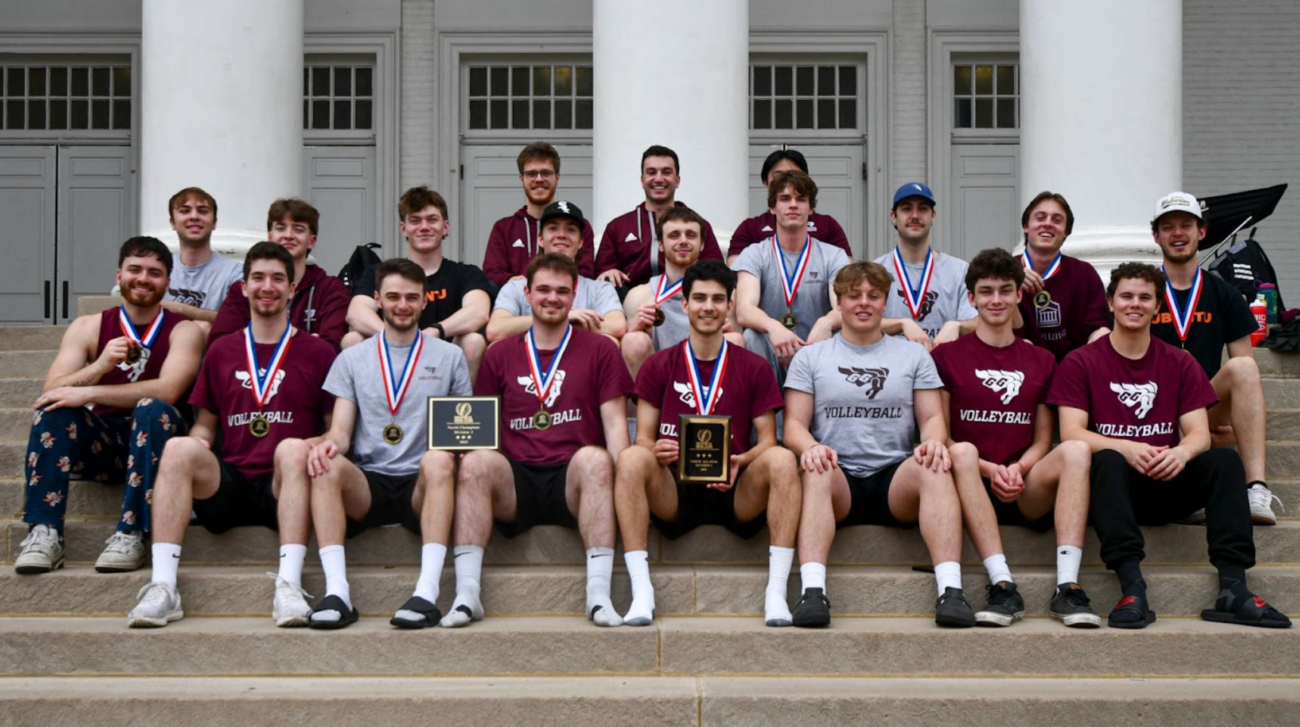
Though the Men’s club has missed the last two Gee-Gees Banquets due to their qualification for their league’s conference tournament , Rowe gave some perspective relating to athlete dynamics at such events. “We’re all athletes. We love the sport we do. We all sacrificed [something] and tried as best we could to get to the next level, whether that’s club or varsity,” he said, concluding that “it’s cool to see SAC make a big effort to bridge the gap between us.”
An administrative perspective
Danika Smith, Associate Director of Recreation and Varsity Sports at uOttawa, credits former Athletic Director Sue Hylland with getting the ball rolling on unification efforts.
“Knowing that we cannot support everyone financially in the same way, she used to always say that showing how much we care and appreciate everyone doesn’t cost that much,” said Smith, who also mentioned, echoing Lloyd and Rowe’s sentiments, that “the more opportunities student-athletes have to interact, the more they will realize how much they have in common”.
Discussing the first edition of the club-inclusive Gee-Gees Banquet in April 2023, she admitted that “I was so stressed that there were just going to be too many people”. A reasonable concern given that there are over 1,000 Gee-Gees student-athletes, but her fears were never realized – the event received overwhelmingly positive feedback. In fact, Smith pointed to that night as a moment that stands out for her in terms of visible relationship improvement between tiers.
However, looking to the future, Smith acknowledged that there is still work to be done both in perfecting the Gee-Gees Banquet and more broadly supporting efforts to bring student-athletes together.
Without equality in funding for all teams (which is impossible for any school to provide – just look at McGill and SFU), there will always be Varsity Club athletes and coaches fighting for more. Frankly, until the Men’s Volleyball team manages to join the OUA, I’ll be right there with them. But a lot of credit is due to the Gee-Gees Volleyball teams, who, in spite of their respective statuses, have created a mutually supportive culture that will continue to benefit everyone who has the pleasure of engaging with the uOttawa volleyball community.
Both teams are back in action shortly; the Women (7-5 record) have their first home games of the Winter term on Jan. 23rd & 24th vs Windsor (11-3), while the Men’s regular season in the Eastern Collegiate Volleyball Association (ECVA) kicks off on Feb. 21st at Syracuse University.