FROM ANTI-RACISM PLANS TO GALAS AND SCHOLARSHIPS, HOW BSAAC IS PAVING THE WAY FOR BLACK STUDENT-ATHLETES ACROSS THE PROVINCE
The Black Student-Athlete Advocacy Council (BSAAC) is a group of BIPOC student-athletes seeking representation, equity and accountability within Varsity sports at uOttawa.
To hear the council’s co-presidents – Kwabena “KJ” Gyimah and Janae McKay – tell it, BSAAC is what you make of it. For them, it’s a space for Black student-athletes to connect with one another and bond over shared experiences in sports, academics, and life in general. It’s an opportunity to learn how to become a young, black professional in the working world, and to support racialized and underprivileged community groups in Ottawa.
“I joined looking to make friends outside my sport,” said McKay, a fourth year student in Commerce (Accounting) and member of the Women’s Volleyball team, who first joined BSAAC in 2021. “[But it also] gave me the opportunity to be the Finance Officer for many years, so that was valuable experience.” McKay added that throughout her time on the council she’s attended leadership conferences, collaborated with other Black student groups on campus, and helped promote Black history in Canada through last year’s Black Excellence Gala.
A deeper dive
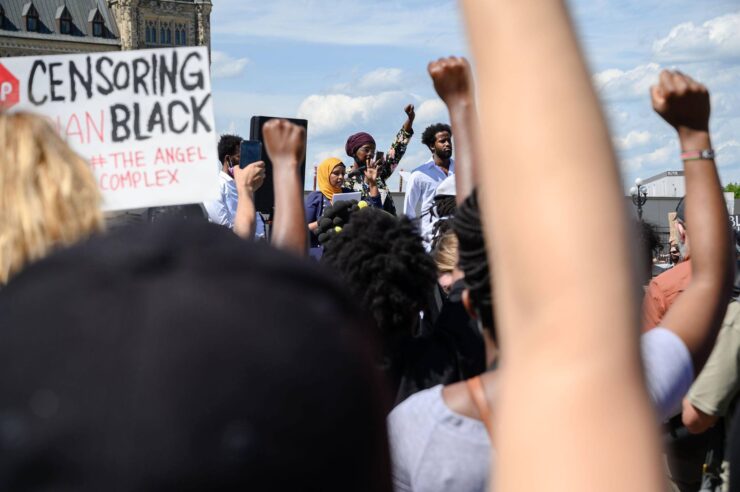
BSAAC was founded in the second half of 2020. Largely inspired by the murder of George Floyd, the subsequent social justice protests, and the broader Black Lives Matter movement, a group of Black uOttawa student-athletes decided that organized action was necessary.
“It [BSAAC] created a much-needed space for Black student-athletes to get together. It was their first time organizing outside of their sports, because it was during COVID when there was a lot of free time. With all the stuff happening in the news, they realized that there was a disconnect between student-athletes and RVS [uOttawa’s Recreation and Varsity Sport department],” said Stefan Supplice, the Gee-Gees’ Culture and SafeSport Manager, who was hired in 2021 in the midst of discussions between BSAAC and RVS.
Women’s Rugby athletes Kennedy Banton-Lindsay and Ketsia Kamba spearheaded the initiative, coordinating with RVS administrators such as Supplice and then-Athletic Director Sue Hylland, among others. Banton-Lindsay served as one of the original Co-Presidents, alongside Men’s Basketball athlete Borys Minger.
Though not without hardships, the council saw some major successes within their first year of existence. Foremost, through consultations with RVS, they were responsible for the establishment of a department-wide Anti-Racism Plan. This ensured, among other long-term initiatives, that anti-racism training would be provided to all Gee-Gees student-athletes at the annual student-athlete orientation in September – training that is still in place to this day.
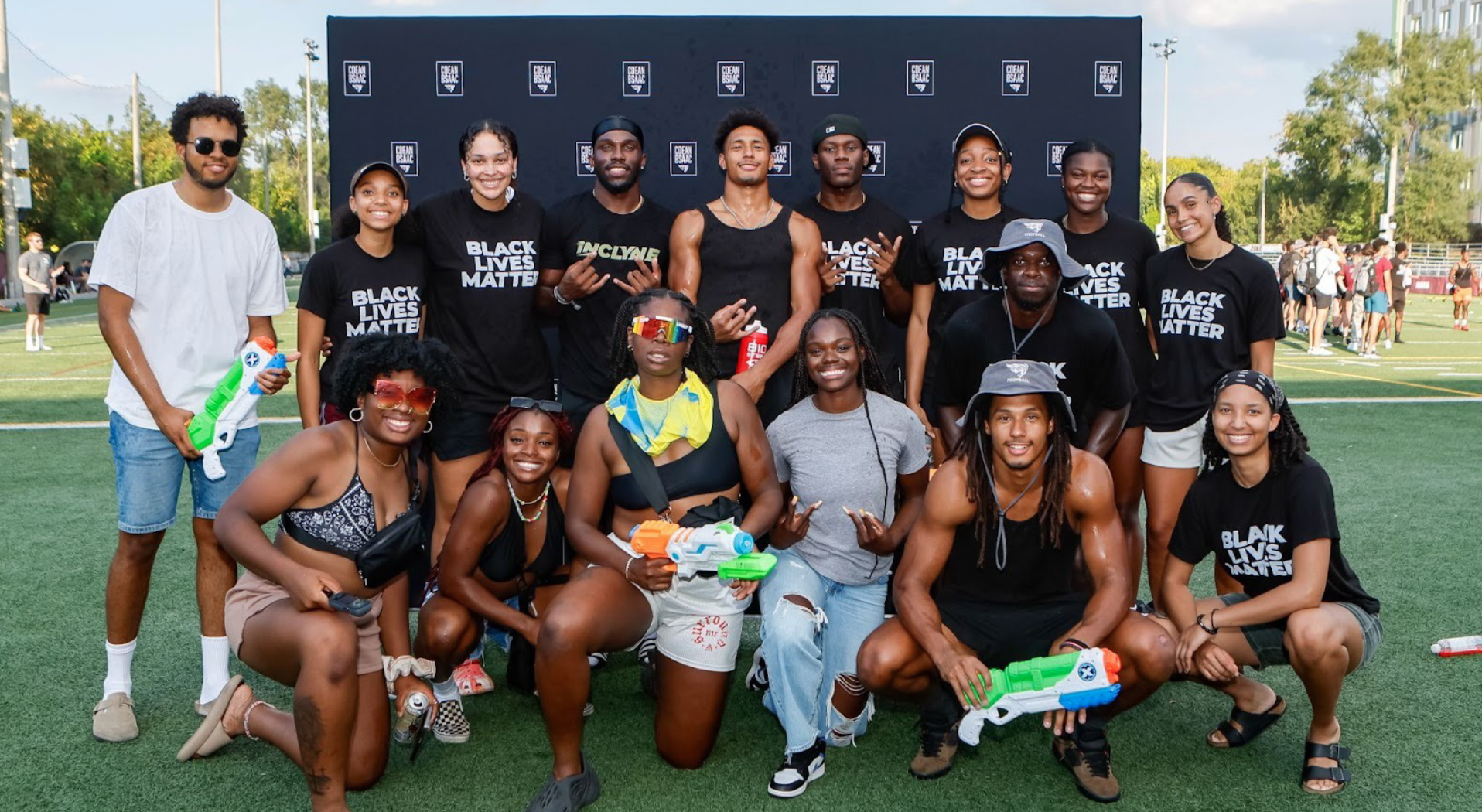
Additionally, a collaboration between BSAAC and RVS saw a “Black Lives Matter” shirt distributed to each student-athlete in 2020 and 2021. RVS has since continued to collaborate with on-campus groups for social justice-themed shirts. 2022 saw an orange “Every Child Matters/Wàskonenindamàwin” campaign designed by the Indigenous Resource Centre, while the 2024 design was back in the hands of BSAAC: they chose to centre the term “Ubuntu”, signifying “I am because we are”.
A full account of BSAAC’s foundation, including all of the council’s initial members, can be found here.
The Black Excellence Gala
BSAAC’s evolution and growth can be most aptly understood through their capstone event, the Black Excellence Gala.
Held annually in February during Black History Month, the ceremony is exactly as titled – a celebration of Black excellence and culture in Ottawa/Gatineau. The first edition of the Gala was held in 2022, hosted in the Camille Villeneuve Room (DMS 4101) of the Desmarais building on campus. 125 attendees filled the room to capacity.
One of the most striking decisions made by the Council during that first Gala was to recognize Black excellence beyond the confines of Gee-Gees teams and the University of Ottawa, intentionally choosing to honour artists, leaders, and influential members of the Black community from across the region.
While most on-campus cultural groups do outreach and organize events that extend beyond the scope of the university, few have ever hosted an event as successful. However, it wasn’t until the following year that they really started to take off. Indeed, the 200-person capacity of the Huguette Labelle space in Tabaret Hall (home of the 2023 Gala) proved to be incapable of satiating the event’s demand. They’ve since upgraded to the Canadian Museum of History, drawing 230 attendees in 2025, and show no signs of slowing down.
To maintain a fresh, unique feel to the event each year, the Council chooses a new theme for each edition: in 2026, they’re collaborating with the university’s EDI Office as well as the Black Student Leaders Association, a fellow uOttawa club, to put on Souls of Resilience, “celebrating the strength, creativity, and enduring impact of Black communities.”
For 2025’s theme, Roots and Routes, McKay said they wanted to highlight the importance of sharing Black history within Canada.
“Since we partnered with the Museum, one of their requirements was to make it educational – which I think is right, it’s a great aspect. So we talked about Africville [a Black community in Halifax that was demolished in the 1960s]; we displayed photos from the Ontario archives. We wanted to showcase how long Black people have been here in Canada,” she said.
The event is widely attended even by non-members of the Black community. While the Gala could undoubtedly thrive without external support, McKay and Gyimah noted their appreciation for non-Black attendees. “I love that my entire team comes out every year, and they’re always excited about it,” said McKay, who is one of three Black members of the Gee-Gees Women’s Volleyball team.
Tickets to the 2026 Gala (held on Feb. 27) are available here.
Community Impact
As a council representing and advancing the interests of BIPOC student-athletes, one of the first initiatives undertaken by BSAAC was the establishment of a scholarship. Officially endowed as of last summer, the BSAAC Scholarship will forever help support a Black Student-Athlete every year – and McKay stated that they’re seeking to endow another.
The process to endow the first scholarship took five years, as the council needed to raise $30,000.
That’s been just one of many community-focused projects that the Council has led; within Gee-Gees sports (on top of the aforementioned Anti-Racism Plan) they’ve helped establish Hoops for Heritage and Digs for Diversity to support and showcase local artists, performers and culture during Basketball and Volleyball games, respectively. This year, Hoops for Heritage will be held on Jan. 31st, the eve of Black History Month as the Gee-Gees Men’s and Women’s Basketball teams take on Lakehead. Digs for Diversity took place on January 23rd, when the Women’s Volleyball team hosted Windsor.
Externally, they supported and attended the 2022 Peace in the Streets basketball tournament – an event honouring Loris Tyson Ndongozi and Creflo Tansia, who had died as a result of gun violence the previous summer.
BSAAC’s impact has extended as far as OUA awards and invitations to their Annual General Meeting. Gyimah – a linebacker for the Gee-Gees Football team – and teammate/council member Mikhail Nembhard have won the conferences’ Bernie Custis Champion of EDI Award in back to back years (2024 and 2025, respectively) for their contributions to equity, diversity and inclusion – in no small part due to their roles with BSAAC.
“I think [those awards] say everything that needs to be said about the work that’s been done with BSAAC,” said Gyimah. “We’ve also been blessed to go to the OUA AGM [Annual General Meeting] and present our best practices – it identifies the work, and spreads awareness, showing people [from other universities] that they can have their own BSAAC.”
The road ahead
Gyimah’s vision for the future of BSAAC is grand. Currently, he and Finance Officer Jeremy Lamothe Ménard are in the process of meeting with other OUA schools that have (or want to establish) their own Black student-athlete leadership group in the hopes of forming a union or partnership. As he explained it, the United Black Student-Athlete Collective (UBSAC) will aim to streamline processes for all BSAACs, potentially meeting quarterly.
Another goal is to support fellow OUA schools in securing funding from their athletic departments. “A lot of other students we talked to were shocked that we’ve worked with RVS, and by the support that they’ve given us,” said McKay. “Some told us, ‘We didn’t get that’, so it’s an opportunity for them to see how we work with our schools, and hopefully that’ll give them some leverage.”
On top of UBSAC, Gyimah said that he had his sights set on making BSAAC – at uOttawa and across the country – into a kind of fraternity. “Obviously not a traditional or stereotypical frat,” he laughed, but mentioned that “I’d like to see each school have a BSAAC, and that once you join, you’re part of that family forever – not just in your university, but beyond. So that, 10 years down the line, I might get a resume from somebody saying ‘I went to this school, I was part of BSAAC there’ and we have that connection automatically. I want to build a huge network of alumni.”
Interestingly, while he fully supports those ideas, Supplice said that his biggest priority for the next five years of BSAAC was simply to still be around.
“Sustainability is the key priority for me, because grassroots and student-run organizations are only as strong as the members that keep them alive, right? So I think for me, I want to see the same drive and inspiration that [Gyimah and McKay] spoke about in terms of community building within the next few cohorts,” he said.
Although Gyimah and McKay will be graduating at the end of this school year, the council is set up for success once they’re gone. They’ve established a contingent of 40 Black student-athletes who are regular participants in their events, and have consistently been one of the most impactful organizations on campus for the past half-decade.
Here’s to another five years (and beyond) of BSAAC!