IF WE FOLLOW THE AMERICAN SYSTEM, WE GET THE AMERICAN RESULTS
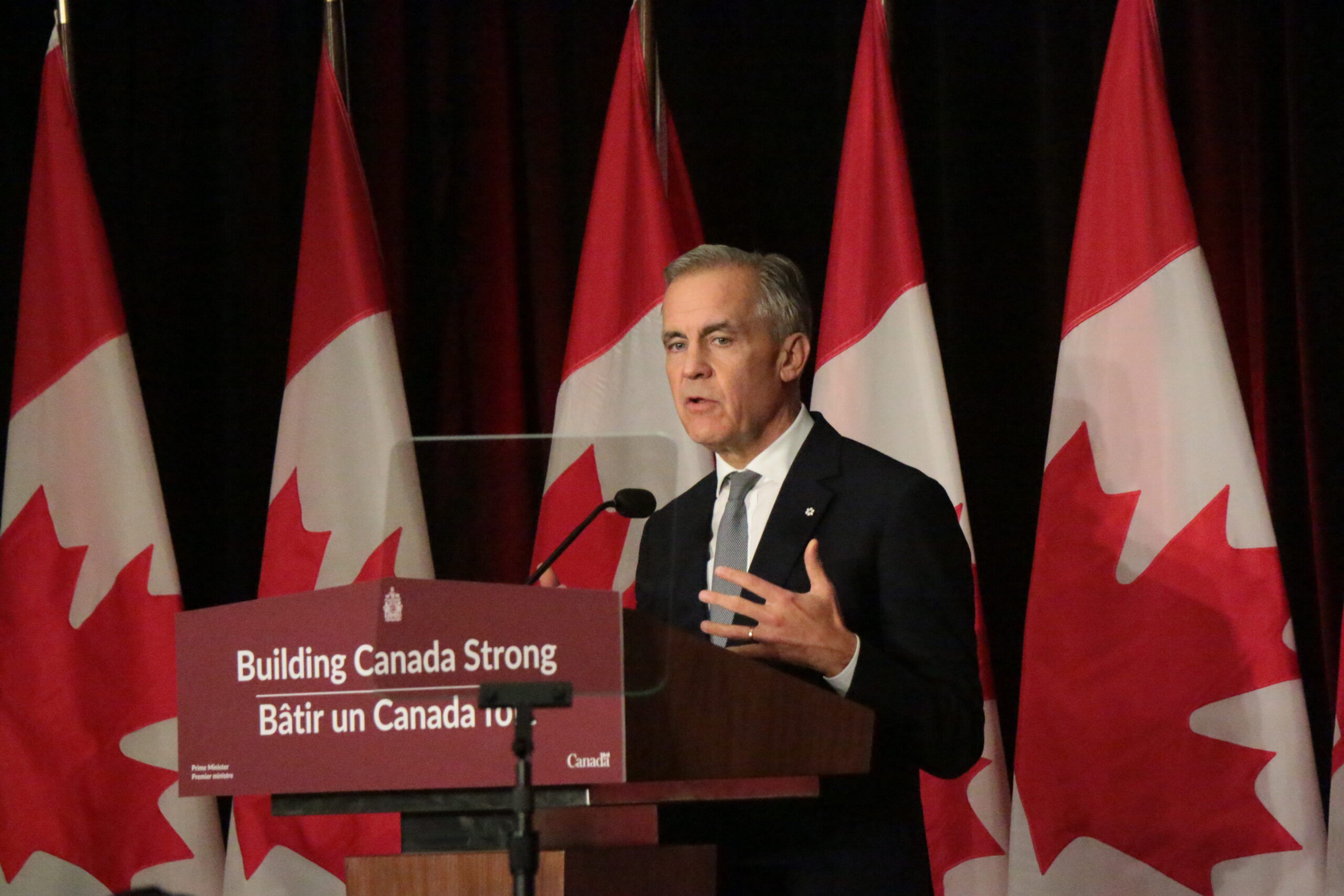
In a last minute appearance yesterday, Prime Minister Mark Carney spoke to students about his 2025 Budget plan and his vision to “Build Canada Strong.”
Carney’s budget plan has been plagued by skepticism, backlash, and even concerns about triggering an election if it doesn’t pass in November. The budget requires cooperation from any other party due to the minority Liberal government, yet negotiations with the NDP and the Bloc Québécois have stalled. Ahead of the speech, Carney met with Conservative leader Pierre Polievre, with the former not making any commitments on concessions.
The event, held on the fourth floor of the Faculty of Social Sciences, was invite-only, and the audience was primarily students, a few professors, university staff, and a spread of reporters. A number of the students invited were members of the uOttawa Young Liberals club.
Because Carney had chosen a university as the venue, many in attendance were expecting an announcement supporting research funding or grants for post-secondary education. However, Carney’s 30-minute-long speech focused on Canadian nationalism in this “new world of protectionism.”
Throughout his speech, Carney alternated between over-the-top patriotic refrains such as “Canada has the values to which the world aspires” and a more somber recognition that Canadians would have to “confront a more dynamic, a more competitive, a more hostile world.”
Carney leaned into themes of Canadian security — claiming that his platform would represent a “generational level” of spending on Canadian defence that pivoted away from American arms. Carney led his platform earlier this year with a promise of five per cent of the Canadian GDP by 2035 spent on defence.
Even though he acknowledged the strained relationship between the U.S. and Canada, Carney and his government do not notably differ from the defence philosophies of our neighbours. His “Canada Strong” idea may seem appealing initially, but in reality, it mirrors the U.S.’s ultranationalism and accompanying protectionism.
Notably, his enthusiastic investment into 2,000 new RCMP and border security officers should not be a point of pride but should alarm Canadians concerned by the actions of the U.S.’s Immigration and Customs Enforcement agency. The violent and racist conduct of ICE agents is not an isolated phenomena but could serve as a blueprint for border enforcement in any country, including Canada.
Anti-immigration sentiment is on the rise in Canada. In 2024, Immigration, Refugees, and Citizenship Canada capped the number of study permits, reducing the acceptance rate by 40 per cent. Together, this raises the question of how we are protecting our international students. As U of O President Marie-Eve Sylvestre told the Fulcrum in September, “Messages that have been sent by our governments are basically saying international students are not that welcome anymore.”
Without specific protections for the international students who are already in Canada, an increase in border officers only heightens anxiety and the probability of hostility. How are we so certain that Canadian border officers will behave any differently than ICE if given more money and power? After all, if we follow the American system, we get the American results.
And what comes at the cost of Carney’s defence budget proposal? Austerity that shaves down valuable public services students use daily. Services such as the Canadian Post, which help parents send food and birthday cards to their children studying far from home, will undergo significant cuts. Carney’s finance minister François-Philippe Champagne proposed in July a 7.5 per cent cut in operational spending for the 2026-27 fiscal year, followed by 10 per cent 2027-28, and 15 per cent the year after.
Carney’s concern about the cost of living crisis paled in comparison to his passion for increased defence spending, which he positioned as a strategic priority despite the mounting housing and rent concerns.
“Now the actual situation is that the rate of inflation has come down, has come down sharply, but it’s also the case that the cost of living is still far too high,” Carney stated. However, his proposal of an initial 13 billion dollars for the Build Canada Homes program is less than half of Canada’s current defence budget.
It is tone deaf to imply that increased defence spending is more important to students than more aggressive investment into affordable housing strategies. Moreover, the expectation that students should be united in celebrating this “generational investment” into defence feels out of touch with students’ reality.
Poignantly, Carney’s hope that there were “some first-time homeowners in the crowd tonight” only indicated a divide between what he perceived as the effectiveness of his policy and the actual circumstance of most university students. Proposed tax cuts only act as a bandaid measure for the anxiety students feel about affordable housing.
If “fortune favors the bold,” as Carney repeatedly claimed last night, then who shoulders the risk of that wager? Carney told the audience that Canadians should be prepared to make sacrifices and that it will take some time. Despite assurances that the goal of the Canadian economy is “to grow stronger than the rest of the G7,” university students are finding it increasingly difficult to secure employment.
It was unclear whether Carney’s message was meant to make us feel hopeful or hopeless. If “Building Canada Strong” means pouring billions into defence while students can’t afford rent, maybe the real weakness isn’t in our borders but in our priorities.