“THE [ATPUO BARGAINING COMMITTEE] HAS SECURED WHAT WE BELIEVE TO BE A VERY GOOD OFFER.”
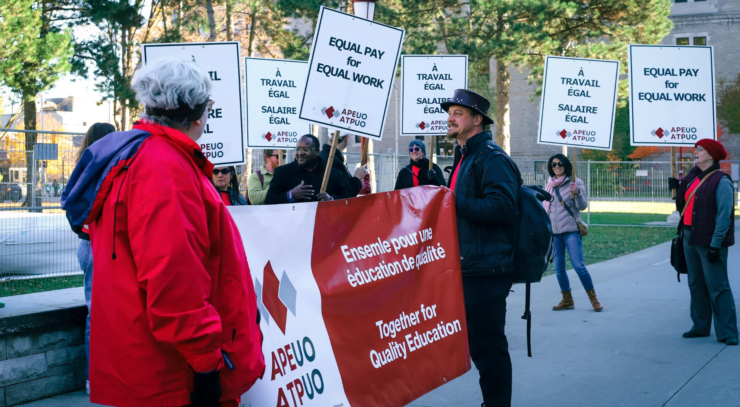
The Association of Teaching Professors of the University of Ottawa (ATPUO) and U of O administration reached a tentative agreement at 1:30 a.m. on Nov. 16. The two parties have signed a memorandum of understanding outlining the proposed terms, which must still receive approval from the Union’s members and the University’s Board of Governors before becoming a formal collective agreement. The ATPUO is expected to hold a general assembly later this week, where members will vote on the proposed agreement. Until then, the exact terms remain confidential.
According to Angers, ATPUO vice president of membership and engagement, the proposed offer “will be acceptable to the Union’s membership,” though he acknowledges that it is now up to the members to ratify it.
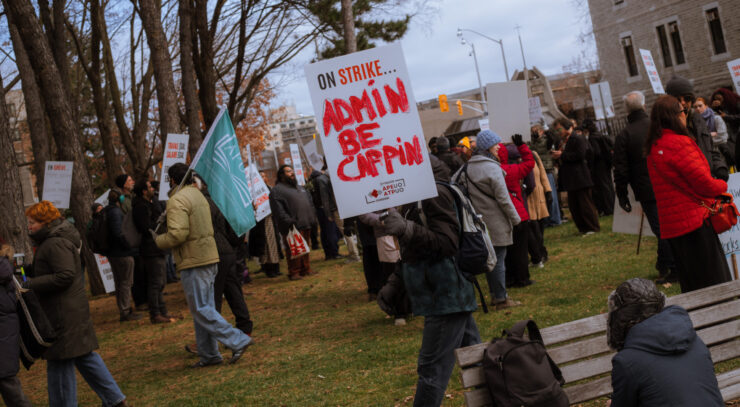
For students, the agreement brings an end to the nine-day strike and lifts the suspension of more than 50 per cent of undergraduate classes. For Angers, the agreement marks the culmination of five months of negotiations, during which ten representatives on each side repeatedly returned to the bargaining table, retreated into caucuses to assess proposals, consulted legal counsel, and exchanged counteroffers back and forth.
“We are very pleased to have a settlement and move forward. There was a good momentum [at last night’s session], so we decided to keep going at it,” said Angers.
A turning point for campus-wide mobilization
Émilie Bernier, ATPUO grievance officer, initially expected the strike to extend further into the week, as “there were enough points of dispute to require further negotiation sessions.” Bernier also noted that it’s “very rare” for an employer to come back to the negotiation table during the first week of a strike:
“I absolutely believe that the strike’s organization, student support, and the media’s reaction influenced the follow-through of this agreement … The administration clearly didn’t anticipate having to confront such a mobilized and united group. It was quite apparent during yesterday’s negotiations … Last week’s strike will shape how day-to-day labour relations play out on this campus going forward. The ATPUO has proven itself to be a counterweight, and we stand united with the other unions.”
Meanwhile, the Association of Professors of the University of Ottawa (APUO), the union representing full-time professors, is currently negotiating the terms of their new collective agreement with the University. The APUO has three negotiation sessions scheduled with the U of O from Nov. 24-26.
“What’s really important about what [ATPUO] has done is that they’ve taught us that supporting the people who teach is also about defending the university’s educational mission,” said Susan Spronk, APUO first vice-president. “The solidarity that has come from this also means that our employer needs to take unions seriously because we are prepared to go out when necessary.”
While the majority of lectures were cancelled this past week, Bernier hopes that the strike offered the U of O community a lasting lesson in the power of collective action:
“People today have reached an intolerable level of precarity and vulnerability, and they are ready for change … Education has become a mere commodity, traded by large corporations. While the [ATPUO’s strike] was happening, students in Quebec have been on strike for the past five days in reaction to rising tuition fees, the high cost of living, and lack of affordable housing. What the ATPUO is fighting for and what students across the country have been fighting for stem from converging struggles.”
Angers noted that students’ support at the picket line and at the rallies was “very valuable in the coming through of this tentative agreement.”
“The way we emphasized our rapport with our students, we hope it helped the administration understand that this is what truly matters,” added Bernier. “The University must understand that its role is to cultivate minds for the betterment of society.”
Suspended courses resumed as of Nov. 17
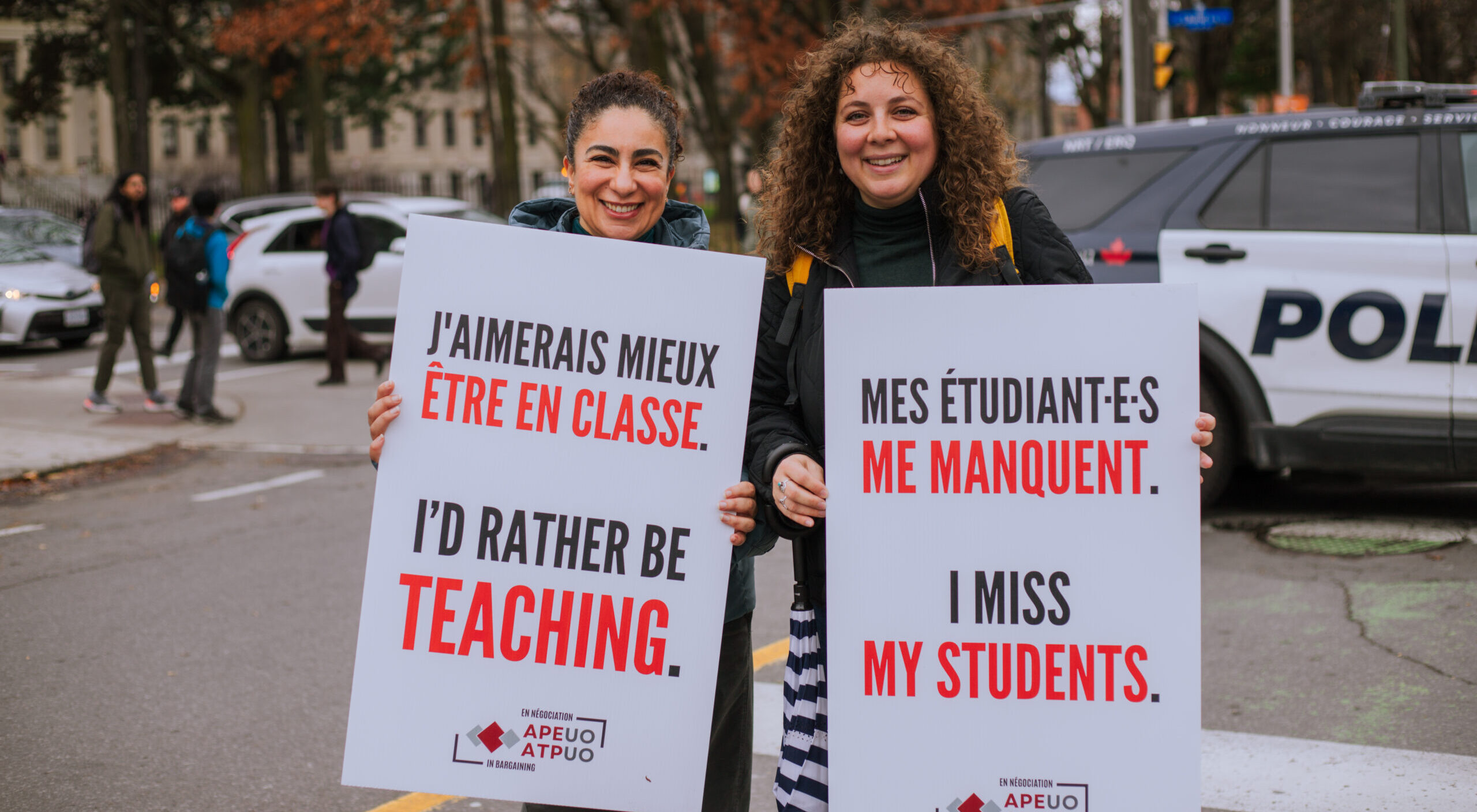
Angers will return to teaching his students at the Faculty of Education, whose practicum had been halted by the Ontario Teachers’ Federation for the duration of the strike:
“You know it’s like being back with family. When I was teaching in elementary schools, I considered my homeroom my ‘family,’ in a professional sense. But I still feel that same way now with my students at the University.”
Bernier will resume her instruction of “Theories of Democracy” (POL3505), with a renewed understanding of the very principles she teaches:
“Unlike full-time professors, [teaching professors] do not have a lot of opportunities to meet each other. We go to our courses, and then we leave … Before this week, a lot of us didn’t know each other, but we knew we shared this precarity. Now, I can say I have over 2,000 new friends in the Union and beyond. Democracy is about building those connections, learning about one another, and belonging to a community that takes action to go forward.”
The ATPUO is already seeing a step towards greater recognition, with the University now acknowledging its members as “contract professors” rather than “part-time professors.” Although the new designation stops short of “teaching professors,” Bernier still views it as a valuable concession on the University’s part:
“Right now, we don’t know if this recognition is merely symbolic, or if it will translate into a better acknowledgment of our rights, our work, and our contributions to the University. We’ll just have to wait and see.”
Author
- Potential part-time professors’ strike as U of O offers no counterproposals
- U of O has 12 days to meet teaching professors’ demands and avert potential strike
- U of O teaching professors’ strike underway
- Teaching professors’ rally draws massive turnout amid strike
- U of O strike contingency plans prove inadequate as academic disruptions mount
- Teaching professors sign tentative deal with U of O following 17-hour negotiation session