
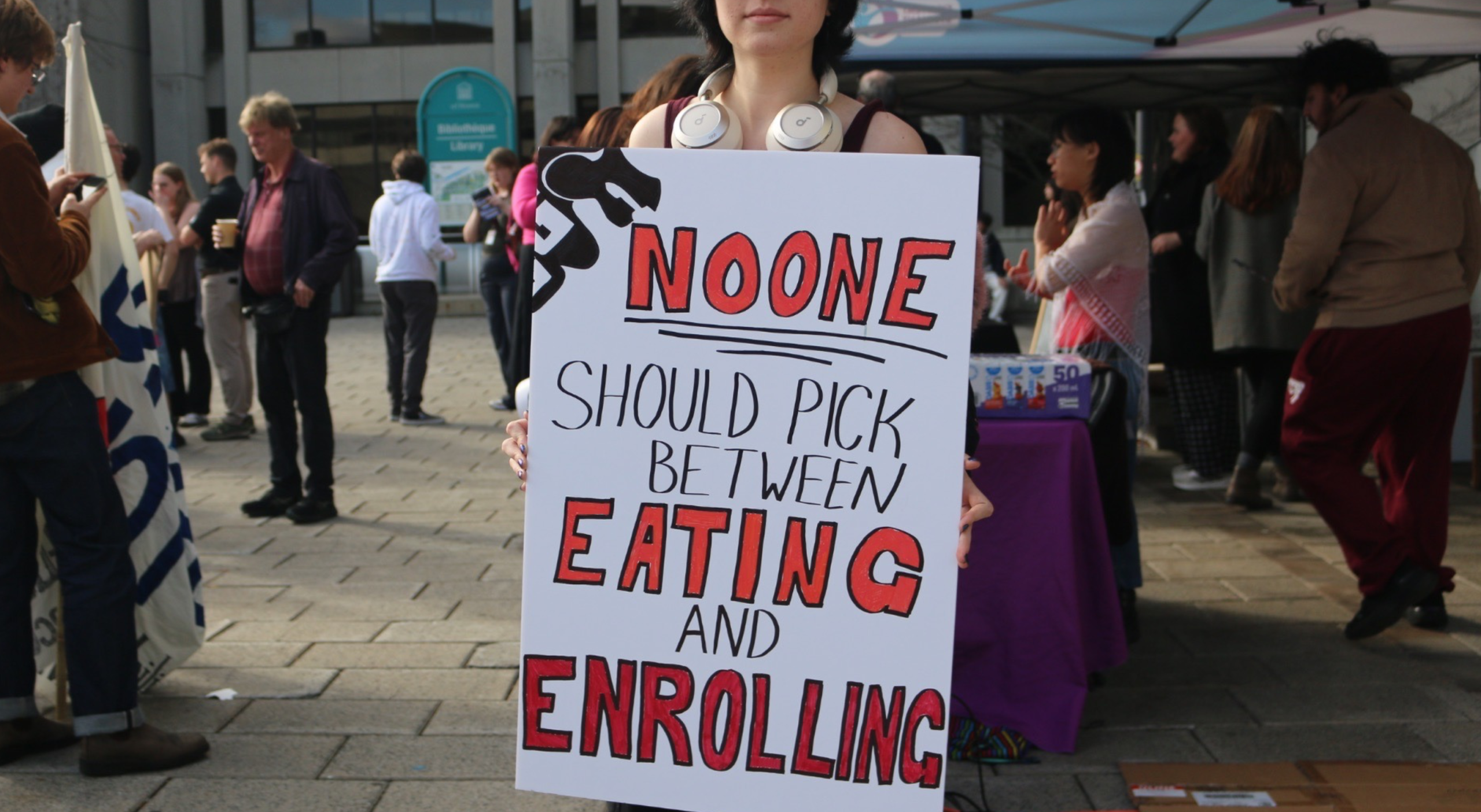
Premier calls students “naive” and likens them to “sheep” for protesting government cuts to OSAP program
Earlier this year, Ontario Premier Doug Ford and his then-Minister of Education, Jill Dunlop, announced their intention to restructure the grant-loan ratio provided by the Ontario Student Assistance Program (OSAP).
These changes saw the maximum grant threshold of the total funding provided dramatically decrease from 85 per cent to 25 per cent, meaning the majority of student assistance provided by the government would now come in the form of loans. While the federal portion of the loans is interest-free, the provincial portion is set at the prime rate plus one per cent; a whopping 5.7 per cent as of November 2026.
This decision was met with intense pushback from students across the province, who promptly responded with a series of protests that occupied locations from campuses and public streets to Queen’s Park and Parliament Hill. The intensity of these protests even encouraged Prime Minister Mark Carney to allocate an additional $1.2 billion towards the Canada Student Financial Assistance Program that was initially set to decrease under Budget 2025.
Conversely, Premier Ford displayed apprehension towards the criticism, accusing students of not enrolling in programs conducive to sustainable economic growth, and going so far as to say they were taking “basket-weaving” courses. Ford’s disdain for Arts and Social Sciences-oriented degrees comes at a time when Science and Engineering degrees are priced significantly higher than its humanities counterparts. At present, the Ontario Learn and Stay Grant only has two active funding streams for Health Human Resources and Medical Education.
Remaining firm amidst protests, the Ontario government implemented these changes on Aug. 1, a few weeks prior to when students would begin to receive their individual payments under the new structure. A structure which, some students say, has severely impeded their ability to pursue an education.
One of those students is U of O graduate student and community pillar Jessica Ruano, whose grant was drastically cut from over $24,000 to $7,000. A figure whose implications, she said, did not initially set in.
I think I thought it was a mistake, said Ruano. I was aware there was going to be a change; [however, it] was very hypothetical until I saw the numbers in my OSAP account.
Ruano is a single mother who is living in Sandy Hill while completing her fourth degree: a master’s in social work. She is also a core component of the Sandy Hill community in her capacity as an advocate and host of weekly community Life Modeling sessions. However, Ruano had to take a step back from volunteering as a result of these cuts:
“I need to prioritize applying for grants, academic grants, and I also need to prioritize work which actually pays.”
Ruano later added, “I have to be very selective about where my energy goes because I want to be a present parent.”
The OSAP cuts are affecting the environments and services surrounding academic spaces. As organizers like Ruano are coerced into prioritizing personal finances over community care to be able to afford higher education, student-run services may deteriorate.
In a continued effort to convince the Ford administration to reverse these cuts, post-secondary students across the province organized once more for a second “All Out for OSAP” protest on Nov. 5, with prominent protests arising in Ottawa, Hamilton, Guelph, and Toronto.
Capitalizing on the momentum of these efforts, the Ontario New Democratic Youth (ONDY) has revitalized its free-tuition campaign with booths set up in collaboration with its post-secondary counterparts during the Nov. 5 protest. Yusuf Rahman, director of communications for the University of Ottawa New Democratic Party (UONDP), says the campaign has garnered extensive support from students.
“The UONDP has played a large role in the ONDY’s push for free tuition, collecting 1,202 signatures over eight days and signing up over 100 members to our club,” said Rahman. “We can’t claim to be an egalitarian society if we’re not guaranteeing university education for every Ontarian.”
The paper signatures gathered during this campaign will be presented at the Ontario New Democratic Party’s (ONDP) provincial convention in Ottawa this spring.
It is safe to say Ontario youth’s continued efforts enraged the Premier. During a conference following the most prominent demonstrations, Ford called students “naive” for resisting the cuts, saying they should be “thanking the government for just investing.”
Ford then equated the demonstrating students to “sheep” who are blindly following what he described as “looney tunes” posts about criticizing the cuts. A sentiment largely resented by students.
I think it’s pretty clear [Ford] prioritizes the material realities of his wealthy friends and the corporate elite, not the material realities of students, Rahman said. I think Ford’s comments are a reflection of his underlying belief that working-class students are sheep whose purpose is to serve the corporate elite in Ontario.
Ruano shares the belief that these comments are to be derived from a larger disconnect between the Premier and the material realities of students:
“What I noticed [was that] he really put an emphasis on the spending habits of particular students to give the impression that students are just loaded with cash and are spending frivolously. What he was doing was presenting an intentionally false picture of the realities of students, many of whom are quite food bank reliant, and after they graduate, are in a position where they have to pay back loans and are not necessarily finding work in their field.”
Ruano says the disconnect between the Premier and the people of Ontario can result in legislation which creates effects outside of educational space and into the broader economy.
“It really affects people on so many levels; a lot of students who are younger are going to continue to live with their parents because they can’t afford to move out,” said Ruano. “It affects the economy generally because people are not able to go out and spend money as ‘the good consumer’ is supposed [to do].”
StrikeBackUO, a student organization dedicated to resisting cuts to the province’s education sector, held an event on campus following the rally on Nov. 5. Irene, one of the event organizers, spoke to the increased pressures felt by students as a result of these cuts:
“[Students] have been forced to take more hours at work; It reduces their hours of sleep because they are always working, and it deteriorates their ability to hand in assignments and schoolwork.”
Many students have already expressed their challenges as a result of these cuts, such as cutting back on leisurely, and in some cases, necessary services. As the Premier continues to espouse his anti-student rhetoric, students across the province begin to tighten their wallets in anticipation of their next tuition payment.