
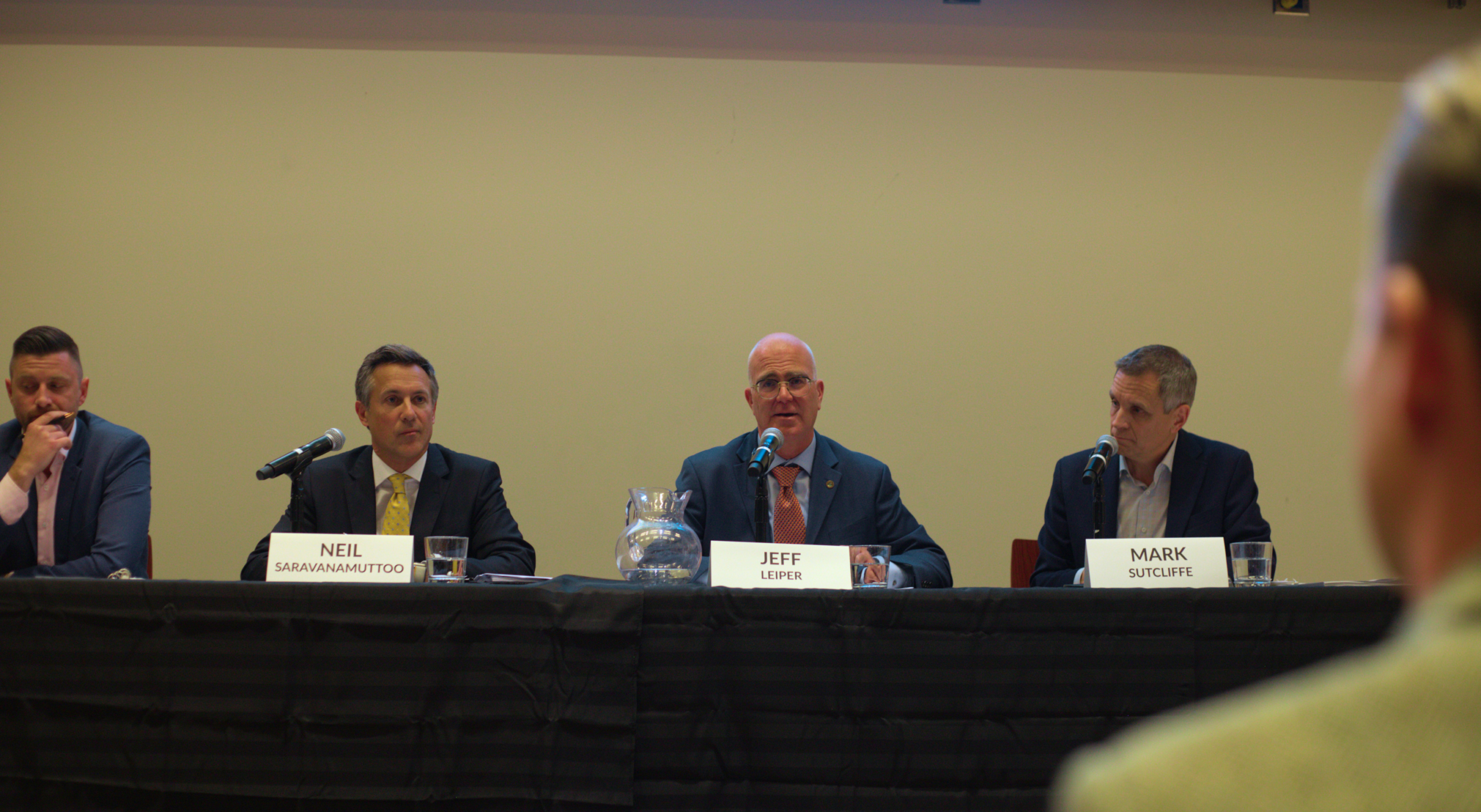
Leading candidates discuss encampments in a heated debate focused on the housing crisis.
In the lead-up to the Ottawa Municipal election on Oct. 26, the Alliance to End Homelessness organized a themed mayoral debate on Oct. 19 to showcase how candidates on your ballot plan to address the housing and homelessness crisis.
But first, here’s some context
In 2020, Ottawa’s City Council became the first in Canada to declare a housing and homelessness emergency, a diagnosis which the figures suggest still holds today. Since 2023, there has been a 76 per cent increase in family homelessness. In 2024, the most commonly cited reasons for family homelessness were low income, lack of social assistance, high rent costs, and a general shortfall of support. Moreover, the average number of individuals using Ottawa’s shelter system has almost doubled since 2022, from 2,000 to more than 4,100.
A report by the City of Ottawa showed that over 16,000 households are on the waitlist for rent-geared-to-income assistance housing. This manifests as social housing waitlists of 5-8 years and a 41% decrease in the number of families finding their way out of homelessness in 2025 compared to the previous year. As of March 1, 2026, over 660 families experienced homelessness in Ottawa. Over 1,200 of those individuals were children, despite incumbent Mark Sutcliffe’s campaign promise to end youth homelessness by 2030
The cry for help could not be louder.
“Our waitlist is way too long. No one has the luxury of waiting for appropriate housing to become available,” said Bader Abu-Zahra, Co-Chair of the Vanier Chapter of Association of Community Organizations for Reform Now (ACORN). “The fact that the waitlist keeps on growing shows that we are in a housing crisis and that what those in power are doing to get ahead of these issues is not enough. We are only playing catch up and keep falling behind.”
ACORN, a membership-based community union, has been working on issues related to housing such as better tenant protections, demoviction protections, and fighting to increase the affordable housing budget in the City of Ottawa. Abu-Zahra said the biggest challenges they hear from individuals are affordability, repairs and maintenance, issues with landlords, and a general feeling of being powerless in the face of this crisis.
“We must come together to make sure these issues are always at the top of mind of those that have the power to make change and hold them to it until we have changed for the better”, said Abu-Zahra.
Debate period
Tensions fluctuated throughout the debate and were amplified during discussions about encampments. Especially following the release of an advertisement from the Sutcliffe campaign which promised the immediate removal of encampment sites.
Jeff Leiper started off the conversation by bluntly stating, “Clearing out encampments is unconstitutional.” Neil Saravanumutto took aim at both Sutcliffe and Leiper shortly thereafter.
“So really we need to bring Mark Sutcliffe into this discussion because Mark has said that he will clear encampments even though that is breaking the ruling of the Ontario Superior Court. So, I’d love to hear what Mark has to say about this, but the reality is that the city actually has been clearing encampments for a very long time. That’s why we don’t have any large encampments in the city. They prevent them from even happening. So, I’d like to know what Jeff and Mark, you’ve been doing to push back on this”.
Sutcliffe rebutted, “I want to be clear about the fact that we are not going to be clearing any encampments until we know that people in those encampments have a safe place to go.”
Sutcliffe was also questioned about the hotel on O’Connor Street that was purchased in March 2026 by the City of Ottawa for families experiencing homelessness but never opened. Sutcliffe responded, “I think the hotel is about to welcome its first family”, however, he failed to provide further details.
According to a CTV article, the O’Connor Street Family Transitional Housing Facility was slated to open in fall 2026, but an exact date has not been released, nor has an official move-in date for tenants been announced.
Alex Lawson referred to shelters as a band-aid, and said, “A band-aid needs to be cleaned.” He said under his plan, shelters would be inspected every three months. Lawson also took aim at Saravanamutto’s platform and his tiny home approach to the housing crisis, referring to it as an irresponsible and inhumane decision.
“Alex, I find it incredibly arrogant that you would say tiny homes are not a solution. The alternative is people living on the street,” Saravanamutto responded. Adding, “You’re saying it’s better to leave people on the street than actually come up with the cheapest, fastest solution that we can put in place that is proven to work well in Gatineau. So, I just find that incredibly arrogant.”
“You want to warehouse human beings,” rebutted Lawson.
Regarding building and preserving affordable housing, Jeff Leiper mentioned his proposal of the acquisition fund to preserve affordable housing. Mark Sutcliffe talked about his aim to add 650 more affordable housing units within the next five years.
Which course of action will be carried out, and which mayor will protect the most vulnerable?
Not sure how to vote? The Fulcrum’s got you covered on a variety of mayoral debates and a quick rundown on the voting process.
Author

- Incumbent Mark Sutcliffe lacks concrete approach to gender-based violence (future)
- Student concerns take the spotlight at Carleton debate
- City of Ottawa makes it easier for eligible students to vote in the upcoming elections
- Ottawa mayoral candidates clash over the environmental costs of growth
- Housing and Homelessness: Who will lead Ottawa out of this crisis?